

Published On 4/7/2026
Israeli Channel 12 quoted an Israeli assessment that the war in the Gaza Strip may resume within two months and before the legislative elections next October, under the pretext of the Islamic Resistance Movement (Hamas) violating the ceasefire agreement, amid Israel’s continued violations.
The channel reported on Friday that Israel expects the Peace Council to announce, within two to three months, that Hamas is violating the agreement because it still maintains its weapons, according to estimates.
The Peace Council, headed by US President Donald Trump, is responsible for supervising the reconstruction process in the Gaza Strip, while the National Gaza Administration Committee is responsible for managing daily life in the Strip during the transitional phase.
According to the Israeli channel, which quoted Israeli estimates, if this happens, the Israeli army will be able to operate in territories not currently under its control, which may lead to a return to fighting in the Gaza Strip.
The channel quoted a political source as saying that the Director-General of the Peace Council, Nikolai Mladenov, had previously considered declaring Hamas a “violator of the agreement,” but he backed away from that at the request of the mediators.
The source said: “Mladenov intended to declare Hamas in violation of the agreement two months ago, and at the request of the mediators, he froze the decision and gave them a deadline to persuade Hamas to adhere to it,” adding that “if nothing changes within 3 months, Mladenov will declare Hamas in violation of the agreement,” as he put it.
It is noteworthy that Israel has made the disarmament of Hamas a basic condition for any permanent arrangements in the Gaza Strip, considering that ending the movement’s rule and disarming it represent two main goals of the war.

A military division on the Jordanian border
In this context, the Walla website reported that the Israeli army changed its military approach and deployed another division along the border with Jordan, in anticipation of a repeat of an attack similar to the attack of October 7, 2023, a thousand days after it was launched.
This comes as Israel heads to legislative elections in October, amid a crisis within Prime Minister Benjamin Netanyahu’s coalition after years of war and political division since the October 7 attack.
The elections are a test of Netanyahu’s survival and the ability of his right-wing camp to maintain a majority of 61 seats in the Knesset.
Hamas’ response to “disarmament”
At the beginning of this July, a leadership source in Hamas revealed that the movement’s leadership had succeeded, through contacts and coordination with mediators, in ruling out any formulations that could be interpreted as surrender to the resistance within the road map proposed by Mladenov to move to the second phase of the US President’s plan for Gaza.
The source revealed that the official response presented by Hamas in the Cairo meetings last month included an agreement to exclude any texts related to disarming or handing over weapons, and approving the wording for “counting, collecting and storing weapons,” which means dropping the demand to disarm the resistance or its infrastructure.
Timetables
On Friday, Israeli reports revealed discussions held by the Peace Council at the beginning of this week regarding timetables and arrangements related to the next day’s plan in the Gaza Strip, in light of what it said was an American decision to proceed with gradual reconstruction in areas controlled by Israel, despite the failure to disarm Hamas.
This came after the Israeli Broadcasting Corporation announced, on Monday, that the United States had delivered to Israel a document containing demands related to the Gaza Strip, including continuing reconstruction even without disarming Hamas.
According to Israeli reports, the land and infrastructure preparation work is expected to be completed within a period ranging between three and six months, allowing Palestinians to move to areas within what is known as the “yellow zone” after the Israeli army withdraws from it.
The “yellow zone” refers to the areas where the Israeli army is deployed inside the Gaza Strip, which Prime Minister Benjamin Netanyahu recently said constitutes about 70% of the area of the Strip.

Regarding security arrangements, the channel said that internal security in these areas will be undertaken by a new Palestinian police force that will be trained in Egypt, in addition to an international stabilization force expected to be deployed in the coming months.
Israel’s violations of the ceasefire agreement announced since October 10, 2025 have continued, resulting in the death of 1,059 Palestinians and the injury of 3,429 others, according to the Ministry of Health in Gaza.
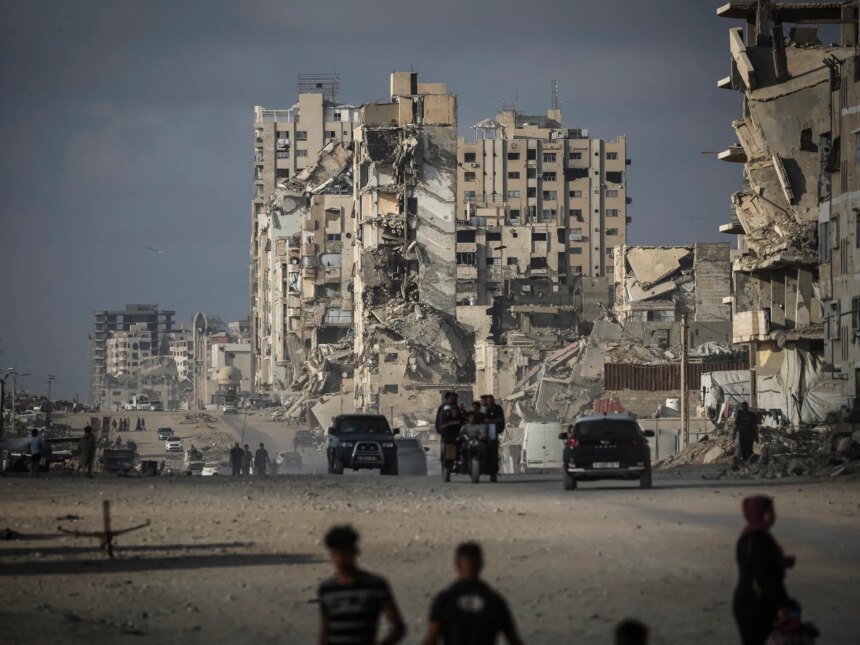
The ceasefire agreement was reached two years after the Israeli genocide, which left more than 73,000 martyrs, more than 173,000 wounded Palestinians, most of them children and women, and the destruction of 90% of the civilian infrastructure.
Despite Trump’s announcement in mid-January of the start of the second phase, disagreements still exist regarding the arrangement for implementing its provisions, especially the Israeli withdrawal, reconstruction, and the Palestinian arms issue.
Source: Al Jazeera + Anatolia + Israeli press