


Published On 7/2/2026
In one of the most violent waves of escalation since the outbreak of the Russian-Ukrainian war, Moscow launched intensive air strikes on several Ukrainian cities, using slide bombs on a large scale, in a development that reflects the accelerating transformation in the nature of combat operations on various fronts.
On Thursday, the Ukrainian authorities announced that at least 6 people were killed and about 50 people were injured as a result of Russian bombing that targeted several areas of the country.
Kharkiv Mayor Igor Terekhov said that 7 slip bombs targeted 3 neighborhoods in the city, killing a 15-year-old boy and wounding 32 people.
A pivotal element in the conflict
The use of low-cost, high-impact slip bombs stands out as one of the most prominent tools of war that has begun to reshape the methods of confrontation between the two sides, and impose a more complex field reality in the course of the conflict.
Field data indicate that glide bombs have become one of the essential components in Russian military operations, as they allow long-range strikes to be carried out with relative accuracy, without the need for aircraft to enter the range of Ukrainian air defenses, which reduces the tactical dangers to the Russian Air Force, and in return increases the pressure on the Ukrainian defense systems.
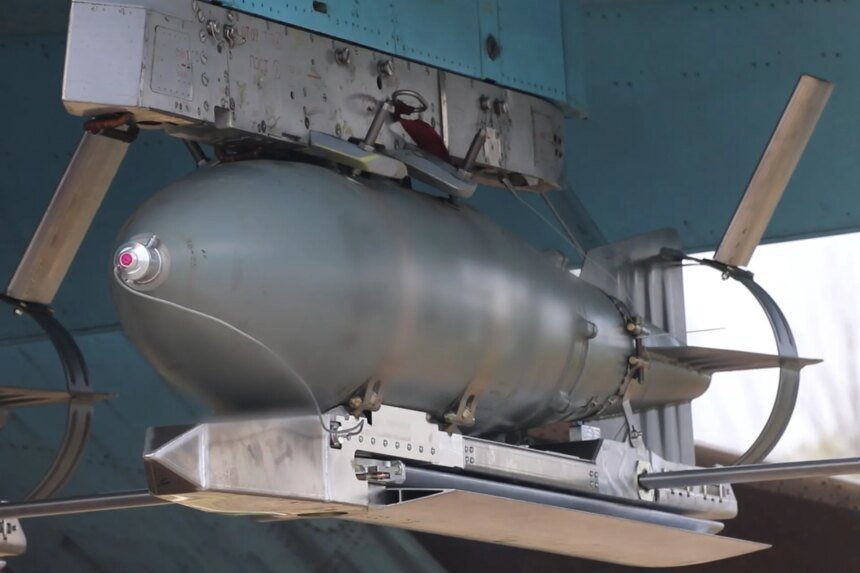
These bombs are based on conventional unguided munitions, which are modernized by providing them with guidance packages and foldable wings, to transform them into weapons capable of sliding towards the target.
This development allows it to fly distances that may exceed 70 kilometers, depending on launch conditions and altitude, making it particularly suitable for a long-term war of attrition environment.
These bombs rely on the Russian GLONASS satellite navigation system, which gives them a guidance capability relatively similar to the satellite system, although it is less accurate compared to Western systems that rely on multi-stage guidance.
The UBAB-1500B glide bomb was also shown for the first time in Russia in 2019. It is a bomb designed to bomb highly fortified targets at a range of up to about 40 kilometers.
Russia’s expansion in the use of this weapon is due to a number of factors, the most prominent of which are:
- The decline in the effectiveness of conventional artillery in achieving decisive field breakthroughs.
- The high cost of precision missiles compared to modified bombs.
- The need to cover the shortage of high-precision ammunition.

Field effect
Although glide bombs appear modern, their roots go back to World War II, and Russia relies mostly on Soviet-era bombs, which are modernized at a cost of approximately $20,000 per bomb, according to estimates by the Center for European Policy Analysis, compared to more than $6.5 million for a single Caliber missile.
This weapon also provides an important operational advantage, which is the possibility of launching from outside the range of Ukrainian air defenses, which gives Russian aircraft a greater ability to carry out strikes while reducing the possibility of direct targeting.
With the escalation of use, slip bombs became one of the most influential factors on the battlefield, as they contributed to increasing the intensity of strikes on the eastern fronts, especially in areas that witnessed violent battles such as Avdiivka and Bakhmut, during the winter of 2024-2025, where they played a role in accelerating the pace of Russian progress by targeting fortifications and trenches.
On the other hand, Ukraine faces great challenges in confronting this type of munitions, due to their short flight time and the difficulty of detecting them early, in addition to their launching from outside the range of air defense systems, which reduces the chances of intercepting them in a timely manner.
On November 13, Reuters quoted a senior Ukrainian military intelligence official as saying that Russia plans to produce about 120,000 slip bombs this year, including 500 long-range bombs of a new type, enabling it to reach wider areas inside Ukraine.
A decisive weapon in battle
Despite the effectiveness of glide bombs, they are not considered a decisive weapon in and of themselves, but they represent an important pressure tool within the framework of a long war of attrition, in which Moscow relies on intense firepower and a multiplicity of means to achieve gradual superiority on the ground.
While Russia is expanding the production of this type of munitions and developing longer-range and more accurate versions, the battle remains open to rapid developments, with Ukraine seeking to enhance its defensive capabilities and reduce the impact of this weapon in the course of the war.
The increasing use of Russian glide bombs in Ukraine has sparked growing interest within European military circles, with reports indicating that they have become one of Russia’s most prominent tools to enhance its ability to carry out long-range, low-cost, high-impact strikes.
Experts in European research centers believe that this type of munition poses a growing challenge to Ukrainian air defense systems, given the difficulty of intercepting it compared to conventional weapons, and its ability to target depth without directly exposing attacking aircraft to danger.