

Published On 4/7/2026
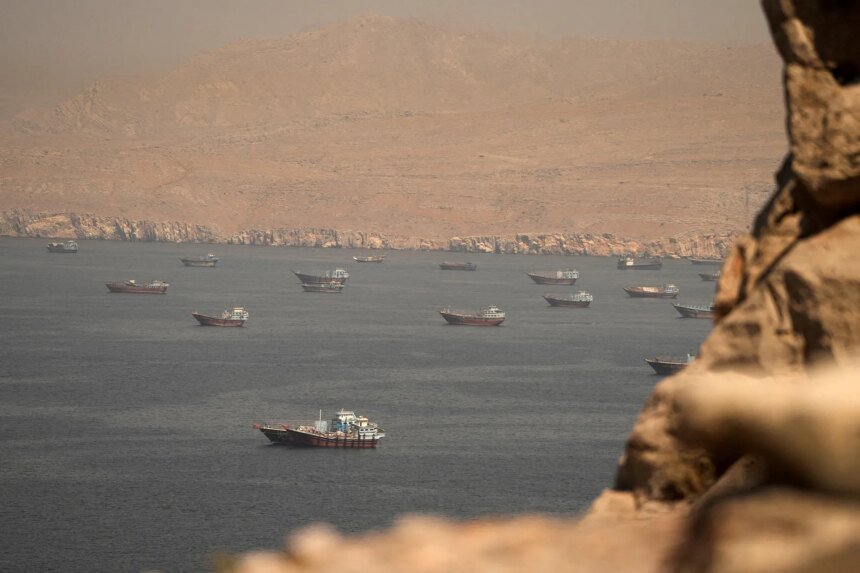
The Gulf region witnessed a new escalation in diplomatic and military tension, following the announcement by Britain and France of a joint statement indicating the Sultanate of Oman’s agreement to work with it to secure navigation in the Strait of Hormuz.
This move was met with Iranian warnings of the consequences of any military movements in the region, amid a stagnation surrounding the implementation of the terms of the memorandum of understanding signed between Tehran and Washington. This position was stated by Deputy Foreign Minister Kazem Gharibabadi.
Gharibabadi stressed that Iran is “the responsible force and guarantor of the security of the Strait of Hormuz,” warning that “anyone who tries to provoke crises will bear the repercussions of his adventures,” stressing that this vital region for transporting oil and the global economy is not an arena for “flexing muscles.”
This warning comes despite France’s withdrawal of the aircraft carrier “Charles de Gaulle” and the current talk is limited to deploying French and British minesweepers.
In this context, the director of the Arab Center for Iranian Studies, Muhammad Saleh Sedqian, considered that Western moves represent “European demonization, sometimes driven by the American side,” with the aim of militarizing the Strait.
Sadiqian explained to Al Jazeera that Tehran is showing excessive sensitivity towards any approaching foreign military assets at this stage, questioning the reality of Western coordination with the Sultanate of Oman or the International Maritime Organization.
Sedqian linked the current Iranian apprehension to the nearby military background, noting that the activation by London and Paris of the “snapback” mechanism (the rapid return of sanctions) in the UN Security Council previously was a prelude and a pretext for launching “the American-Israeli aggression against Iran on February 28 of last year.”
On the other hand, former US Deputy Assistant Secretary of Defense Sergio de La Peña refuted the Iranian accusations, stressing that the European move reflects a commitment to the United Nations Convention on the Law of the Sea.
De La Peña stressed that this water gateway cannot be allowed to remain under joint control imposed by Iran and Oman, directing a direct accusation against Tehran of being the one who militarized the strait by planting mines and targeting commercial ships.
He added that the United States and its allies represent the actual guarantor of the free flow of global trade and its protection from piracy.
Oil price controversy
At the level of the political agreement, the discussion revealed a deep crisis of confidence surrounding the “Memorandum of Understanding” signed between the two parties about 3 weeks ago. In this regard, Sedqian accused the American administration of procrastinating and appropriating the paragraphs of the memorandum to serve only its interests.
He stressed that Iran is the only party that implemented the first clause by opening safe routes in the Strait without imposing fees, which allowed the flow of oil tankers and its global prices to fall from $100 to levels ranging between $72 and $76 per barrel, which allowed US President Donald Trump to “breathe a sigh of relief,” as he described it.
In response, former US official De La Peña attributed the decline in oil prices to US military support that helped ships navigate and cross through channels controlled by the Sultanate of Oman.
Regarding the financial file, he explained that activating the lifting of sanctions and accessing the $300 billion reconstruction fund is contingent on a comprehensive cessation of hostilities, calling on Iran and its allies, led by Hezbollah, to stop bombing commercial ships and military operations against Israel as an essential first step.
Despite the exchange of accusations and the recent Israeli raids that targeted infrastructure in southern Lebanon, attention is turning to the Swiss capital, Geneva, where officially unconfirmed news has emerged about an upcoming meeting between Iranian Foreign Minister Abbas Araqchi and American officials Steve Witkoff and Jared Kushner, under Qatari and Pakistani sponsorship, to discuss ways to save the agreement.
The Iranian and American speakers agreed that negotiations remain the most effective and complete option for both parties, and in this context, De La Peña indicated that the current timing is an appropriate opportunity to conduct a comprehensive assessment of the negotiating path and achieve a “win-win” agreement.
It was considered that this coincided with the 250th anniversary of the independence of the United States and the funeral ceremony of former Supreme Leader Ali Khamenei in Tehran, which would prevent the region from returning to the military options that Washington is ready for if necessary.