

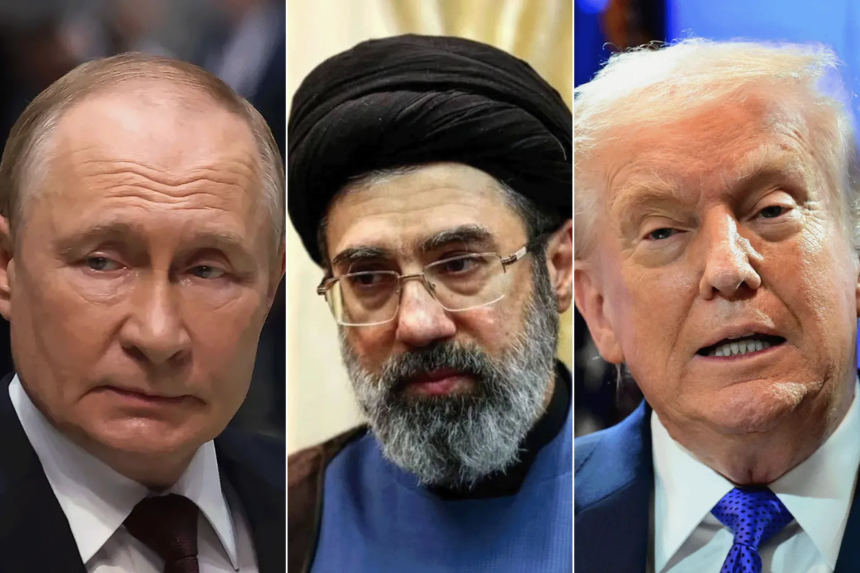
Russian writer Pavel Roberts considered that those he described as naive and foolish in the Kremlin were deceived by the Alaska Agreement, just as they were deceived by the Minsk Agreement. He pointed out that if these people had read US President Donald Trump’s book “The Art of Negotiation,” they would have realized how he plans to manipulate them.
The writer explained – in an article on the “Svobodnya Pressa” website – that Russian President Vladimir Putin When allowed For Washington 2014, By overthrowing the Ukrainian government and installing an anti-Russian “agent” in its place, it became clear to him that Moscow’s inaction would undoubtedly lead to the outbreak of armed conflict.
Read also
list of 2 itemsend of list
When Washington and Europe forced Putin to launch a strategic military operation against Ukraine 8 years later, it also became clear to the writer that the slow and limited military operation would give Washington and the North Atlantic Treaty Organization (NATO) enough time to increasingly intervene, and that the conflict that Putin thought could be confined to Donbass would expand, and this is what actually happened.
In time sameThe writer emphasizes that the illegality of the sanctions imposed on Russia does not mean that this makes things easier for it, because International law –From his point of view – always It was irrelevant, andUnited Nations No longer Reference.

The illusion of peace
The writer continues that Putin still He refuses Using the decisive force necessary to end the conflict victoriously and stop mere escalation,Although he finally acknowledged this reality, which had been completely clear for 12 years.
The writer adds that Putin is focusing on advancing an additional kilometer in Donbas, while Ukrainian drones, which launch attacks deep into Russian territory, continue to disrupt life in the country, disrupt energy supplies, and cause civilian casualties.
After Putin allowed the conflict in Ukraine to spiral out of control through his inaction, he told military college students in June that Russia’s nuclear forces would be strengthened and that the army’s combat readiness would be improved in anticipation of war with Europe.
The writer believes that Iran has apparently benefited nothing from Russia’s experience with Washington, and like Russia, Tehran was drawn into peace negotiations that Washington did not intend to complete from the beginning.
According to the writer’s opinion, the function of peace negotiations is to besiege Russia and now Iran, in a way that prevents the use of decisive military force.
Putin was more interested in negotiations than achieving a military victory, while Iran was prevented from achieving a decisive and final victory by accepting the ceasefire agreement, as the writer says.
Russian writer Pavel Roberts:
It is surprising that throughout the 79 years of implementing the Greater Israel Program, no Islamic country has demanded opposition to Israel’s aggressive policies, and even today the Iranians have not demanded the inclusion of the “Greater Israel” Program in peace negotiations.
Greater Israel Program
The writer continues that it is unreasonable for any Iranian to believe in the possibility of bringing peace to the Middle East while the Zionist “Greater Israel” program remains at the core of Tel Aviv’s foreign policy.
It is surprising – according to what the writer believes – that throughout the 79 years of implementing this program, no Islamic country has demanded opposition to Israel’s aggressive policies, and to this day the Iranians have not demanded the inclusion of the “Greater Israel” program in peace negotiations.
On this basis, it has become quite clear that Russia and Iran are better at evading reality than confronting it, and from here the writer reaches the conclusion that two major wars are still on the agenda, and they may take more dangerous forms at any moment.

Between defeat and slow decline
On the “Al-Sharq Al-Jadeed” website, Simon Nderito wrote that the failure of American policy in the Middle East, which was provoked by Israel’s actions and its belittling of Iran, led to the depletion of the resources of the United States of America, the weakening of the dollar and the reduction of American military influence in the region.
According to him, the failure to sign a memorandum of understanding between the United States and Iran in Lucerne, which was supposed to launch negotiations for 60 days without the preconditions set by Trump at the beginning of the conflict, was a defeat for Washington.
While Trump favored the agreement to ease tactical pressure, Israel sought to achieve gains in southern Lebanon, which ultimately harmed American interests, according to the writer’s belief.
Israel made a mistake -According to the writer’s opinion- In appreciation of Iran’s determination to maintain the unity of the resistance front, he expected Hezbollah Such Israeli moves.
As a result, the Memorandum of Understanding collapsed due to Israel’s insistence on continuing its occupation of Lebanon, and continued hostilities and the closure of the Strait of Hormuz forced the United States to reduce its strategic petroleum reserve, reducing oil trade in dollars, leading to a weakening of the dollar.
Thus, Israel’s actions worsen the strategic situation of the United States and threaten the stability of fuel prices in the West, which in turn makes it more difficult for the United States to withdraw from the region.
The writer points out that Trump acknowledged the depletion of US oil reserves as a result of the war, the worsening fuel shortage, and the threat facing the dollar if Iranian assets continue to be frozen.
This acknowledgment – according to the author – shows the failure of the United States to control Iranian oil or change the regime, which has effectively dashed hopes of increasing international transactions denominated in dollars.
Concern in Washington
The writer believes that there is a major shift in Washington’s thinking after Trump realized that the mere American military presence near Iran is not enough to force it to surrender, a fact that will have long-term repercussions on how Washington seeks to achieve its goals.
And it wasn’t Trump – as the writer confirms – was initially frustrated with Iran’s refusal to surrender because he believed he had many other options, but these other options seemed ineffective 4 months after the start of the war with Iran.
The most important development after the American adventure was that Iran was able to close the Strait of Hormuz, limiting oil supplies to the point of further depleting American reserves, and raising the prices of consumer goods throughout the West, which may worsen if the war continues.
The writer believes that additional attempts by the US army to open the Strait will reveal more of Washington’s shortcomings.
The quagmire into which the United States has found itself – as the author sees it – is one of the most prominent indicators of the decline in the West’s ability to use military force to politically and economically influence medium-sized countries.
Trump’s intervention in leading the war against Iran has demonstrated Washington’s capabilities Military It is not sufficient to intimidate Iran into surrender, nor to defeat it militarily.
As a result, Trump has become a staunch supporter of concluding an agreement with Iran, even criticizing the Israeli government for the war crimes it committed in Lebanon, which complicate peace efforts.
The writer concluded that Washington You will find In the future, it will become increasingly difficult to use its military power to achieve its strategic goal in the Middle East, even as it faces dire consequences such as the depletion of strategic reserves and the decline in the value of the petrodollar.