

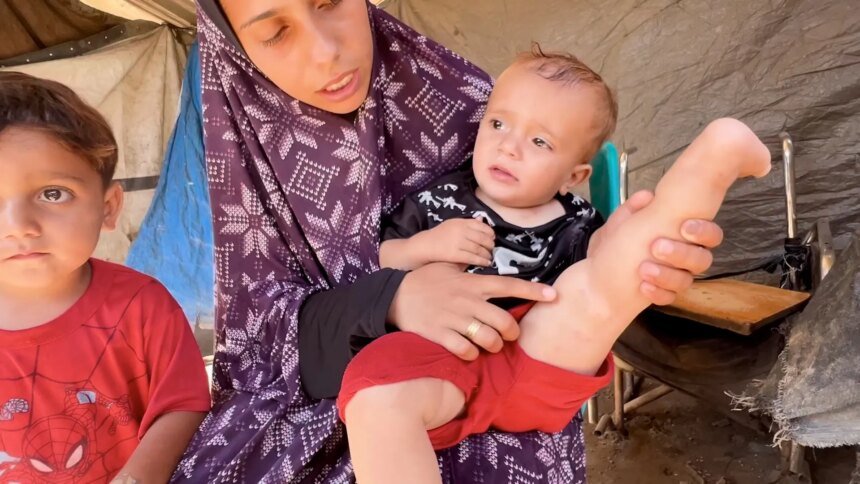
Gaza – Before Palestinian child Naeem Sobh learned to walk, he learned the meaning of displacement, and before his brother Saddam uttered his first words, his early memory was linked to the sounds of planes and explosions.
Saddam was born just two months before the war on Gaza, while his mother, Dima Sobh, became pregnant with his brother Naeem during it, and he was born 13 months ago, becoming young witnesses to a war that has been going on for 1,000 days, during which the details of their early childhood were shaped by hunger, fear, and displacement.
They represent the condition of thousands of children who were born during the war or lived the beginnings of their lives under it, as their stories share conditions of displacement, hunger, and fear. Their mother, Dima, recalls the details of the 1,000 days, and tells Al Jazeera Net that the war did not only steal her two children’s childhood, but also accompanied them from the first moment.

Birth in a tent
Dima says that her son Naeem’s suffering began before his birth, as she spent the months of her pregnancy in harsh conditions of displacement, during which she suffered from hunger and food shortages, and was unable to obtain the minimum amount of health care.
When she went into labor, she did not find an ambulance or transportation to take her to the hospital, so she put her baby inside the tent.
After the birth, the family faced a new battle. With great difficulty, they were able to find an animal-drawn cart to transport the mother and her infant to the hospital, as Naeem’s weight was only 1,500 grams, which required him to be admitted to the nursery for 4 days to receive the necessary care.
The suffering did not end there, as the family faced a crisis in providing formula milk and the necessary food for the breastfeeding mother.
Dima believes that these conditions left clear effects on the growth of Naeem, who has reached 13 months today, but he is still unable to walk, and only two teeth have grown in his lower jaw, at a time when he was supposed to have passed greater stages of his physical development.
Psychological effects
As for Saddam, who preceded the war by only two months, he only knew the sounds of bombing and displacement from his childhood. What affected him the most, according to his mother, was his survival from a bombing that targeted the shelter center where the family was taking shelter.
In those moments, his mother embraced him as she heard the sound of explosions, while shrapnel and rubble scattered in the place where he was sleeping.
Since that day, his behavior has changed noticeably. Any loud sound, whether it be gunfire, a plane flying, or a nearby explosion, causes him to shake, cry, and search for a place to hide.
His mother also says that he, like thousands of children, suffered from repeated hunger, and he would cry for hours asking for food while the family was unable to provide it in light of the famine and depletion of food supplies.
Severe sanitary conditions
The two children’s suffering extends to the harsh health conditions inside the tents. The family lives in a tent that lacks the necessities of life, amid the spread of insects and rats, high temperatures and deteriorating environmental conditions.
Dima tells Al Jazeera Net that her child, Naeem, was bitten by a rat about a month ago, and she had to take him to the hospital to receive the necessary vaccinations. He also contracted scabies, smallpox, and other skin diseases, as a result of the unhealthy environment in which he lives.
She confirms that her children are growing up in conditions that are not suitable for human life, while their suffering increases day after day inside a tent that has become for them the only home they have ever known.

Caesarean section and malnutrition
In another displacement tent, the child Alaa Atallah grows up, who only knew the sounds of bombing and news of displacement and famine in the world.
He was born on December 23, 2023, a few weeks after the outbreak of the war, while his mother was displaced with her family from her home in the Al-Daraj neighborhood to a shelter inside a university in the southern Al-Rimal neighborhood.
His mother, Heba, told Al Jazeera Net that labor took her by surprise at a time when Gaza was almost devoid of means of transportation, while ambulances were busy transporting the wounded and martyrs from the bombing sites.
She had no choice but to walk about 5 kilometers while suffering from childbirth pain, until she reached Al-Sahaba Hospital, where she underwent a caesarean section after it was not possible to perform a natural birth.
Alaa’s birth was not the end of the suffering, but rather the beginning of a new chapter. He refused to breastfeed throughout his first week, at a time when his mother was suffering from malnutrition and lack of food, while the family struggled to provide anything to subsist.
Eat animal feed
Alaa’s mother says that on many days they had to eat barley and animal feed after there were no food supplies, adding that the most difficult thing a new mother can face is to search for any food, whatever it may be, so that she can breastfeed her child.
As the famine worsened, Alaa suffered from severe malnutrition, requiring him to be transferred to the hospital, where he lost a large portion of his weight until his rib cage became clearly visible. He was also diagnosed with nematode worms, at a time when treatment was not available.
According to his mother, the effects of the war on Alaa are not limited to his physical health, but rather extend to his psychological and linguistic development. Although he is approaching his third year, he only says the words “daddy” and “mama,” and spends most of his time isolated from children, while he seems extremely afraid of loud noises and explosions.
Mother Heba says that any strong sound causes him to throw himself into her arms, as if he is searching for a place to take shelter, adding that the repeated bombings left a clear impact on his personality, making him more withdrawn and afraid of his surroundings.
When he goes out with his mother and sees toys in the markets, he points to them with his little eyes, but she is forced to silently push him away, after even the simplest details of childhood have become a luxury beyond the family’s ability.

Birth amid force majeure circumstances
In another tent in Gaza, Lina Hassanein lives with her two-and-a-half-year-old child, Ghassan, who was also born in the heart of the war, without knowing a single moment of stability.
Lina says that she was forced to flee, while she was pregnant, after her home was destroyed, and move from one area to another until she settled in the city of Rafah, in extremely harsh conditions, coinciding with a severe wave of famine that directly affected her health during pregnancy.
She explained to Al Jazeera Net that malnutrition was present throughout the months of pregnancy, at a time when the family was unable to secure the minimum amount of food, which made the prenatal stage one of the most difficult things she went through, amidst instability and the absence of adequate health care.
She describes the moment of birth as being very difficult inside one of Rafah’s hospitals, where overcrowding and lack of medical personnel were among the most prominent challenges, in light of the influx of large numbers of wounded and displaced people, which made the care provided very limited compared to the needs.
Lina says that her child was born without any clothing, at a time when the family was unable to secure the most basic necessities, which made the beginning of his life a direct extension of the crisis of displacement and famine. She adds that she delayed weaning him until some goods and foodstuffs were available in the markets, for fear of “starvation.”
It confirms that Ghassan today suffers from clear effects of the circumstances that accompanied his birth and upbringing, both on the health and psychological levels, as he shows an intense fear of loud noises, and he associates the sound of flying directly with scenes of bombing, which puts him in a constant state of anxiety when he hears any plane in the sky.
Serious psychological effects
Mental health consultant Dr. Osama Imad warns of significant negative effects on the physical, psychological and social development of a child who is born or lives in the shadow of war, as he finds himself surrounded by rubble, killing, the sounds of missiles and displacement.
The child is deprived of all his basic rights, including his right to play, education, health care, acquiring skills, and even his right to be next to his parents or one of them, according to Imad’s statement to Al Jazeera Net.
Children may also be exposed to direct physical injuries, including burns, amputations, and bombing, which deepens their physical and psychological suffering and makes them lack the most basic necessities of life, such as proper nutrition, including breastfeeding.
The specialist pointed out that these children lack safe spaces, means of entertainment, writing and reading tools, family care, school, and treatment, and that many of them do not know basic concepts such as home and electricity, and they may suffer shock if they return. They also live in very difficult living conditions inside tents, which prevents them from acquiring the social and educational skills necessary for their development.

Malnutrition and psychological trauma
Imad explains that malnutrition, whether during pregnancy, breastfeeding, or after birth, has harmful and continuing effects on the child’s personality in the future and on his physical health and development. Deprivation of proper nutrition may also lead to physical complications, such as weak physical structure, difficult fractures, hair loss, skin ulcers, and general weakness.
The psychological expert stated that the psychological trauma resulting from war, and comparing oneself to other children who live a normal life, may lead to a loss of self-confidence and the ability to communicate with others due to a feeling of inferiority.
He stated that the delayed speech of some children in Gaza is directly related to their deprivation of their right to proper growth and development, which affects their ability to understand and form sentences and phrases correctly.