


In an era in which screens have become a part of study, work, and entertainment, an old question is being renewed: Do we understand and remember information better when we read on paper or through screens? Recent research does not provide a conclusive answer, but it indicates that the difference is related to the type of screen, the method of reading, the nature of the text, and the amount of distractions surrounding the reader, more than it is related to the medium alone.
This question reflects the tension experienced by many today: students wondering whether printing is worth all this effort, parents concerned about their children’s reading habits, and professionals trying to choose the most efficient method of comprehension amid a flood of digital content.
Read also
list of 4 itemsend of list
Why does paper reading seem more focused for many people?
Psychologists believe that one of the advantages of reading on paper lies in what is known as the “spatial sense of the text.” The brain deals not only with words, but also with their location within the page and the entire book, which helps the reader form a mental map of the text, remember the locations of information and link ideas together, especially in long and complex texts.
Printed books also provide additional sensory cues: the texture of the paper, the thickness of the reading portion, and the feel of the remaining pages. These simple details help organize information mentally and make it easier to return to important passages.
Developmental and cognitive psychologist Marianne Wolfe – from Tufts University – points out in an article for Scientific American that reading has a physical aspect that is often overlooked in the age of screens, and that these sensory cues accompanying the book help to absorb the content more deeply.
This observation is supported by an extensive scientific review conducted by researchers at the Spanish University of Valencia and published in 2018 in the journal “Behaviour and Information Technology,” which included 54 studies and more than 170,000 participants. She explained that readers achieve, on average, a better understanding of texts when they read them on paper compared to screens, a phenomenon that researchers described as “the advantage of paper,” especially in informational texts and tasks that require deep understanding.
In addition, reading on phones and computers is often associated with a stream of notifications, messages, links, and digital temptations, which are frequent interruptions that weaken “deep concentration” and limit the ability to absorb the fine details of the text.
Not all screens are the same
The digital reading experience clearly varies depending on the type of screen and the way content is displayed, as screens do not form one homogeneous category.
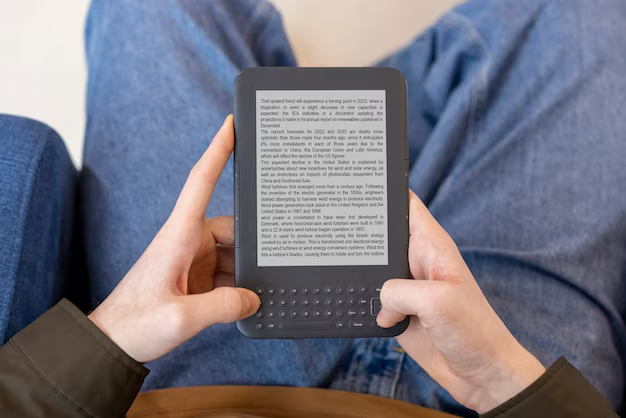
Smartphones and laptops are mostly associated with fast browsing and multitasking, which forces the reader to visually scan rather than read carefully. In contrast, E-Ink devices and reading tablets provide a closer experience to a paper book, especially when using fixed page mode and reducing distractions.
Continuous scrolling of text imposes an additional burden on attention and working memory, because the reader is simultaneously following the content and its movement, which may reduce opportunities for depth. While presenting text in the form of stable pages helps enhance the sense of organization and build a clearer mental map of the content.
The backlight in traditional displays may increase visual fatigue with prolonged use, while e-ink devices rely on reflecting light in a manner closer to paper, making them more suitable for extended reading sessions.
When is a screen sufficient or even useful?
The advantage of paper in some cases does not mean that digital reading is always bad. In short texts, quick articles, and recreational reading, the differences in comprehension become less pronounced, and the screen becomes a completely acceptable option.
Digital tools such as built-in dictionaries and instant search can also help some readers, especially children or language learners, as they remove barriers to comprehension without significant interruptions to the reading sequence.
Screens also provide an unprecedented ability to access knowledge, with the ability to carry an entire library in a small device, which makes it more practical in daily life. Features such as digital commentary, instant sharing, and full-text search represent advantages that are difficult for paper to match.
Is the problem with the screen or with our reading habits?
A number of researchers point out that the main problem is not the screen itself as much as it is how it is used. Smartphones have been associated with patterns of “speed reading” and constant switching between links, which prompts the brain to browse more than delve into depth, and the reader may exit an entire article without retaining its details after a short time.
This effect is more evident in educational settings. In a study conducted by researchers at the Norwegian University of Stavanger and published in the International Journal of Educational Research in 2013, students who read texts on screens achieved slightly lower performance on comprehension tests compared to those who read the same text on paper, even though everyone was allowed to refer to the text during the test. This small, recurring difference indicates a difference in the depth of processing and the way of interacting with the content.
Other educational experiments show that screen learners may sometimes overestimate their level of understanding, which reduces the time they devote to actual review. Therefore, experts advise using tools such as full reading mode, turning off notifications, and reducing multitasking while reading digitally, which are simple adjustments that can improve comprehension and bring the screen experience closer to the quality of paper reading.
Which is better in the end?
The most accurate answer is that what is best depends on the purpose of the reading. If what is required is a deep understanding or study of a long and complex text – such as legal, scientific or literary subjects – paper still excels for many, especially those who grew up reading traditional.
In cases of speed reading, browsing, searching for specific information, or recreational reading, screens perform the task very efficiently and save time and effort that cannot be ignored.
Some researchers hypothesize that a new generation raised in a digital environment may over time develop different skills in “deep digital reading,” which could reduce the current gap between paper and screen. But currently available data indicate that paper continues to have an advantage when it comes to deep understanding and long-term comprehension.
The future is for paper or for screens?
It seems that the future does not lie with paper alone or with screens alone, but rather with an intelligent combination of the two. Paper provides an environment that helps focus, contemplate, and build a calm relationship with the text, while screens provide unprecedented flexibility and ease of access to knowledge.
Perhaps the most important question is not “Paper or screen?” Rather: when do we choose paper, when do we turn to the screen, and how do we design reading habits that allow us to make the most of the advantages of each medium without losing the joy of deep understanding that forms the essence of reading itself.