Aden- Adham Fahd was five years old when Yemenis went to the polls to choose members of the House of Representatives in April 2003, and today, at the age of 28, he is still waiting for the first opportunity in his life to participate in parliamentary elections.
During these years, Fahd completed his school and university studies, graduated from the Faculty of Law, and began working in a law firm in the city of Aden, but the representatives who were elected when he was a child still retained their seats in a council whose membership had not been renewed for more than two decades.
Fahd, a youth activist, told Al Jazeera Net: “An entire generation grew up and reached voting age without participating in choosing members of the House of Representatives, and therefore many young people do not feel that the current House represents them.”
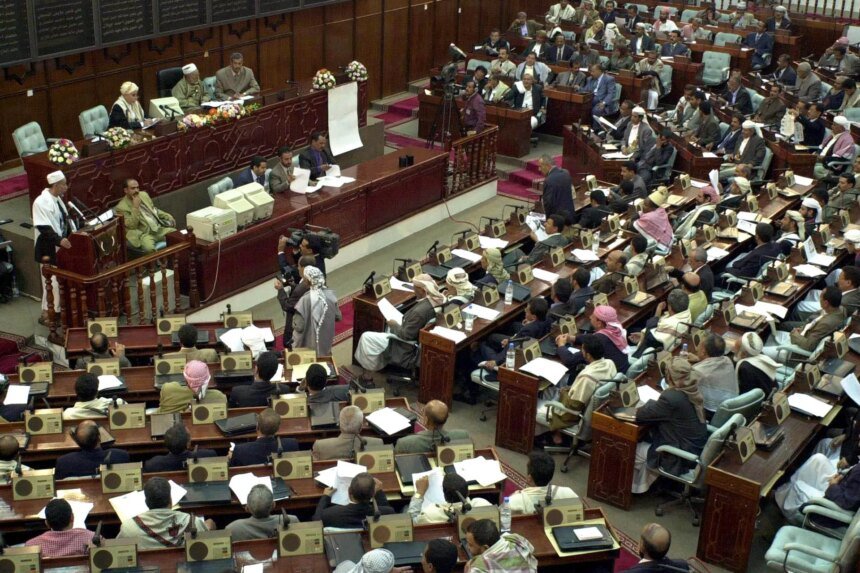
Fahd’s story reveals a broader approach to understanding the crisis in the Yemeni parliament. The issue is no longer linked only to postponed elections, but rather to a legislative institution stuck between a constitutional text that allows extension in force majeure circumstances, and a political and war reality that has hindered renewal, oversight, and accountability.
This paradox is highlighted as the world celebrates, on June 30, the International Day of Parliamentary Action, which coincides with the anniversary of the founding of the Inter-Parliamentary Union in 1889, and was approved by the United Nations General Assembly in 2018 to highlight the role of parliaments in representing citizens, legislation and oversight.
Through 6 main questions, this report attempts to dismantle the reality of the Yemeni House of Representatives: When did the elections stop? Why did the council continue? How did death and division affect its structure? What remains of his oversight role? Do partial elections represent a possible way out? Then what does all of this mean for a generation that has reached voting age without choosing its representatives?

When did parliamentary elections stop in Yemen?
The last Yemeni parliamentary elections were held on April 27, 2003, to choose 301 representatives in the third parliamentary vote after unity. According to data from the Inter-Parliamentary Union, 6.1 million voters participated in it out of about 8 million registered, and 1,536 candidates representing 22 parties competed, along with independents.
The Council’s term was supposed to end in 2009, but disagreements between the authorities and the opposition regarding the election law and the formation of the Supreme Elections Committee led to the postponement of the vote for two years. Then came the protests of 2011 and the transitional period, before the Houthis’ control of Sana’a in 2014, and the war that followed, closed the way to any new elections.
With the succession of these stations, the parliamentary elections that Yemen witnessed in 1993, 1997, and 2003 turned into a distant memory of a previous generation, and an experience unknown to millions of Yemenis who reached voting age during the past two decades.
In an interview with Al Jazeera Net, the political activist in Aden, Akram Al-Bujairi, believes that this long interruption has created a wide representational gap between the Council and society, with the decline in the connection of many representatives with their constituencies, and the absence of citizens’ daily issues from the parliamentary debate.
As for Adham Fahd, he believes that the absence of elections not only weakened the connection between representatives and voters, but also reduced popular pressure and periodic accountability, to the point that the presence of the Council among many citizens became associated with seasonal statements and positions more than with legislative and oversight sessions.

How did the constitutional extension turn into a political crisis?
The Yemeni Constitution sets the term of the House of Representatives at six years, and requires it to call for the election of a new house before the end of its term. However, at the same time, it stipulates that the House will continue if elections cannot be held due to force majeure circumstances, until those circumstances disappear and a new house is elected.
The constitution specifies Sanaa as the seat of the Council, with the possibility of it being held outside the capital when it is impossible to meet there. Although these texts were put in place to prevent a constitutional vacuum, the continuation of the exceptional state for many years raised a dispute regarding the temporal and political limits of the extension.
Lawyer and legal expert Abdul Rahman Berman believes that force majeure may justify temporarily postponing the elections in order to preserve state institutions, but they do not grant Parliament a permanent mandate. Berman tells Al Jazeera Net: “The text cannot be understood as granting the Council an indefinite period, because that conflicts with the periodicity of elections and the renewal of the popular mandate.”
On the other hand, Member of Parliament Shawqi Al-Qadi adheres to the constitutionality of the continuation of the Council, basing his speech on Al Jazeera Net on the inability to organize free and comprehensive elections in light of the war and political and geographical division.
According to the judge, the Council is still the elected and recognized legislative institution, and overthrowing its legitimacy without electing an alternative may lead to a political and constitutional vacuum from which the Houthi group will benefit.
But he acknowledges that the continuation of the Council in this manner has widened the gap with new generations, which requires it to develop its methods of work and communication with citizens until conditions are created for new elections.

How many seats did Parliament lose through death and absence?
In addition to the statute of limitations on the electoral mandate, the Council lost dozens of its members to death without holding by-elections to fill their seats. An analysis published by the Sanaa Center for Strategic Studies in April 2025 reported the death of 60 representatives since the 2003 elections, or about five members of the Council, while the youngest living representative was 47 years old at the time the analysis was published.
The analysis estimated that 132 deputies were affiliated with the internationally recognized government, compared to 96 deputies in the Houthi-controlled areas, while 13 members remained in a gray political zone. These remain research estimates, in the absence of an updated and published official list showing the number of living members and their locations.
The judge says that the pro-government representatives are still able to achieve a quorum, explaining that some of those in Houthi areas do not participate in the Sanaa sessions, while others reside outside the country or have moved away from both parties.
However, calculating the quorum has remained a matter of controversy, as the controversy revolves around whether it is calculated from the total members of the Council, which is 301 representatives, or from the number of members whose membership is still valid after excluding the deceased.
Berman believes that the quorum should be calculated based on the number of living members whose membership is still in effect, and in accordance with the constitution and internal regulations. He warns that decisions issued by sessions without a quorum may be subject to appeal, especially if they relate to general laws or issues affecting state institutions.

How was the House of Representatives divided between Sanaa and Aden?
The Parliament crisis deepened after the Houthis took control of Sanaa in September 2014, as its members were divided between a group that remained in the capital and another that sided with the internationally recognized Yemeni government.
According to the judge, the Houthis closed the council’s headquarters in Sanaa after they took control of the city, before reopening it later, after a large number of representatives had left the capital or stopped attending its sessions.
In April 2019, pro-government representatives held an unusual session in the city of Seiyun in Hadramaut Governorate, during which they elected Sultan Al-Barakani as Speaker of the Council, and then approved the state budget for 2019.
The completion of the quorum remained a matter of dispute, as an analysis by the Sana’a Center, published in 2025, stated that the session was attended by 141 deputies, according to most sources, while a previous report by the Center stated that only 118 deputies were present. As for the supporters of the session, they considered that the quorum was achieved after excluding the deputies who died before it was held.
The judge confirms that the Seiyun session had a quorum, and that it restored the pro-government council’s representation in regional and international parliamentary institutions.
On April 19, 2022, the Council met in Aden and the President and members of the Presidential Leadership Council took the constitutional oath before it, but it remained an extraordinary session and did not establish a regular session.
As of June 9, 2026, the Council’s Presidency and the heads of parliamentary blocs were still discussing, via a video meeting, the necessary arrangements for holding a new session, more than four years after the Council’s last meeting in Aden.

What remains of Parliament’s oversight role?
The powers of the House of Representatives include enacting laws, approving public policy, the budget, and final accounts, and monitoring the executive authority, but the absence of regular sessions disrupted a large part of these functions.
During the past years, successive governments and authorities continued to make broad financial, economic and administrative decisions, without a stable parliamentary oversight session that discusses budgets or interrogates officials.
The judge says that representatives are following up on some issues individually, through communication with the government, the Presidential Leadership Council, and the competent authorities, but he acknowledges that this follow-up does not replace institutional work. He adds: “The Council’s role in legislation and oversight remains suspended as long as the sessions are not held regularly.”
He points out that parliamentary committees faced obstacles when trying to reach government institutions and investigate financial files, considering that many parties benefit from the absence of a supervisory institution whose members’ positions are difficult to control.
Al-Bujairi says that the war explains the impossibility of holding elections, but it does not justify the disruption of Parliament, stressing that the continuation of the Council should be accompanied by the resumption of its sessions, the activation of its oversight of the government, and the discussion of budgets and public spending, until a settlement is reached that allows new elections.
As for Berman, he believes that the failure to approve budgets and final accounts during the past years has weakened transparency and oversight of public funds, and disrupted one of the most important tools for combating corruption and holding the executive authority accountable.

Are partial elections suitable to save the Council?
As war and division continue, by-elections in government areas are being presented as an option to fill the seats of deceased representatives and introduce new members to the Council.
But this option faces major obstacles, including the occurrence of a number of vacant districts in Houthi areas, and the widespread displacement that has changed the demographic composition in governorates such as Marib, Taiz, and Lahj.
Berman believes that partial elections may be possible in principle, but they require legal, security and administrative guarantees, and a national consensus that prevents them from being used to deepen division.
Relying on electoral records and districts dating back more than two decades also raises questions about where displaced people can vote, the fairness of representation, and the integrity of the electoral process.
As for the judge, he believes that the priority is to provide a safe headquarters and administrative equipment for the council in Aden, and to resume its sessions and activate its committees, before moving to general elections after the situation stabilizes.

What does the current parliament mean for a generation that did not elect its representatives?
23 years after the last parliamentary elections, the crisis in the Yemeni parliament is no longer just a dispute over the constitutionality of the extension, but rather a crisis of both representation and function.
Millions of Yemenis have reached voting age without choosing their representatives. About five members of the Council died, and the rest were divided between two authorities and multiple regions, while the ability of the legislative institution to meet and monitor the government declined.
Berman believes that restoring parliamentary legitimacy requires a national agreement that prepares for free and transparent general elections, while Al-Bujairi summarizes the issue by saying that Yemen “does not only need a parliament that maintains its name, but rather a present institution that legislates, monitors, and holds accountable.”
Between a council still stuck in the results of the 2003 elections, and a generation waiting for the first parliamentary ballot box in their lives, the Yemeni parliament on International Parliament Day appears more like a mirror of the state’s crisis than an institution capable of monitoring it and addressing its imbalances.