Published on 6/30/2026
|
Last update: 7/1/2026 00:53 (Mecca time)
An international research team, led by scientists from the Mansoura University Center for Vertebrate Paleontology, has documented the first confirmed fossil evidence of the presence of pterosaurs, or flying reptiles, in Egypt more than 95 million years ago.
This documentation, according to the study published in the journal “Acta Paleontologica Polonica,” came through a fossil of a pterosaur wing that was found inside the rocks of the “Bahariya Formation” in the Bahariya Oasis Depression in the Western Desert, an area known for its richness in a fossil record dating back to the Cretaceous period.
The Cretaceous era is the last era of the Mesozoic era. It extended from about 145 to 66 million years ago, and witnessed the flourishing of dinosaurs, pterosaurs, and flowering plants, before ending with a major mass extinction.

Special importance
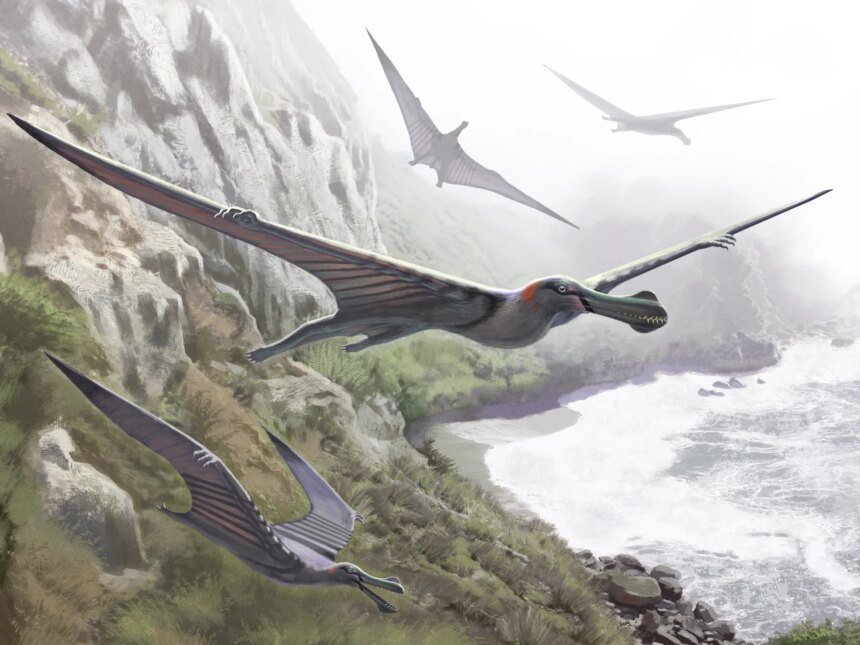
This fossil holds special importance, as it opens a new window on ancient life in Egypt during a time when dinosaurs dominated the land, while pterosaurs dominated the sky. These creatures are the first vertebrates known for their true ability to fly, as they preceded birds by tens of millions of years.
Although they lived side by side with dinosaurs, pterosaurs were neither flying dinosaurs nor ancestors of birds, but rather represented an independent branch of flying reptiles, closely related to dinosaurs.
These creatures were characterized by membranous wings extending between the body and a very elongated fourth finger, a structure that gave them a great ability to fly long distances, taking advantage of air currents.
The feeding patterns of pterosaurs varied according to their species and environments. Some of them hunted fish, and some of them ate small vertebrates, invertebrates, or carrion. These flying reptiles remained a prominent part of the Earth’s sky for more than 150 million years, before they disappeared with the great wave of extinction at the end of the Cretaceous period about 66 million years ago.
Based on the size of the bone, the researchers estimate in their analysis that the animal had a wingspan of about four meters, making it a medium-sized pterosaur that was flying over the rivers, floodplains, and coastal environments that covered northern Egypt at the time.

Exceptional location
Bilal Salem, a doctoral student at Ohio University, a member of the Mansoura University team, an assistant lecturer at the Faculty of Science at Benha University, and the main author of the study, says: “This fossil represents great scientific and personal value to me. It was found during my first field expedition to the Bahariya Oasis Depression with the Mansoura University Center for Vertebrate Paleontology in 2018, and it later became part of my research as the center’s reptile and bird fossils official.”
He added in statements obtained by Al Jazeera Net: “The Bahariya Oasis is an exceptional site in paleontology, as all African dinosaur researchers know it as one of the most important and famous fossil sites on the continent. Therefore, the discovery of the first confirmed fossil of a pterosaur from Egypt in this place was an exceptional moment that I will not forget.”
The importance of the discovery also stems from the scarcity of pterosaur fossils around the world, as their bones were thin-walled, light, and hollow to suit flight. These are characteristics that gave them high efficiency in flight, but made them less capable of fossilization compared to the bones of ancient dinosaurs or crocodiles.
For this reason, the fossil record of pterosaurs in Africa and the Arabian Peninsula remains limited and fragmentary.
The study indicates that the importance of the Egyptian fossil is not limited to being the first confirmed evidence of the presence of pterosaurs in Egypt, but it also contributes to filling an important geographical gap in the record of the spread of these flying reptiles along the southern coast of the ancient Tethys Sea. It also presents the first preserved three-dimensional part of a pterosaur wing from the Bahariya Formation, which provides researchers with rare anatomical information about the flight apparatus of these animals.

Desert heritage
“This discovery highlights the importance of continuing to explore Egyptian fossil sites,” says Egyptian paleontologist Hisham Salam, founder of the Mansoura University Center for Vertebrate Paleontology, professor of vertebrate paleontology at Mansoura University, and head of the research team. “Every new mission brings with it an opportunity to answer questions that have been asked for decades.”
He adds: “Although the Bahariya Oases are among the most studied areas in Africa, they still reveal unexpected discoveries that reshape our understanding of ancient ecosystems.”
He concludes by saying: “This discovery demonstrates that the Egyptian paleontological heritage still contains many untold stories. The rocks of the Western Desert continue to reveal, with every new expedition, new pages of Africa’s ancient history, and confirms the growing role of Egyptian researchers in documenting, studying and protecting this heritage.”