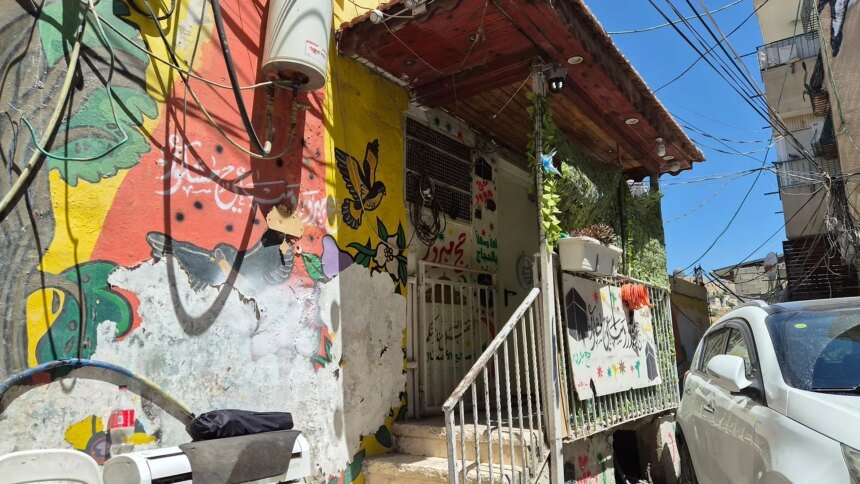
Jerusalem- In the alleys of the “Batn al-Hawa” neighborhood in the town of Silwan, adjacent to the Al-Aqsa Mosque, the chapters of a Jerusalem tragedy are embodied, summed up by the policy of seizure and systematic pressure led by the “Ateret Cohanim” settlement association, with Israeli judicial and political cover.
It highlights the story of Al-Maqdisi Zuhair Al-Rajabi and his seven brothers, who live with their families of 62 members, in a building containing 7 residential units.
Their steadfastness in the face of evacuation orders became an existential battle, after they faced pressure represented by being asked to pay an amount of 1.5 million and 500 thousand shekels (about 666.6 thousand dollars) as an indirect punishment for their success in issuing a decision to freeze their displacement.
The Al-Rajabi family’s roots go back to the Al-Sharaf neighborhood, adjacent to the Al-Maghariba neighborhood, from which nearly three thousand Jerusalemites were displaced in 1967, and the occupation later turned it into what is called the “Jewish Quarter.” Following this displacement, the family insisted on clinging to Jerusalem, as they had purchased, before the Nakba in 1948, a land in the Batn al-Hawa neighborhood of 150 square metres.

Family home
Zuhair Al-Rajabi tells – to Al Jazeera Net – the story of the house, saying: “My father, Khader, and my mother built it, stone by stone. My mother used to carry stones on her back to support my father, who was working in the oven to secure our food at that time.”
As the family expanded, Khader allocated the roof of the house to Zuhair and his siblings, and the space turned into a complex that today includes 62 individuals who live in a state of constant tension and psychological trauma, as a result of the occupation’s displacement policies.
Al-Rajabi explains that the occupation court gave them until May 17 to vacate the property, but the family obtained through its lawyer a decision to temporarily freeze the eviction for a period of 60 days.
The freezing decision angered the settlement association, which quickly filed a counter-suit before the Israeli District Court, demanding that they pay an amount of 1.5 million shekels (about 500 thousand dollars), retroactively, as an alternative to the alleged rent for 7 years, in addition to a fine of 18 thousand shekels (about 6 thousand dollars) per month from the date of filing the lawsuit until the property is vacated, in addition to charging them court fees, lawyer fees, and all legal expenses, which made the family live in a state of anxiety, waiting for what will happen. The case will come to him.
The harassment did not stop at the financial aspect, as the family was subjected to direct threats from the settlement association’s lawyer, who threatened them after the decision to freeze the eviction, saying: “I will show you what I will do to you.”

Pressure campaigns
The Rajabi family’s tragedy doubles as their social events approach. Zuhair says bitterly: “I have a wedding for my two sons in the coming days, and I don’t know how I will hold it in light of the possibility that the eviction freeze decision will not be extended.”
The family is racing against time to extract a new extension decision from the Central Occupation Court, amid fears that settlers will take advantage of their preoccupation with the party to seize the house.
This pressure coincides with campaigns of harassment and daily police and intelligence sieges. Fazhair, who represents the Batn al-Hawa neighborhood residents’ committee, and spent 16 years in the occupation prisons, was repeatedly arrested, and the occupation stormed his house and destroyed its contents. In addition to the settlers’ attacks on the family’s children, and “intelligence pressure that amounted to an explicit threat, as an Israeli intelligence officer called Zuhair and said: “Burn the houses and get out.”
The family confirmed its intention to file an official objection to drop this lawsuit, pointing out “a fundamental contradiction in the settlement association’s claims.” Zuhair explains: “Their case is based on their claim of ownership of the piece of land on which the property has been built since 1829, while what we own are real estate and houses, and they themselves acknowledge our ownership of them with evidence that they previously offered us millions of shekels to buy them, which we absolutely rejected, and now they are trying to evict us and demand money from us in a case related to the land.”
Tools to grab
The Jerusalem Governorate does not view the issue of the Al-Rajabi family as an individual case, but rather as part of a broader policy targeting the Palestinian presence in Silwan through various tools.
The governorate’s media official, Omar Rajoub, told Al Jazeera Net that the “Ateret Cohanim” association represents one of the most prominent settlement arms working to seize Palestinian real estate in Jerusalem, by claiming the existence of Jewish properties dating back to before 1948, even though it does not have any official status that would enable it to represent these claims.
Rajoub explained that the association relies, like other settlement institutions, on the Israeli “Administrative and Legal Affairs Law” issued in the 1970s, which allows for claims to properties allegedly owned by Jews before 1948, while Palestinians are deprived of claiming their properties that they lost in the same year.
According to him, this law was used to market allegations of alleged ownership by Yemeni Jews of an area of about 5,200 square meters in the Batn al-Hawa neighborhood, which threatens between 750 and 800 Jerusalemites, belonging to about 75 families.
He added, “The pace of lawsuits has escalated significantly since 2015, as today 84 families face the risk of eviction, while 33 families were actually forced to leave their homes in favor of settlers, while the neighborhoods of Batn al-Hawa and Wadi Hilweh remain among the areas most targeted by evacuation orders.”

Systematic pressure
The pressures extend to imposing exorbitant financial demands, which Rajoub believes have become an additional means of pressure to push Jerusalemites to leave their homes.
He said that asking the Al-Rajabi family to retroactively pay a large sum of money, in addition to requiring monthly sums of money, “is nothing but one of the tools of systematic pressure and collective punishment adopted by the settlement associations through the Israeli courts to accelerate the evacuation of Palestinians from their homes.”
He pointed out that this method was previously used with the Dweik family in Batn al-Hawa, before Palestinian legal efforts succeeded in dropping the financial lawsuit.
If families are unable to pay these amounts, they are threatened with seizure of their money and property, in a policy similar to the occupation municipality’s pursuit of Jerusalemites with fines even after forcing them to demolish their homes with their own hands, according to the media official in the governorate.

“Ring plan”
In addition to prosecution, the occupation authorities adopt a planning policy that limits Palestinian urban development in Silwan, by refraining from issuing building permits, and then using unlicensed construction as a pretext for issuing demolition orders.
Rajoub pointed out that hundreds of homes in the neighborhoods of Al-Bustan, Wadi Yasoul, Ain Al-Loza, and Wadi Hilweh are at risk of demolition, which threatens thousands of Palestinians with the loss of their homes, and turns demolition into an additional tool of forced displacement.
The targeting in the town of Silwan, which is inhabited by 59,000 Jerusalemites distributed among 12 neighborhoods, extends into the ground through extensive excavations and tunnels, especially in the Wadi Hilweh neighborhood, according to Rajoub.
The excavations caused cracks and landslides that caused increasing damage to Palestinian homes, in an effort to impose the biblical narrative and expand settlement and tourism projects at the expense of the historical Palestinian presence.
He stressed that all of these tools serve to implement what is known as the “encirclement plan,” which is based on “linking settlement outposts together, isolating Palestinian neighborhoods, and strengthening control over the vicinity of Al-Aqsa Mosque, thus weakening the Palestinian presence in the city.”

“Biblical” claims of Judaization
For his part, researcher on Israeli affairs, Yasser Manna, believes that what is happening in Silwan goes beyond individual real estate disputes, and represents part of a long-term settlement strategy based on what is known as “biblical nuclei.”
He explained to Al Jazeera Net that this policy depends on planting small settlement outposts within Palestinian neighborhoods, then gradually expanding them and connecting them together, leading to the fragmentation of Palestinian communities and limiting their natural expansion.
According to him, Silwan has a special place in settlement thought, “as it is presented as an area with religious and historical connotations, which prompts the settlement associations to intensify their attempts to prove alleged Jewish ownership, benefiting from a legal and institutional system that provides them with the information and facilities necessary to file lawsuits and speed up eviction procedures.”
According to him, this policy does not rely on direct military force as much as it relies on legal and administrative tools, such as eviction lawsuits, real estate claims, and devious purchases, which he describes as “soft violence.” He added, “Today’s settlement associations do not come as the Zionist gangs did in 1948, but rather manage the process of gradual control under the cover of the law, making displacement appear as a legal procedure.”
Manna stresses that these tools are integrated with settlement, tourism and archaeological projects aimed at changing the geographical and demographic landscape in Jerusalem, strengthening the Jewish majority, and tightening control over the vicinity of Al-Aqsa Mosque, which contributes to imposing new facts on the ground that will be difficult to reverse in the future.