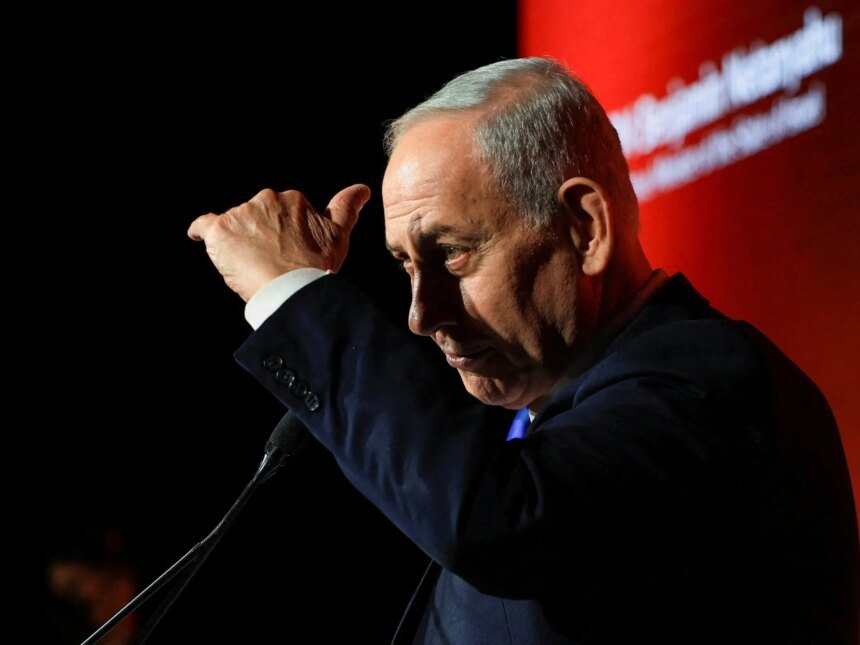
“I lost a little weight,” with this sarcastic phrase, Israeli Prime Minister Benjamin Netanyahu chose to answer first when asked about how he had changed personally since the events of October 7, 2023, before moving on to talk seriously, drawing lessons on the necessity of imposing “buffer zones on enemy land and not on our land,” as he put it.
This beginning reflects the escalation of incitement against the Gaza Strip over the past few days in Israeli political discourse, where disdain for personal responsibility intersects with the insistence on imposing a new field and military reality, in statements that appear to be a framing of Israel’s new field and political trends in the Strip.
Who is responsible?
These statements come amid an ongoing public debate inside Israel about responsibility for the attack, which prompted many senior military and intelligence officials to publicly acknowledge failures and resign. However, Netanyahu did not explicitly accept personal responsibility for the attack and refused to form an official investigation committee. Instead, he called for a politically controlled investigation.
In his appearance on Channel 14, Netanyahu was asked whether previous proposals regarding “voluntary migration” of Gazans were still being studied after a large part of the international community rejected them outright, and he accused the idea’s supporters of trying to ethnically cleanse Gaza of its Palestinians. Netanyahu refused to elaborate on the details, saying: “I prefer that we talk less and do more.”
The Israeli Prime Minister said, “The most important thing, in my view, is first and foremost the existence of buffer zones within enemy territory and not within our territory. I do not want the residential communities in the north to be a kind of border area whose reality differs from the reality of the areas directly south of them.”
Netanyahu did not state a clear, specific position when asked about the possibility of renewed Israeli settlement in Gaza, but rather said only: “Sometimes it is advisable to separate” between actions and public statements, and that “therefore, I have nothing to add on this matter.”
In the past, Netanyahu had ruled out settlement in Gaza, but analyzes by Yedioth Ahronoth newspaper indicate that he is now adapting his public position in line with the approaching elections.
Netanyahu claimed that Israel had achieved two of the war’s three goals: returning the hostages and eliminating Hamas as a military threat. He said, “We also had a third goal, and this goal has not yet been achieved: eliminating their civilian rule,” and he vowed to achieve it.
He then added, “Israel is still targeting those involved in the October 7 attack,” adding, “We will find” anyone still remaining who planned or participated in the attack.
Indicators of the resumption of war
In conjunction with Netanyahu’s statements, the Israeli media and security preparations are focused on resuming military operations in the Gaza Strip, by broadcasting intelligence reports warning of the preparation of the Al-Qassam Brigades, the military wing of the Hamas movement, for a new round of war and the development of its field capabilities.
The Military Intelligence Authority and the Southern Command of the Israeli occupation army claim, through a warning to Chief of Staff Eyal Zamir, that the military wing of Hamas is preparing for a renewed war with Israel, and is producing hundreds of explosive devices and anti-tank missiles per month, in addition to recruiting fighters (18-22 years old), resuming elite force training, rebuilding the underground infrastructure, and attempting to smuggle drones and communications devices through Sinai.
The authority adds that Hamas is strong on the ground, no one threatens it, and it refuses to give up control of Gaza, according to the Kan public broadcaster, on Sunday.
The occupation army quickly used this information as a pretext to justify its desire to resume its attack on Hamas, while the United States opposes this and prefers to maintain the status quo and strengthen the “Peace Council” initiative of US President Donald Trump, which resulted in a ceasefire in October 2025.
The Peace Council envoy to Gaza, Nickolay Mladenov, links Israeli commitment to the conditions of the first phase to the extent of Hamas’ agreement to disarm in the second phase, while Hamas insists on not disarming until Israel adheres to all conditions.
The field tells a different story, as the Israeli army continues to launch almost daily strikes in Gaza, claiming that it is responding to violations of the truce and thwarting alleged attacks. It is also expanding the limits of its control within the Strip to reach 60% instead of 53% when the truce began, with instructions issued by Prime Minister Benjamin Netanyahu to occupy additional lands, bringing control to 70%.
As part of the ongoing operations, the Israeli army announced today, Wednesday, that it had carried out several attacks on four Hamas members in the Gaza Strip, in addition to targeting rocket launching pads and launching openings inside the Strip.
The military correspondent for Israeli Army Radio, citing army data, said that 28 drones successfully infiltrated Gaza in recent months, most of which reached Hamas, and the security apparatus fears they will be used in terrorist operations.

Official plans for settlement expansion
In conjunction with these instructions from Netanyahu, political and security paths began to unfold within the Israeli government related to practical plans for re-settlement and geographical control of the Gaza Strip, which places these trends in direct confrontation with the American opposition and internal rejection from the families of the hostages.
Finance Minister Bezalel Smotrich announced that the Settlement Administration of the Ministry of Defense – which he runs – has completed the basic work to establish three settlements in the northern Gaza area, and that the project is awaiting Netanyahu’s approval.
Smotrich also called for controlling more than 70% of the territory of the Gaza Strip, which exceeds the area allowed for Israeli forces to remain temporarily under the ceasefire agreement signed in October 2025.
Smotrich considered that the settlements would act as a security belt based on his rule: “Where there is no settlement, there is no security,” and insisted that the end of the war must be accompanied by territorial expansion and the occupation of the entire Strip.
In the field and political context, Israeli Energy Minister Eli Cohen announced more expanded official directions by saying: “We will control 100% of the Gaza Strip and will not allow Hamas to raise its head,” which represents an escalation in the political ceiling compared to previous orders to control 70% of the Strip.
The Times of Israel report confirms Smotrich’s continued opposition or provision of conditional support for hostage deal proposals throughout the two years of war, and his vote against them inside the cabinet, threatening to withdraw his “Religious Zionism” party from the government and topple it if it signed an agreement he was not satisfied with, preferring to continue the military attack and overthrow Hamas.
On the other hand, Smotrich’s positions and his taking credit for the return of the hostages caused a massive wave of anger and protests that led to the cancellation of his visit to Kibbutz Be’eri, his boycott, and shouting at him in Kibbutz Ein Hashlosha by the families of the hostages and those killed, who accused him of causing the hostages to be killed in captivity and their return in coffins because of his rejection of the deals, and the use of promotional tours as a trick and a propaganda campaign with the elections approaching, in which his party is hovering around the decisive threshold.
Source: The island + The Times of Israel + Yedioth Ahronoth