

Published On 7/7/2026
As the 2026 World Cup matches entered their most exciting and exciting stages, attention did not remain focused on what was happening in the green rectangle, but rather went beyond it to the repercussions of US President Donald Trump’s direct intervention in a sporting decision that was supposed to remain within the jurisdiction of the International Federation of Association Football (FIFA).
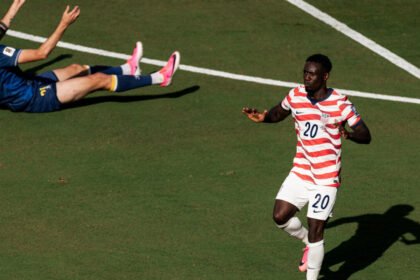
The red card announced by the referee against US national team striker Folarin Balogun has turned into a political and legal issue with international dimensions, raising questions about the independence of sports institutions, the limits of American political influence, and respect for the principle of the rule of law.
Read also
list of 2 itemsend of list
The beginning of the crisis dates back to Balogun’s expulsion during the match between the United States of America and Bosnia and Herzegovina, a penalty that automatically requires a one-match suspension according to FIFA regulations. But what seemed like an ordinary arbitration decision quickly turned into a file inside the White House, the kitchen of the American decision, after the Trump administration moved to cancel the penalty before facing Belgium in the quarter-finals.
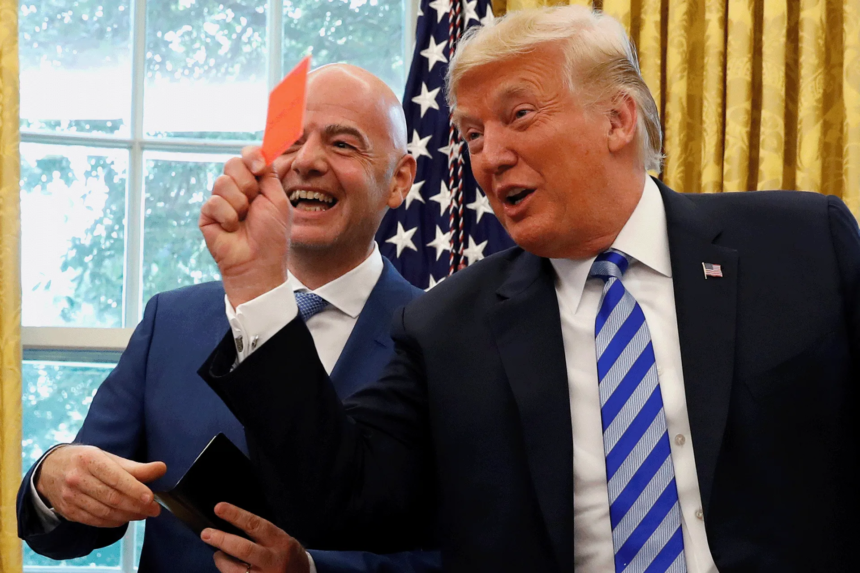
Politico revealed that the move began just minutes after the end of the match, as a campaign of legal and diplomatic communications was launched from the White House, in which government officials and the US Football Association participated, and ended with Trump making a direct call to FIFA President Gianni Infantino, in which he demanded that the suspension decision be reconsidered.

Rule of law
Although FIFA confirmed that the Independent Disciplinary Committee made the decision based on Article 27 of its disciplinary regulations, the timing of the decision and the absence of a legal report explaining its merits, in addition to the close personal relationship between Trump and Infantino, fueled suspicions about the sports institution being exposed to political pressure.
The New York Times, in an article written by Bill Saporito, saw that the case went beyond football to a test of the principle of the rule of law. The writer says that the referee’s decision may have been wrong, but – according to the rules of the game – it was not subject to review, “until Trump called Infantino to confirm that the rule of law in football, as in America, does not apply to him.”
He adds that resorting to a rarely used legal article to cancel the penalty sends a message that political influence is capable of reinterpreting the rules when it comes to American interests, considering that what happened caused more harm to the image of the American team than it benefited.
Former US Secretary of Labor Robert Reich, in an article in The Guardian newspaper, believes that the incident represents an extension of a political approach that ignores the rules whenever they conflict with Trump’s interests.
He says that societies teach their children to respect the decisions of rulers, even if they seem unjust, because trust in institutions is based on accepting the rules, but “Trump is sending the world the opposite message, saying that the United States does not abide by the rules, does not accept loss, and does not recognize the provisions of the law.”
The British newspaper The Daily Telegraph described what happened as a “new shameful decline” for FIFA, considering that the organization reinterpreted its regulations to please Trump, as it had previously done with exceptional cases involving major stars such as Cristiano Ronaldo.
Destruction of trust
Reich believes that Trump’s intervention spoiled the integrity of the tournament, because any achievement achieved by the American team will remain surrounded by doubts about the fairness of the competition, adding that the abuse of power to change the rules of the game “destroys the trust on which any system is based, whether it is a sports tournament, political elections, or a free economy.”
As for writer Pablo Iglesias Maurer, in the Guardian, he believes that Trump’s intervention brought to mind an era when sports decisions were subject to political influence, recalling a historical incident from the 1962 World Cup when the President of Chile intervened to save Brazilian star Garrincha from suspension.
He says that FIFA insists that the decision is legal, but asking the world to believe that Trump’s communications did not influence the decision is “hard to believe,” noting that the close relationship between Infantino and Trump has become a growing source of concern about the independence of FIFA.
In the same context, the Daily Telegraph described what happened as a “new shameful decline” for FIFA, considering that the organization reinterpreted its regulations to please Trump, as it had previously done with exceptional cases involving major stars such as Cristiano Ronaldo.
A losing situation
As for the Independent newspaper, it quoted critics of the American president as saying that his intervention put the American team in a “losing position, whatever the result,” because any victory will be seen as having been achieved with political assistance, while any defeat will turn into evidence that even the president’s intervention was not enough.
It is noteworthy that the case also revealed a political paradox within America, as the New York Times indicated that Balogun is an American citizen by birth, which is the same principle whose scope the Trump administration sought to reduce through recent judicial battles, which prompted commentators to accuse the president of selectively dealing with legal principles according to what serves his political interests.
In the end, the Balogun crisis was no longer just a dispute over a red card, but rather became the subject of a broader discussion about the relationship between power and law, and the limits of political influence in international institutions.
When a phone call from a head of state becomes sufficient to reconsider a final sporting decision, the issue goes beyond the borders of the green rectangle to pose a larger question: Do the rules still govern everyone, or has influence become able to rewrite the rules themselves?
Source: Independent + POLITICO + telegraph + New York Times