

Published On 7/6/2026
The Russian-Ukrainian war, which has exceeded its fourth year, has entered a highly sensitive military and diplomatic turn, as attention turns to the NATO summit in Ankara over the impact of mutual strikes in the two depths, and sharp Western differences regarding paths to ending the conflict, coinciding with US President Donald Trump’s announcement that the end of the war has become “closer than imagined.”
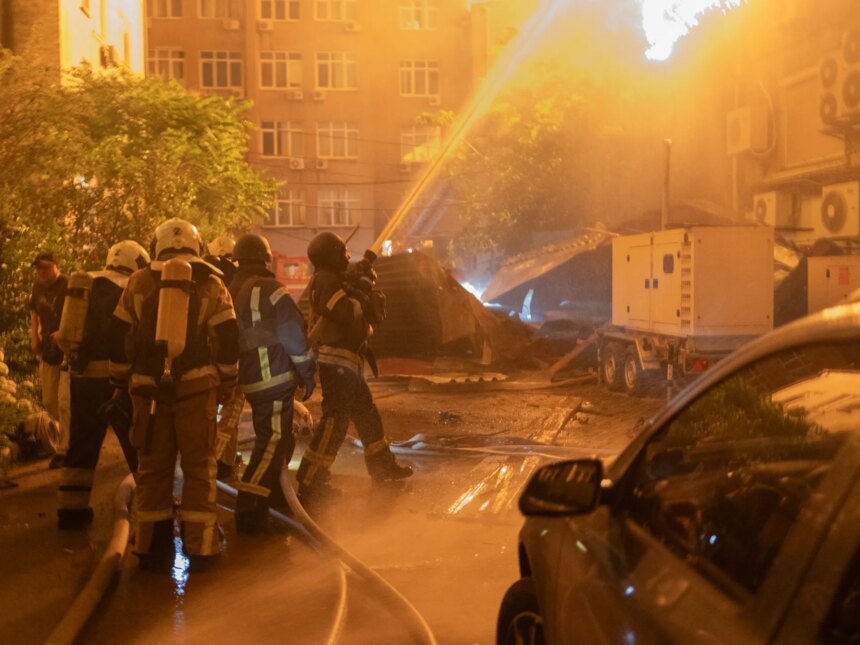
On the ground, developments revealed Russian targeting of Kiev and its surroundings with missiles and drones, resulting in the killing of at least 22 civilians, while the Ukrainian General Staff announced that the Omsk oil refinery – one of the largest Russian refineries – was being targeted for the first time in the history of the conflict.
Political timing
In reading the context, Ziad Majed, professor of political science at the American University in Paris, believes that the current escalation is governed by summer weather conditions that allow the vision to fade, driven by “psychological pressure” to prove the continuation of the battles.
Majid explained – during his talk to the “Beyond the News” program – that the timing reflects a desire from Moscow and Kiev to draw international attention again to the front after it faced a kind of marginalization in favor of the Middle East and China Sea disputes, as Russian President Vladimir Putin seeks to attract Trump’s attention, while the Ukrainians are pressuring Europe to push Washington towards strengthening support.
He adds that the “White General” (Winter) left the region four times without stopping the war, and despite Putin’s inability to resolve the battle and change the regime, he succeeded in keeping the cities of Moscow and St. Petersburg away from daily suffering by recruiting the poor, rural residents, and Muslim republics, taking advantage of the change in the American tone, while Ukraine succeeded in steadfastness on the ground in keeping European financial support and Atlantic armament continuing.

Conflict of narratives
As for direct positions, the head of the Foreign Affairs Committee in the Ukrainian Parliament, Oleksandr Mirezhko, confirms that the Russian president is the only obstacle to peace. Because of his reluctance to end the war for fear of losing his power and his life.
Merezhko explains that Putin resorted to destroying infrastructure and civilian facilities due to his inability on the ground and his failure to fully control the Donbass region for 5 years, or to protect his positions in Crimea and the Black Sea.
He said that Russia had suffered – according to the international community’s documentation – human losses amounting to 1,400,000 soldiers, pointing out that Kiev was counting on a direct meeting between its president, Volodymyr Zelensky, and Trump in Ankara to secure more Patriot defense systems.
On the other hand, former Duma member Sergei Markov adopts a different narrative, describing the Russian operations as “humanitarian” through a statistical comparison with the victims of the Gaza Strip, and claiming that Russia does not target civilians but rather seeks to “liberate the Ukrainian people from the modern colonial system.”
Markov justified the bombing of Kiev by responding to Zelensky’s previous threats to spread terror and try to burn Moscow, citing the advance of Russian forces and their control of the city of Konstantinovka. He stressed that the percentage of losses in the field was in favor of Russia, with one Russian soldier compared to 40 Ukrainian soldiers.

“Trump formula”
Regarding the prospects for a solution, Ziad Majed points out that the expected “Trump formula” may propose an initiative whereby Ukraine would agree to give up parts of its occupied territories in exchange for stopping military operations and Russian guarantees, which Europe does not object to on the condition that it obtains clear guarantees from NATO and determines the size of the Ukrainian army, suggesting that field escalation will continue as a tool for mutual pressure ahead of any anticipated negotiations.
Since February 24, 2022, Russia has been launching an attack on Ukraine and stipulates in order to end it that its neighbor abandons joining Western military entities, which Kiev considers “interference” in its affairs.