

Analysts who spoke to Al Jazeera Net did not hesitate to describe what happened in Damascus on Tuesday morning as part of a systematic campaign seeking to create a climate of instability, and to send a clear message to the international community that Damascus, a year and a half after the fall of Assad, is still fragile in terms of security. However, these same analysts agree that this message did not achieve its goal and did not reach its goal.
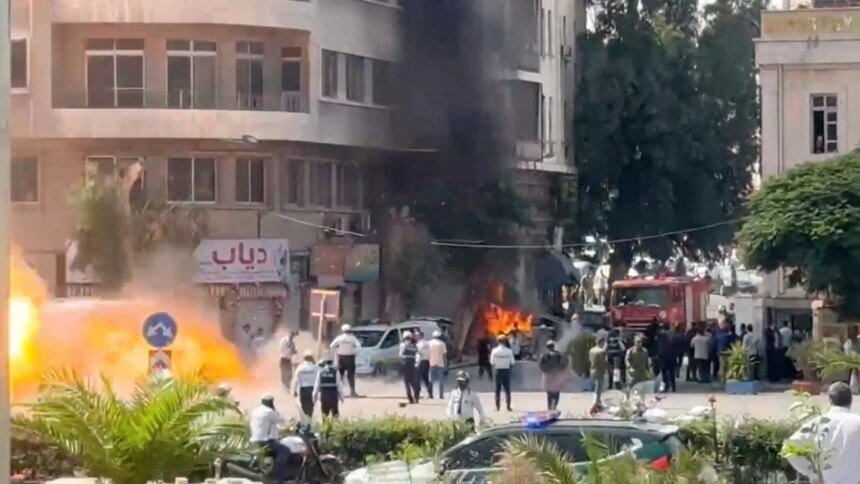
Today, two explosive devices exploded in the heart of the Syrian capital, Damascus, at close times. The first was inside a car parked near the Ministry of Tourism building, and the second was in a nearby trash container. The incident occurred at a time that revealed a message wanted by those behind the bombing, and his bet was not on the size, but on the addresses to which his messages would reach.
That morning, Damascus was preparing to receive French President Emmanuel Macron, the first major Western president to visit the country since the fall of Bashar al-Assad’s regime in December 2024.
This visit was described by analysts as “historic” even before it began, and it carries with it huge economic, political and humanitarian files, from returning frozen assets to shipping and energy agreements, and from supporting the political process to discussing the fate of Syrian refugees in Europe. Therefore, the visit was described as “the historic gateway for European investments towards Syria.”
These two explosions come after another explosion that struck a café in the Hijaz region only a few days ago, killing dozens. This succession of incidents is what makes them go beyond the immediate security dimension, and prompts the raising of fundamental questions such as: Who is bombing? And what does he want? Can he really stop the train of international openness to Syria?
Advanced messaging with primitive tools
In the logic of complex security operations, the timing is not a coincidence and the location is not random, and what Shukri al-Quwatli Street witnessed in Damascus this morning bears the fingerprints of a plan in which the message exceeded the size of the explosion, and in which the goal took precedence over the material impact.
French international relations professor Pierre-Louis Raymond puts the two explosions in a broader context when he notes that they followed the Hejaz Café explosion, and this sequence cannot be read as isolated incidents. “There is a clear attempt to create a climate of instability and security tension, which ends with an effort to obstruct the path of international openness.” Thus, the explosive device becomes not just a tool of destruction, but rather a tool of carefully directed discourse.
As for the security and strategic expert, Fayez Al-Asmar, he details the operational system of the operation, which suggests the depth of planning, as the first bomb was carried out to lure the ambulance and security forces to the site, then the second came to double the impact and confuse the response.
Al-Asmar added – in his statements to Al-Jazeera Net – that this method likely belongs to the Islamic State, which announced last February what it described as “a new phase of operations against the Sharaa government.”
Here, Al-Asmar intersects with Raymond in the same conclusion: The real goal is not to raise the number of victims, but rather to paint a bleak picture of Syria in front of international public opinion, summing it up: “This is a land that is still exploding.”
For researcher in political studies and Middle East conflicts, Wael Alwan, this autopsy presents a dimension that raises deeper concern, “The location is not random, as the region was theoretically subject to the highest levels of alert.” This means that the perpetrators were able to insert the two devices into an area subject to exceptional guarding, whether through a penetration into the intelligence system, or exploiting blind spots that had not yet been closed in a security system that is still taking shape.
Who benefits?
When a regime falls after decades, it leaves behind a network of those who have lost privileges and those affected by the equations of regional influence. This network is the natural starting point for any reading of responsibility for what is happening in Damascus.
In direct words, Fayez Al-Asmar puts his finger on the map of officials: The suspects include “Israel, which wants the Syrian state weak and unstable, ISIS, which is carrying out a series of organized attacks, Iranian and Hezbollah cells, the remnants of the former regime, and the Hijri militia.”
However, Al-Asmar does not stop at enumerating the officials, but rather goes deeper: “The unifying goal of all of them is to perpetuate the image of Syria as an unsafe country, and therefore not prepared to receive international investments and funds.”
In contrast to this definition, Pierre-Louis Raymond deals with the issue of responsibility with security-related caution. “We leave the issue of the beneficiary to the results of the investigation,” but he does not avoid pointing out that his conclusions “intersect with analyzes on the spot and attribute attempts to spread instability to either ISIS, the remnants of the former regime, elements linked to the former regime, or factions contrary to the directions of Syrian President Ahmed al-Sharaa.”
Instead of delving into the debate over identity, the French international relations professor frames his final ruling with a phrase that pierces the discussion: “Whatever the source, these operations remain immediate and cannot undermine confidence in the sound structural assessment of the Syrian security services.”
The researcher in Middle East conflicts also meets Raymond in the same conclusion, but he reaches it from a different path. “The beneficiaries are everyone who was harmed by the fall of the Assad regime, as they were managing political, security and economic trade linked to the state of chaos.”
Then he turns the equation around: “The current primitive bombings do not deliver the message that those who launched them wanted,” reasoning that countries such as France and the United States were subjected to more severe attacks without losing their international standing or withdrawing their investors.
Is there a security vulnerability?
The most pressing question is not only related to who exploded, but also how did the two devices pass at a time when the security alert reached its maximum? This question may represent the heart of the real crisis facing Syrian security, and answering it represents an urgent necessity to fill any gaps in the emerging wall of the state.
The security and strategic expert diagnoses the problem by saying that “the security forces are in real need of more expertise and security logistical tools in all their forms, including surveillance cameras and radio jamming devices.”
But what is most urgent in his analysis is not the technical aspect alone. Rather, it goes beyond that to the structural plans. Achieving security – as he sees it – “is not limited to the security authorities alone. Rather, there must be real participation and cooperation between the citizen and the state.”
Wael Alwan adds another criterion to the scene: “The security aspect today is almost one of the unique aspects that the Syrian government has succeeded in controlling, compared to Syria emerging from a 14-year war, in which there were armies of more than five countries and multinational sectarian organizations and militias.”
That is, the correct measure – from his point of view – is not what Syria measures according to the best international standards, but rather what it has exceeded in comparison to what it was.
Pierre-Louis Raymond meets this spirit when he acknowledges that “building a central state is difficult, and that President Sharaa faces great challenges.” However, he sets a basic rule in analyzing the impact that these explosions could have, and distinguishes between operational gaps that can be addressed and a structural collapse that did not occur to the security system in Syria.
Can the train be stopped?
In the grand economic equation, there is a fundamental difference between disturbing a train and stopping it; The two explosions disturbed Damascus, but did they stop what has been developing with increasing force for months? The answer begins with understanding what France really means to Syria economically.
The French researcher recalls a historical fact that gives the visit its true dimensions. “It is known historically that France represents for Syria the gateway to international investments and investments in Europe in particular.”
This essential role explains why the French delegation came carrying senior executives from companies the size of Total Energy and Airbus, with major deals that, if mature, would turn Syria into an arena of attraction, not an arena of risk.
Among these important deals is the important one that Airbus is preparing to sign with Damascus, and it is a living example that such decisions are based on a long-term economic philosophy, and not an immediate reaction to an explosion in a trash container.
This is exactly what Raymond’s analysis embodies when he says, “The economic evaluation takes place in the long term, and business owners know that reconstruction requires time and long-term deals.”
Which implicitly answers the fundamental question: Will these explosions affect Macron’s visit program? Raymond responds, “The visit program was predetermined, and the area where the explosion occurred is outside the security cordon designated for the president.”
Then he goes to the broader ruling: “In no way can such explosions, even if they were not improvised, change the program of a visit that is considered historic.”
With a remarkable irony, Wael Alwan says that the explosions, instead of discouraging countries from engaging in investments, may push them in the complete opposite direction, towards building “deeper security partnerships with the Syrian government.”
In this intertwined scene, Alwan summarizes the geopolitical equation in a way that reveals the depth of what is going on. “The international position is consistent with the regional trend sponsored by the United States, Turkey, and the Gulf states to make Syria a focus of stability at the regional level.” This is exactly what the bomber fears, not because the explosions will not cause casualties, but because the train’s path is moving despite it.
Security challenges
What Tuesday’s bombings reveal goes beyond the dimensions of the temporary security question, and puts the Syrian state before a very complex equation: How do you build a security system capable of preserving progress, while the deeper political and economic challenges remain under achievement?
The researcher in political studies distinguishes between what the government has accomplished and what it has not yet accomplished. “The security aspect has become easier due to the efforts of the Syrian government, but the political and economic challenges seem more complex and require longer and more complex paths.”
Pierre-Louis Raymond adds the structural dimensions of this equation, which are building a central state in a country that has lived for years in conflicts between several armies and dozens of militias, which is “a difficult matter that does not happen overnight,” and the state faces “major challenges in this field, from integrating minorities and building governance institutions to unifying the security system.”
Here, Fayez Al-Asmar offers his approach to the solution: Security is not achieved by devices and technologies alone, but rather by “real participation between the citizen, the state, and the international community.” This tripartite partnership is the unifying thread of any successful strategy in the post-conflict phase, and it is not enough for the state to tighten its security cordon unless it gains the trust of its citizens. It is not enough for international investment to come unless there is a security environment to protect it.
The bottom line is that the bombings wanted to say one thing: Syria is still fragile, and opening up to it is a risk. But what happened next was exactly the opposite; The visit passed, the agreements were signed, and the train of international openness did not stop, according to what the three analysts told Al Jazeera Net.