

Published On 7/6/2026
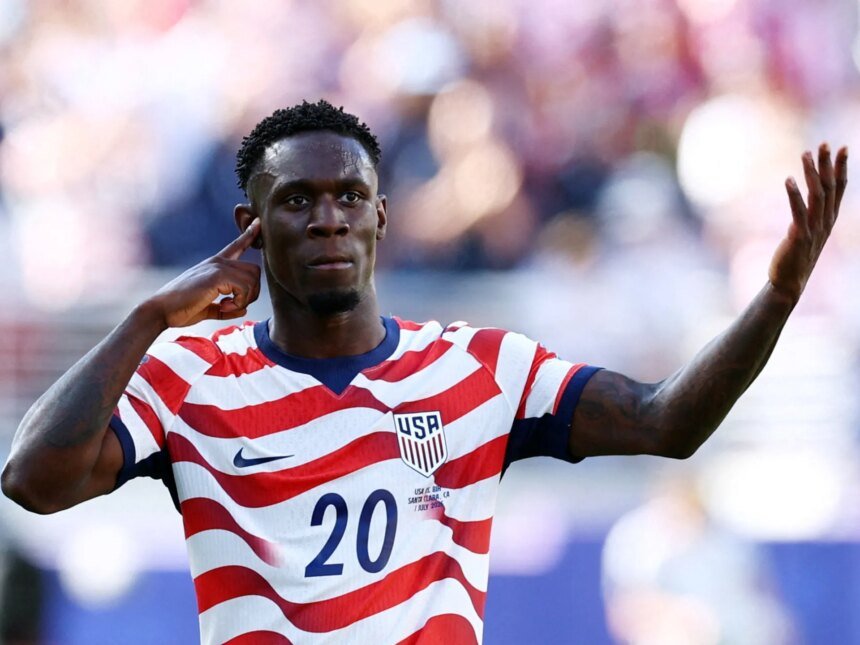
The move by the International Federation of Association Football (FIFA) to suspend the implementation of the suspension penalty against US national team striker Folarin Balogun sparked a new wave of controversy, after sports law experts in Germany considered that the decision conflicts with the basic principles of sports law, and may open the door to legal challenges affecting the results of the 2026 World Cup.
Balogun had received a direct red card during his country’s match against Bosnia and Herzegovina in the round of 32, before FIFA announced, on Sunday evening, the suspension of the implementation of the automatic suspension penalty, allowing the player to participate in the match against Belgium in the last 16, with the penalty placed on probation for a year.
Read also
list of 2 itemsend of list
Illegal decision
In statements to the German News Agency (DPA), the German lawyer specializing in sports law, Thomas Sommerer, described the International Federation’s decision as “illegal.” He said: “FIFA’s decision to cancel the suspension for the next match and suspend the implementation of the penalty while putting it on probation is an illegal decision.”
He added that the International Federation “ignores the basic principles of sports law, which are adherence to regulations, and the irreversibility of realistic decisions taken by referees.”
Sommerer is considered one of the most prominent specialists in this field, as he also holds the position of President of the German Society for Sports Law.
Automatic suspension does not accept diligence
Sommerer explained that FIFA regulations leave no room for discretion in such cases, stressing that the penalty of suspension after a direct red card is applied automatically. He said: “The suspension for the next match applies automatically and leaves no room for diligence or discretion.”
He added that the International Federation itself confirmed this principle in an official letter sent to the national federations before the start of the World Cup, noting that “relying on the option of suspending the penalty stipulated in Article 27 of the disciplinary regulations contradicts the approved legal system.”

Warning of appeals that may threaten the championship
The German legal expert warned of the repercussions that might result from Balogun’s participation in the next match. He said: “If the player participates in the next match, this match will be marred by a violation of the regulations, which allows Belgium, if it loses, to appeal the result. This may threaten the completion of the entire tournament.”
He added, criticizing the International Federation’s decision: “FIFA, with this mistake, turned its slogan (for the good of the game) into its opposite.”
Astonishment within legal circles
For his part, German lawyer specializing in sports law, Christoph Schickhardt, expressed his surprise at the decision, considering that it violates a rule that has been stable for years in international sports law.
He told the Ludwigsburger Kreiszeitung newspaper: “The rule that an expulsion requires a suspension for at least one match is well established in international sporting law, and it is a basic rule that cannot be violated.”
He added: “The entire proceedings raise clear questions. Among sports law experts, such a matter only raises astonishment, because this issue was considered settled for a long time.”

A expanding crisis
These criticisms come at a time when the repercussions of FIFA’s decision continue, after the Belgian Federation filed an appeal against lifting the suspension of Balogun.
American media also previously reported that US President Donald Trump called FIFA President Gianni Infantino, demanding that the punishment be reconsidered, which sparked a wide wave of controversy regarding the independence of FIFA’s decisions and the possibility of them being affected by political pressure.
While the International Federation insists that its decision was taken in accordance with established legal procedures, critical legal voices are increasing, amid warnings that the Balogun case will turn into one of the most controversial cases in the history of the modern World Cup, if it results in legal challenges that affect the integrity of the competition or the results of the tournament.