

South Lebanon- Hassan Halal does not search for his daughter’s grave among the rows of gravestones, as he knows the way to it by heart. However, he slows down as he approaches, as if the distance is no longer measured in meters but rather by what has been broken inside him since that day.
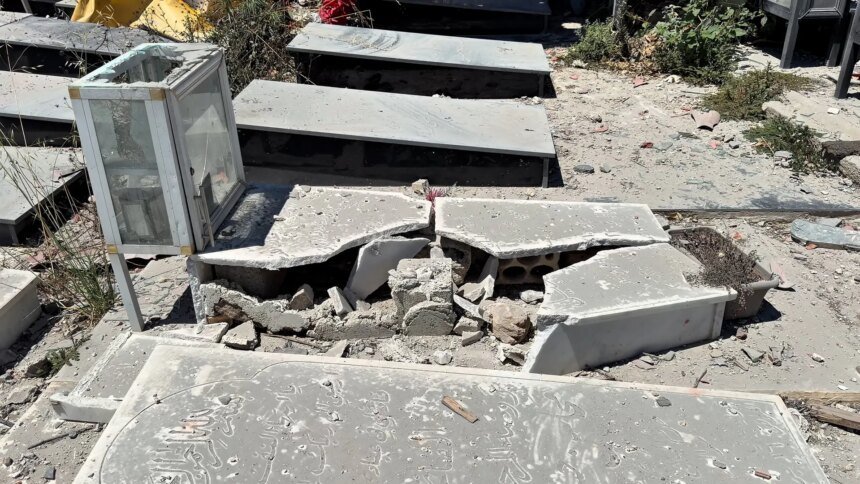
In the cemetery of the town of Mifdoun, the ground is no longer as it was, broken glass is scattered among the graves, and stones were uprooted from their sites by Israeli raids. Tombstones bent under the impact of explosions, and others cracked as if they shared the fragility of the living, while a light layer of dust covered names that were thought to have been finally granted by death by wars.

Hassan arrives at the grave of his child, Narges, slowly sweeps the ground with his hand, removes a withered tree branch that fell on the gravestone, then stands silent. No supplication comes out, no clear crying, only silence seems to be the only possible language in front of what is not said.
Just months ago, Narcissus was running around the house, filling it with her little questions and intermittent laughter, a five-year-old girl, who was growing faster than her age, and her father’s ability to imagine absence.

The last truth
On the night of March 2, 2026, with the beginning of the war on Lebanon after the exchange of bombings between Hezbollah and Israel, an ordinary day turned into a complete collapse. Hassan was at work when news began to circulate about massive raids on Beirut, the south, and the Bekaa. He did not understand at first the extent of what was happening, but one feeling crept into him: that nothing would remain as it was.
On the phone, the leads began to be cut off one by one. His wife did not answer, the neighbors had no voice, the numbers all led to nothing, and one sentence kept being repeated in the news and rumors: “The building was destroyed.”
In those hours, sadness had not yet crystallized, but rather a dense confusion resembling loss. He moved between hospitals, ambulance numbers, and contradictory narratives: survivors here, victims there, alive in one place, and missing people everywhere. Until the news settled on its final, heavy truth: his child no longer existed.

Since that day, the road to the cemetery was no longer just a visit. It became an extension of the road that ended at the doorstep of the house, but the war was not limited to that. When pictures of the bombing in southern towns began to spread, Hassan was not looking for his house among the rubble, nor for his shop, which had burned, but for the cemetery itself. A new fear was forming inside him: What if he didn’t find her grave? What if the only place that brings him together turns into a lost trace?
After the ceasefire, he finally returned. He entered the cemetery with hesitant steps, examining the evidence one by one. Some were shattered, some fell to the ground, and some looked as if they had narrowly escaped complete obliteration, but the grave of his child was there. It wasn’t as he left it, but it was there. This alone was enough to prevent his world from collapsing again.

A recurring scene
In the villages of the south, this cemetery was not an isolated case. The raids and explosions affected a number of cemeteries, causing their headstones to crack, their shrines to collapse, and the rubble mixed with the dried flowers left by the people on their recent visits.
In a scene that was repeated silently, some residents would return first to the cemeteries before their homes, as if checking on the graves of their dead was more important than searching for the fate of their homes.
In another corner, an elderly woman bends over her husband’s tombstone in the town of Burj Qalawiya in the Bint Jbeil district. She lifts a piece of marble that had been separated from its place, wipes the dust with the edge of her scarf, then carefully returns it to its place, as if apologizing to him because the war has reached him as well.
Nearby, a man stands contemplating names whose letters were lost under the impact of shrapnel. He says in a faint voice to Al Jazeera Net that the dead do not fear bombing, but the living need a place to visit those who have passed away, to maintain contact with what remains of them.

Within the targeting circle
The effects of the Israeli war on Lebanon did not stop at the borders of homes, roads and fields. They extended to the cemeteries that are supposed to be the last thing left outside the time of conflict. But, in this war, it also entered the circle of targeting, adding to the people’s memory a different kind of pain: the pain of a place that was supposed to be free of loss.

Lebanese human rights and journalistic reports documented damage to cemeteries in multiple towns in southern and eastern Lebanon, including Yahmar al-Shaqif, Deir Qanoun al-Nahr, Burj Qalawiya, Shamstar, and al-Nabi Sheet, in addition to other villages to which raids and bulldozing operations spread.
This damage is not limited to the border villages, but extends deep into the south and the Bekaa, where bombing and bulldozing operations targeted cemeteries and religious sites, in a scene that reflects the expansion of the scope of targeting outside the traditional rules of engagement.
A human rights approach indicates that cemeteries are classified as civilian objects protected under international humanitarian law, like places of worship and cultural sites, and it is prohibited to target or harm them except in cases of direct military use, which makes what was recorded in a number of cases subject to legal and moral accountability according to multiple human rights reports.
But on the ground, the legal texts seem far from the scene, while the reality is much harsher: scattered stones, broken tombstones, distorted names of the dead, and families trying to restore the relationship that does not break easily between life and death.
In conclusion, cemeteries do not appear to be mere burial places but rather small maps of memory, and when war strikes them, not only does the stone crack, but the idea of tranquility itself is also shaken.