


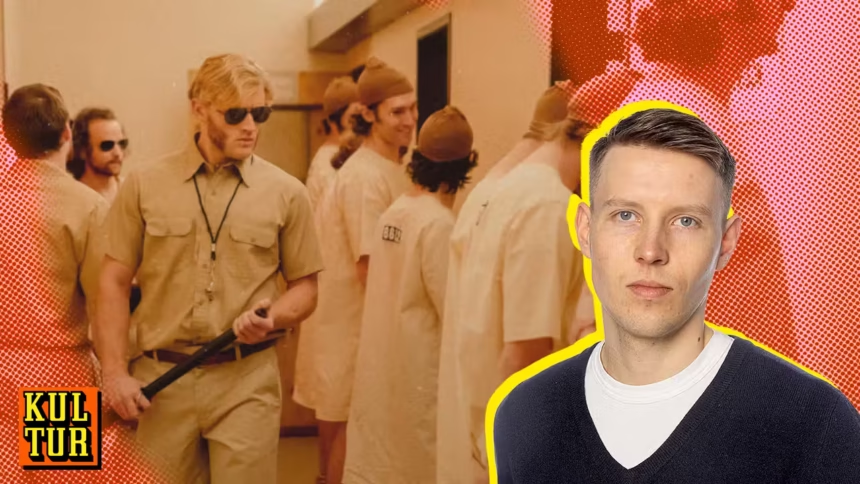

New documentary reveals how controlled the Stanford experiment was
About twenty men students at prestigious Stanford in the north Silicon Valley offered to participate in an experiment. It will last for a week in the university’s basement and in return they will be paid. A perfect summer road.
Once in place, coins are singled out, the participants are randomly assigned the role of either prisoner or prison guard. Then a prison role-play begins. However, the trial must be terminated after only a couple of days. The humiliations, punishments and violence run rampant. Five of the guys have nervous breakdowns. One is sent home. Philip Zimbardothe research leader behind the study, pulls on the handbrake.
The Stanford experiment is one of the most famous and controversial of modern times. It has been widely used to explain how power corrupts: how the soldiers in Abu Ghraibthe Nazis in the concentration camps, the Tutsis in Rwanda and seemingly ordinary people of the upper class are capable of committing atrocities. The study has captivated generations.
A new documentary however, sheds new light on what actually happened on those hot Californian summer days in Palo Alto in 1971. “The truth about the Stanford experiment” (SVT Play) calls into question the scientific accuracy and thus also the conclusions the study is said to prove.
The Stanford experiment was among the first things you had to learn about as a newly hatched sociology student in Lund. Maybe for tactical reasons. Few social psychology studies can capture the interest of twenty-year-olds with the same hypnotic power. The only competitor would be Stanley Milgram electric shock experiments at Yale ten years earlier, which also investigated the psychological effects of power and authority.
The studies have in common that they have been criticized for violating good research practice. Any informed consent from the participants was hardly given, they were harmed, and the experiments could not possibly have been carried out today. But they are also united in their claim to reveal deeply uncomfortable—not to say unpleasant—truths about the impact of the social on the individual. Perhaps straight from something fundamental about human nature, about good and evil.
The experiment catches on quickly public interest. It’s an incredible story. Think: If only ordinary guys are given a position of power, they turn into monsters. The common condition is that we are all – no matter how good we like to think about ourselves – potential perpetrators, rapists and murderers. Opportunity makes the thief. Evil lives in all of us.
Zimbardo’s career takes off. He becomes an academic superstar, a so-called public intellectual who are invited to TV sofas, act as expert witnesses in large trials and release books such as “The Lucifer effect: Understanding how good people turn evil”. It sells like hotcakes.
But in the documentary gets a different narrative place. The participants themselves get to speak, and the picture they paint is completely different from Zimbardo’s and the one conveyed in social science and psychology textbooks.
First: it was the 70s. In Cali as well.
The radical zeitgeist as well as personal motives influenced the students’ entry values. One had a background in improvisational theater and went wholeheartedly into the role of sadist. Another thought that the experiment would prove how horrible prisons are and therefore took a little extra with the hard gloves: “Given the times and given the fact we were students, and very antiestablishment, we would have done anything to prove that this prison system was an evil institution.” So there were reasons other than omnipotent evil for the guards to do what they did.
But more important than that hip culture and individual driving forces is that Zimbardo was constantly pulling the strings. Contrary to what he claimed in books and interviews, the guards did not act spontaneously. Before the experiment, they were given careful instructions, including a list of what punishments were allowed, and they were coaxed into the role as if by a director. Everything was predetermined. Zimbardo wanted to prove his thesis and steered the participants towards the desired outcome.
Despite his involvement, however, he did not quite manage to get what he was after. In fact, not everyone agreed with the premises, further undermining the thesis. One of the “guards” (on a daily basis he studied Taoism, Jewish mysticism and Chinese art, but above all he took all the drugs he could get his hands on) felt compassion for the prisoners and offered them hash every day as a band-aid. Then one of Zimbardo’s PhD students intervened and said he had to tough it out.
But the main example that blows the theory is Kent Cottera conscientious young man who canceled his participation even before the experiment started. He did not want to participate in the repression and found the atmosphere unpleasant from the start. Zimbardo timely enough does not mention him in his accounts.
After all that the documentary reveals, one is inclined to dismiss the experiment. See! It was rigged! We are not evil, even when the situation is evil.
But even if the Stanford experiment was unscientific and Zimbardo a successful hoaxer, it does not mean that the conclusion is disproved. If you look around, there are plenty of real examples of destructive subcultures that lead to abuse. Just take the recent storming around Lundsberg that appeared in another SVT documentary. Or why not Macchiarini-the scandal at KI or Jim Jones suicide cult. All examples of when hierarchical group dynamics, prestige, power and loyalty derail.
We are not the power-hungry pencillers that Zimbardo wanted to make Easter shine, but we are not immune to socialization and culture either. Maybe you shouldn’t shout hello just because of a fake experiment – especially not as we are in the middle of an authoritarian mass psychosis. We can only hope that students will soon once again, with the same enthusiasm, burn to rid themselves of repressive institutions.
Ruben Lind is a writer on Aftonbladet’s culture page.