


Free art is threatened from several sides
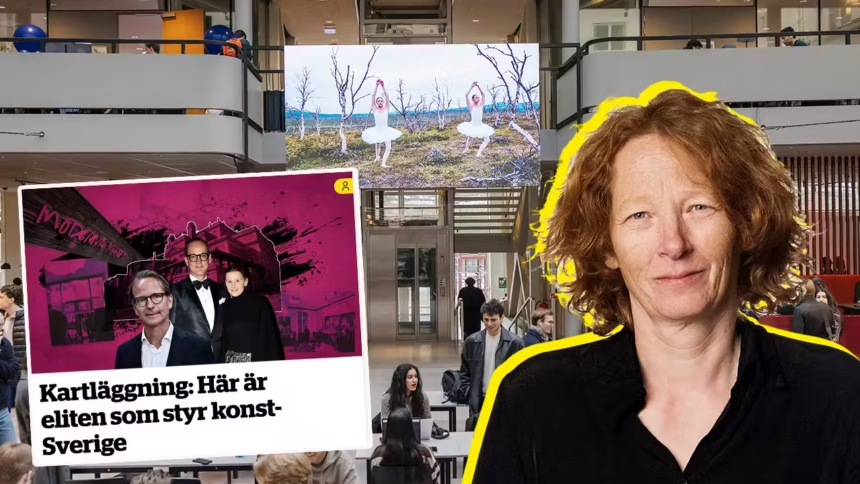
In Thursday’s Dagens ETC led to the rambling headline “Mapping: Here is the elite that controls art Sweden”. a well-written and interesting report about the change in the art world. Over the past decade, it has become a place controlled by commercially oriented networks. Yes, between thumb and forefinger, for the clearest examples in the text relate to such things as the art firm CF Hill (founded in 2015), the Stockholm School of Economics and their art initiative Art initiative (from 2013).
It is of course nothing new that the inclusive cultural policy has disappeared. So that society, that is to say we together, takes responsibility for everyone being able to both create and take part in what others have created. Such dreary and unglamorous as accessible culture schools, studios, libraries. The slow erosion of those values has been sped up in recent years, with Tidölaget’s attacks on, above all, public education. For the art world, mediation and capital in the form of art dealers, collectors and the occasional patron have moved in.
The School of Economics with outgoing principal Lars Strannegård may in the ETC report embody the development: He has gone from the “people-building” (as in “making people out of brats”) Art initiative at Handels to chairman of the board of the new major authority Moderna museet and future CEO of Princess Estelle’s art foundation. Of course, most of it is about networks and contacts, and here it is close between Handels, CF Hill, Bukowskis and the institutions mainly in Stockholm. Mingling and networking is mandatory for everyone in the art world – if the article is to be believed. I myself get tired of noting who is kissing on the cheek with whom.
The development towards commercialism – and that right-wing politics’ mantra “everything should carry itself” dominates – is not only visible in the context of art. In the world of literature, everyone knows which books are published and marketed most persistently. Who will sell. However, it is of course a completely different five in the world of art: it is more social – for the most part it is “consumed” in public or semi-public environments, it requires greater investment in materials and surfaces. And it is sold. IN Clara Lee Lundberg’s article points out the fact that, of course, works of art are sold more and more expensive, records are broken. But it is at the auction houses, a secondary market where it is the collectors, not the artists, who pull in the money.
Statistics from KRO has showed how low incomes artists have and in the ETC report it is Andreas Mangione who gets to represent the ordinary artist: a person who makes a living from something completely different from art and instead creates in his spare time. But here is also a bridge to the epicenter of power. Mangione was the one who started and ran a Facebook group in protest of a hybrid gallery and art store calling itself CF Hill. It is unworthy because the artist CF Hill did not have a little to do with commerce – rather he lived a precarious life. Andreas Mangione doesn’t actually claim that his career came to a standstill because of that protest, but that’s how it looks in the text.
An artist should bend down to get into the heat, is the text’s message. Or: it was better before. It is clear that a new and completely different cultural policy is needed. If one can be created from the rubble that remains.
In Örebro has a work of art at the annual exhibition Open Art exposed for vandalism and the artists behind the work, Petter Pettersson and Elin Lundgrentestify to widespread and aggressive hatred.
Free art is threatened from two sides, so to speak: from a market that sucks it out – where everything from studios to materials to living expenses has become more expensive but the income ends up elsewhere – and from populist politicians who incite art as unnecessary, as in Örebro. A really nasty cocktail.
Ulrika Stahre is editor and critic at Aftonbladet Kultur, responsible for art coverage.