Al Jazeera correspondents

Published On 1/7/2026
|
Last updated: 7/2/2026 08:13 (Mecca time)
Amid the widespread devastation caused by two powerful earthquakes that struck Venezuela, Arab rescue teams participating in field operations emerged as an essential part of the international response to the disaster.
In the capital, Caracas, teams from Jordan, Qatar, and Syria continued to work in complex conditions between collapsed buildings and blocked roads, searching for survivors under the rubble, recovering victims, and providing medical and logistical support in the affected areas.
The Jordanian search and rescue team continues its field operations in Caracas, as part of a broad international response that followed the two earthquakes that struck the country last Wednesday, causing major damage to buildings, roads and infrastructure.
Six days after the earthquake, the Jordanian team was able to rescue a three-year-old child from under the rubble of a house in the capital, amid complex field conditions.
The media spokesman for the Jordanian Public Security Directorate, Brigadier General Amer Sartawi, said in a statement to Al Jazeera Net that the team found the child alive, and his vital signs were good.

Al-Sartawi explained that the search and rescue personnel worked for continuous hours to remove the rubble using specialized equipment, while monitoring the child’s vital signs using thermal devices, until they were able to reach him and remove him without harm. He added that the doctor and the ambulance crew accompanying the team provided first aid to the child, before transporting him to the nearest hospital and informing the local authorities.
Since arriving in Caracas on a Royal Jordanian plane, the Jordanian team has begun its operations in coordination with the Venezuelan authorities and the United Nations, and has been able to recover 11 bodies from two different locations, one of which is a collapsed residential building more than 10 stories high, while search operations continue in other locations where missing persons are believed to be located under its rubble.
The team also contributed to finding the body of Jordanian citizen Taghreed Saber, who had been trapped under the rubble since the earthquake. The Jordanian Ministry of Foreign Affairs and Expatriate Affairs confirmed that the Directorate of Operations and Consular Affairs and the Jordanian Embassy in Brazil continue to provide support to her family and follow up on the conditions of Jordanians in Venezuela.

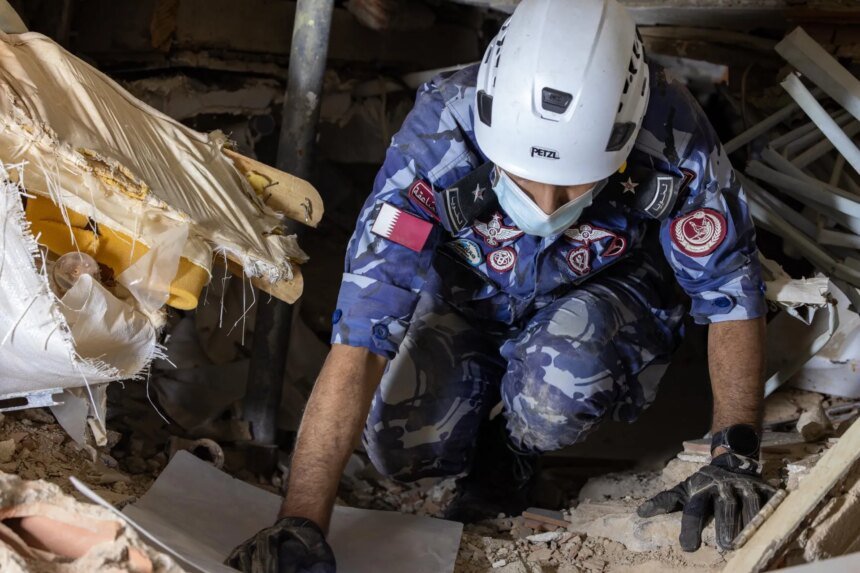
In the context of the same Arab response, Qatar sent a team from the Qatari International Search and Rescue Group, affiliated with the Lekhwiya Force, as part of a humanitarian air bridge to Venezuela, accompanied by medical personnel, a field hospital, and advanced equipment, to support rescue operations and medical support in the affected areas.
Qatari participation gains its importance from the nature of the work required in the first hours and days after the earthquakes, as the task is not limited to removing rubble, but rather includes identifying the locations of stranded people, securing corridors, providing first aid, and sorting cases that need urgent medical intervention.
According to the Qatari Ministry of Foreign Affairs, the air bridge came in support of international efforts aimed at rescuing those affected by the two earthquakes, while Anadolu Agency reported that the Qatari team is participating in the operation alongside the Syrian rescue team within joint field coordination.
In this mission, the country group provides an important aspect of technical and logistical support, including the necessary machinery and equipment to work amidst destruction, which is a crucial element in seismic disasters, when the ability to open a safe passage or lift a concrete block becomes the difference between life and death.
As for the Syrian team, its participation in Venezuela comes as a direct field rescue mission, as Syria sent a team of 15 search and rescue specialists, equipped with individual disaster response equipment, to participate in the operations of retrieving stranded people and supporting those affected in the stricken areas.
This is the first international mission of a Syrian search and rescue team outside the country, and is being implemented in coordination with the Qatari team, within the framework of humanitarian cooperation aimed at supporting emergency response operations after earthquakes.
The importance of Syrian participation is highlighted in the experience that rescue teams have accumulated while working in destroyed environments, as these tasks require precise operations that include manual searches, the use of light penetration equipment, stabilizing parts of damaged buildings, and reaching narrow spaces in which survivors may remain for hours or days.

The death toll from the two earthquakes that struck Venezuela on June 24 has risen to 1,943 people, while tens of thousands of survivors suffer from a severe shortage of food and shelter.
Two successive earthquakes measuring 7.2 and 7.5, the most violent tremors to hit Venezuela in more than a century, left tens of thousands missing, while health experts warned of the risk of epidemics following the disaster.