Published on 6/25/2026
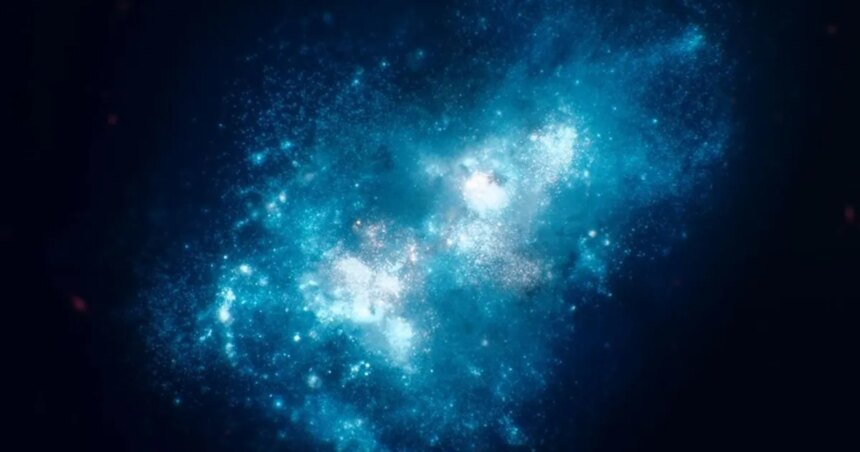
In a discovery that scientists described as impossible a few years ago, the Hubble Space Telescope was able to detect ultraviolet light emanating from a very distant galaxy known as MXDFz4.4, which appeared only about 1.4 billion years after the Big Bang.
This observation gives astronomers the first almost direct evidence of how the first galaxies helped clear the cosmic fog that filled the early universe.
Read also
list of 2 itemsend of list
The results of the study came in a research published on June 23, 2026 in The Astronomical Journal, led by researcher Elias Govarts from the Space Telescope Science Institute in Baltimore, USA, with the participation of researchers from several international institutions, relying on data from the Hubble Telescope, the James Webb Telescope, and the European Very Large Telescope.
The end of the era of cosmic fog
During the first billion years of the universe’s existence, the spaces between stars and galaxies were filled with neutral hydrogen gas that absorbed most of the ultraviolet radiation, making the universe resemble a dense fog that obscured vision.
Scientists call the stage that followed that the “Era of Reionization,” which is the period during which the matter between galaxies gradually transformed from an opaque state to a transparent one.

The galaxy MXDF-4.4 was at the end of this crucial transition, and Hubble showed that ionizing light from its young stars was able to penetrate the surrounding gas, allowing researchers to see signals that were not expected so early in the history of the universe.
“Observing a galaxy like this was thought to be impossible, because early hydrogen fog would have completely blocked this type of light,” lead researcher Elias Govaerts said in an official press release.
Super-impressive young stars
The data revealed that the galaxy contains very dense clusters of young, hot, and massive stars, which were formed during only a few million years before the time in which we see them today.
What is interesting is that this galaxy is about 100 times smaller than the Milky Way in terms of area, but it produces stars at a rate about ten times greater than what our galaxy currently produces. Researchers believe that this massive concentration of young stars enabled them to produce large amounts of ionizing radiation capable of penetrating the surrounding gas.

The science team estimates that between 50% and 100% of this high-energy light would have managed to escape into outer space. “Having a large number of young, hot stars in a small space makes them better able to make their way through the dark gas,” Govaerts says.
Giant stellar explosions resulting from the death of some of these stars also contributed to opening large gaps within the gas clouds, allowing more radiation to escape.
Hubble, Webb and European Telescope collaboration
Hubble was not alone behind this scientific achievement. The team also used data from the James Webb Telescope in the near-infrared range, in addition to data from the European Very Large Telescope (VLT) of the European Southern Observatory.
Webb telescope observations helped measure the mass of the galaxy and study its oldest stars and the history of star formation, while data from the European Very Large Telescope accurately determined its cosmic age, confirming that it existed only 1.4 billion years after the Big Bang.

Mark Rafelsky, deputy head of the Hubble mission at the Space Telescope Science Institute and one of the study participants, explained that astronomers have found many galaxies dating back to this era, but we have not observed ionizing photons from any of them before, which makes MXDF-4.4 a unique case.
The comparison between Hubble and Webb data also showed that star formation within the galaxy occurred in successive bursts, rather than continuously.
A new step towards understanding the origins of the universe
In 2023, observations by James Webb show that early stars were producing enough energy to heat and ionize the gas surrounding them. But the most important question remained unanswered: How was that light able to escape from within galaxies in the first place?
Today, the galaxy MXDF-4.4 provides the first direct evidence of a possible mechanism for this process. Scientists believe that discovering more similar galaxies may help paint a clearer picture of how the cosmic fog will dissipate and the universe will unfold as we see it today.
Researcher Alexandre Beckett from the Astrophysical Laboratory in Marseille, France, says that combining the capabilities of Hubble, Webb, the European Very Large Telescope, and advanced analysis software has enabled scientists to study this exceptional galaxy with unprecedented precision.
This discovery reveals that the greatest cosmic transformations may have begun within small, hidden, barely visible galaxies. By tracking photons that were emitted more than 12 billion years ago, man is a new step closer to understanding his first chapters in this vast universe.
It is a reminder that scientific research not only answers questions, it opens new doors of wonder, and gives us a renewed ability to explore the roots of our existence and our place in the grand story of the universe.