Published on 6/25/2026
|
Last update: 6/26/2026 21:26 (Mecca time)
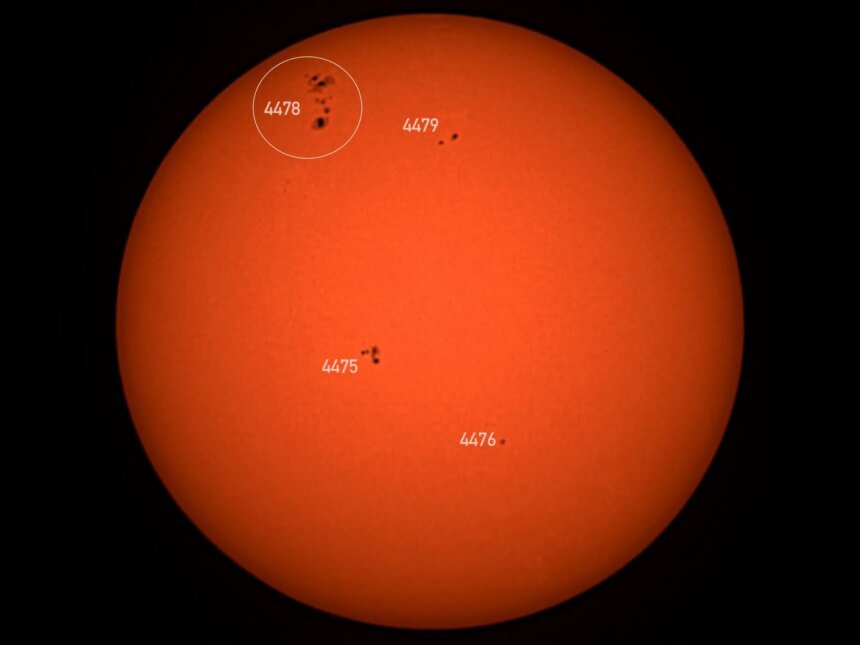
The sun is preparing to enter a new phase of activity with the appearance of a huge sunspot on the southeastern edge of the solar disk, in an event that attracted the attention of astronomers and observational enthusiasts around the world.
The first striking images of the new spot came from astrophotographer Maximilian-Vlad Teodorescu from Romania, who excitedly announced: “The wait is over!”

The appearance of the spot was not completely surprising to scientists, as the European Space Agency’s Solar Orbiter vehicle had been following it for several days as it crossed the far side of the sun, which is the invisible part of the Earth.
Read also
list of 2 itemsend of list
This advance observation allowed researchers to expect it to reach the side facing our planet within the current days.
Huge size and unusual behavior
The new sunspot is of exceptional size; Scientists estimate that the width of the group of associated spots is about ten times the diameter of the Earth, making it one of the most prominent active regions currently visible on the surface of the Sun.
Despite this enormous size, scientific observations indicate unexpected behavior. The X-ray detector aboard the Solar Orbiter spacecraft observed the region while it was on the far side of the sun, but did not record any powerful solar flares or large explosions associated with it.

This calm is remarkable, because large sunspots are often associated with complex magnetic fields that can lead to powerful flares and coronal mass ejections that affect the space environment surrounding Earth.
Therefore, scientists are closely monitoring the development of this region to see whether it will remain calm or become more active in the coming days.
What are sunspots?
Sunspots are temporary dark areas that appear on the surface of the Sun as a result of an intense concentration of magnetic fields rising from its interior.
These areas prevent part of the heat from reaching the surface, so the spots are colder than the surrounding areas and appear darker. The dark area in the middle is called the shadow, and the area around it is called the penumbra.
Despite its dark appearance, it remains very hot, as the average temperature of the shade is approximately 4000 degrees, while the average temperature of the penumbra is 5000 degrees.
Sunspots are one of the most prominent manifestations of solar activity, as they are often associated with solar flares and coronal mass ejections that may affect satellites, communications, and energy networks on Earth. They also follow an activity cycle that lasts on average for about 11 years.

The current active area is known as (AR4478) According to solar observation records. Sunspots carry serial identification numbers given to them by the authorities responsible for monitoring solar activity.
It is noteworthy that if the spot disappears behind the western edge of the sun during its rotation and then reappears about two weeks later from the eastern edge, it is given a new number even if the spot itself is still alive and active.
This tradition dates back to an era prior to the emergence of modern space observatories that today allow monitoring the far side of the sun that is not visible from Earth, so the historical numbering mechanism is still used to this day.
An easy opportunity to observe from the ground
Thanks to its large size, the spot is relatively visible even using simple and safe monitoring methods.
Observers confirm that specialized solar eclipse glasses provide a convenient way to view the spot, while optical projection methods allow a clearer view of details without looking directly at the sun.

Binoculars or telescopes can also be used by projecting onto a screen or white paper to see the shape of the spot more clearly, which is a popular educational method among amateur astronomers and public activities.
A number of astrophotographers in Europe have published additional images of the spot, including “Pepe Manteca” from Spain and “Thierry Legault” from France, providing diverse documentation of the development of the active region as it enters the direct field of view from Earth.
Scientific anticipation during the peak of the solar cycle
The appearance of this spot comes at a time when the Sun is still at the peak of its current solar cycle, which is the stage in which the number of sunspots, flares, and magnetic activity increases.
Scientists believe that monitoring such areas helps understand the mechanisms of formation of solar magnetic fields and predict space weather, which may affect satellites, communications networks, and navigation systems around the world.
Although the spot appears calm so far, the history of the sun shows that activity may change within just a few hours or days, making it a prime target for ground- and space-based observatories at the present time.