Published on 6/22/2026
Researchers have developed an ultra-light synthetic textile material inspired by the “fluffy” structure of cotton, but superior to it in its ability to regulate heat and resist moisture.
The innovation, prepared by a research team from the Thermochemistry Laboratory at the Dalian Institute of Chemical Physics in China, relies on polymeric fibers containing microcapsules of phase-change hydrocarbons, which allows the fabric to store heat or release it automatically depending on the temperature of the surrounding environment.
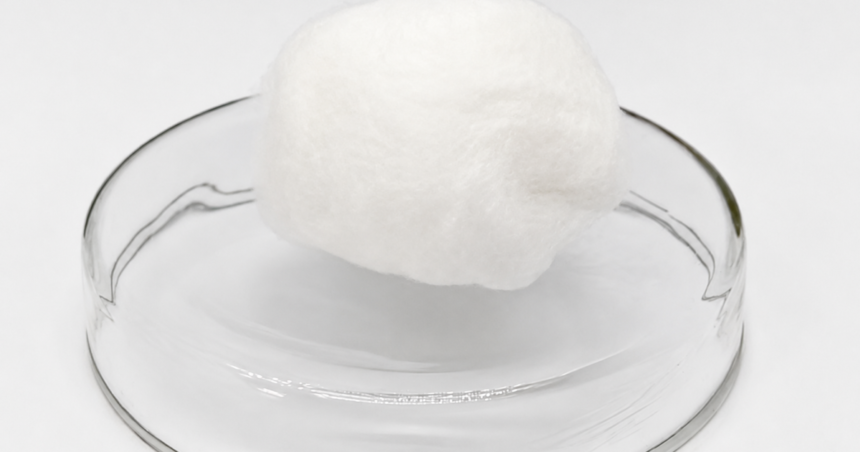
According to the study published in the journal ACS Energy Letters, in manufacturing the new textile material, researchers relied on constructing a highly porous three-dimensional fibrous frame inspired by the fluffy structure of cotton, to act as a lightweight, highly efficient support structure in trapping air.
This structure was then combined with microcapsules containing phase-change hydrocarbons, which were distributed within the fibrous network in a homogeneous manner that ensured its stability and non-leakage, while maintaining its effectiveness in storing and releasing heat.
This combination resulted in a material that can be formed into fibers or blocks similar to cotton, combining lightness, flexibility and high thermal insulation, along with an automatic ability to adapt to temperature changes without losing its mechanical or thermal properties.

Impressive results
Tests showed that the new material does not absorb water vapor or liquid droplets like cotton, and maintains its flexibility and strength even after repeated use and continuous bending.
In thermal experiments, it provided much greater warmth than cotton or traditional synthetic insulators at temperatures as low as minus 25 degrees Celsius, while allowing heat to pass through better in moderate climates, which helps prevent the feeling of overheating.
The results also showed that the fabric retains its properties even after 20 washing cycles, without loss of fibers, while regaining its original fluffy shape and maintaining about 97% of its ability to trap heat.
The researchers point out that these properties make the material promising for developing clothing designed for extremely cold environments that combines thermal insulation, comfort, and resistance to wetness at the same time.
The fabric also has a smart thermal adaptation feature. When the temperature rises, the phase change materials inside the microcapsules absorb and store heat instead of releasing it to the body, which helps prevent heat accumulation and the feeling of thermal suffocation. At the same time, the light porous structure allows part of the heat to pass away from the skin, which enhances ventilation and reduces the feeling of heat.