Published 21.41

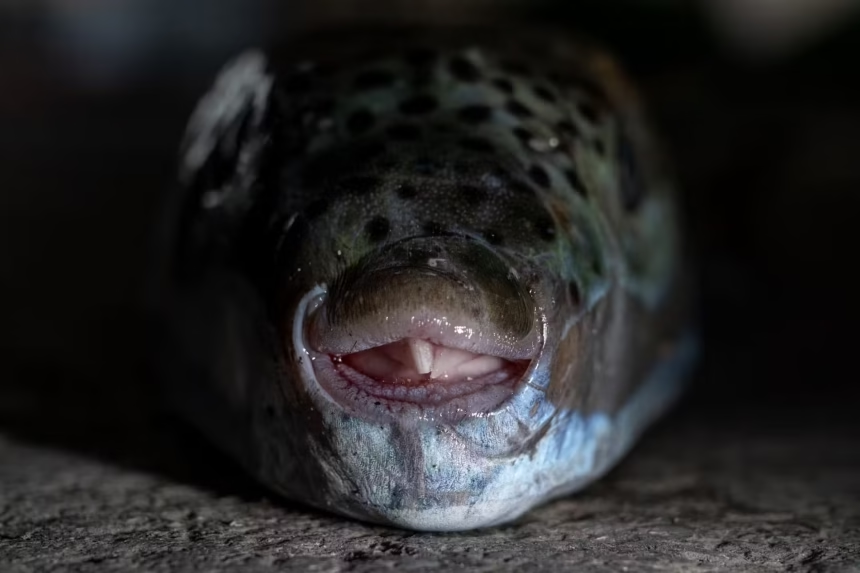
The silver-cheeked blowfish has attracted a lot of attention in the Mediterranean. In Greece, it has created unpleasant problems for bathers, several media reports.
But the risk of being attacked is extremely small, according to Gothenburg professor Kristina Snuttan Sundell.
The fish normally belongs to the Indian Ocean and has entered the Mediterranean as an invasive species via the Suez Canal. It has started to spread mainly in the southern parts – outside Greece, Cyprus, Egypt and Turkey.
– It is poisonous, so if you see one you should absolutely not poke it, says Kristina Snuttan Sundell, professor of zoophysiology at the University of Gothenburg.
Just like many pufferfish, the silver-cheeked – also called silver-striped – pufferfish contains the nerve poison tetrodotoxin. The poison is mainly found in the fish’s liver and gonads, but also in the skin. Because it blocks signals in nerves and muscles, even in low doses it can cause respiratory and heart paralysis and be fatal. But anyone who comes into contact with a fish does not have to suffer.
– If you touch it, a tingling and numbing sensation may occur, but it is not fatal, says Sundell.
Sharp teeth
According to reports in, among others, The Telegraph, the blowfish has bitten people. It has strong teeth because it feeds on clams, shells, sea urchins and other hard-shelled things. But Sundell doesn’t think it’s very likely that it would attack.
– Fish that feel threatened often try to swim away. But they can bite by mistake and some fish become aggressive if they have a mating territory to defend, she says.
In the last ten years, the species has greatly increased in number and spread westwards towards Italy. Above all, it affects fishing, AFP reports.
Swim the other way
She does not think that anyone planning a sun holiday in Greece or Cyprus needs to be afraid of swimming.
– But if you see it, you must absolutely swim in another direction and absolutely not touch it.
In Japan, poisonous puffer fish, so-called fugu, is considered a delicacy.
– But I don’t think you should choose blowfish from the menu. Possibly if you know it was prepared by a certified chef, says Sundell.
Blowfish
There are about 120 species of blowfish (Tetraodontidae), and some of them contain the poison tetraodotoxin, which is one of the strongest animal poisons known to us.
In Japan, blowfish is called fugu, and cooked as a dish it has been called the world’s most dangerous meal, or a gastronomic version of Russian roulette. Fugu chefs undergo a thorough training before they are licensed to prepare the dish. Among gourmets, the liver is prized the most, as it is the most poisonous (but forbidden by law to serve).
Silver-cheeked blowfish, Lagocephalus sceleratus, has approached us, coming to the eastern Mediterranean from the Red Sea via the Suez Canal. It is considered a delicacy, but the skin and some internal organs contain a neurotoxin that can cause muscle spasms if cooked incorrectly. The poison is not affected by boiling or heating.
Source: National Museum of Natural History