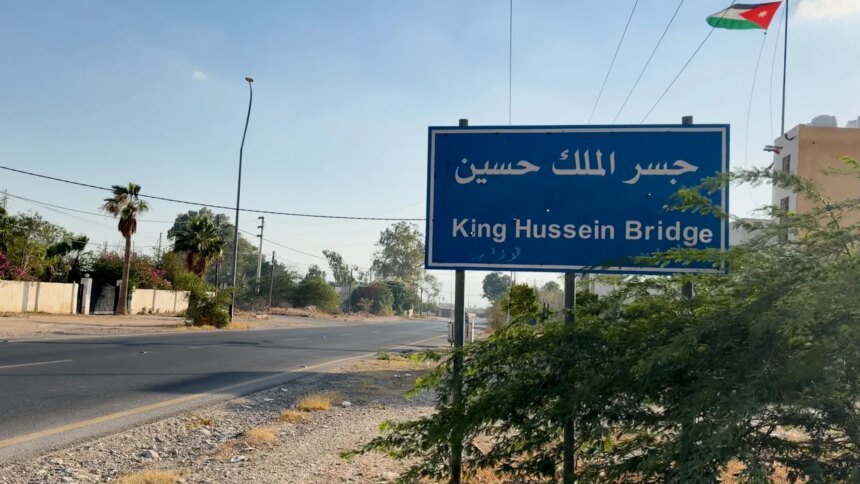
Oman – The Palestinian woman, Hanadi Al-Hamouri, did not expect that her trip to Jordan to receive treatment would end with a new infection instead of being a step towards recovery. While crossing the King Hussein Bridge (Allenby) weeks ago, she found herself in the midst of severe crowding and crowding among hundreds of passengers, before she suffered an injury that led to a fracture in her foot, according to her account.
She told Al Jazeera Net that she was heading to Al-Salt Hospital to complete her treatment journey, but the overcrowded conditions and long waiting hours turned the trip into a harsh experience that ended with physical injury and psychological effects that she still suffers from today. She added that she had filed an official complaint with the competent authorities in Jordan, demanding an investigation into the incident and the circumstances that led to it.
Al-Hammouri’s story summarizes part of the suffering of thousands of Palestinians who cross the King Hussein Bridge annually, as crossing it – for many – is no longer just an ordinary travel trip, but has turned into a stressful experience in which long waiting hours are mixed with procedural ambiguity, operational restrictions and sudden closures, in a scene that is repeated almost daily and worsens during peak seasons and summer holidays, due to Israeli measures.
With the escalation of complaints in recent weeks, the bridge issue has returned to the forefront of public debate in the Kingdom and Palestine, especially after the statements of Jordanian Interior Minister Mazen Al-Faraiah, in which he described the reality of services on the bridge as “garbage,” which sparked widespread interest as it is an official recognition of the extent of the crisis that travelers experience on a daily basis.

A single access to the world
For most Palestinians in the West Bank, the King Hussein Bridge represents not just an ordinary border point, but a vital artery connecting them to the outside world.
Travelers who refused to reveal their photos and names – to Al Jazeera Net – for fear of obstructing their future trips by the Israeli occupation, say that the available seats run out in a very short time, which prompts many to postpone their plans, change their travel dates, or remain stranded outside their country for long periods.
Although the electronic platform was created with the aim of organizing travel and reducing congestion, a number of them believe that it has become part of the problem instead of being part of the solution. The traveler who succeeds in obtaining an advance reservation does not necessarily guarantee a smooth trip, as new suffering begins upon arriving at the bridge area.

The testimonies of a number of them indicate that there is a long series of repetitive procedures and various checkpoints, as the traveler passes through several stations to verify the reservation, deliver the luggage, and obtain the required forms.
The most prominent reasons for the bridge crisis – in their opinion – are due to the randomness of the procedures of the Israeli occupation authorities in determining working hours and opening the crossing, in addition to sudden closures or disruption of work on specific days, including Saturday and other days when it was decided not to operate the bridge.
They explain that these measures lead to crowding of travelers, including those who have made advance reservations through the platform, in a very hot area, with long waiting hours that increase their suffering. Officials confirm that this reality restricts the ability of the Jordanian and Palestinian sides to organize transit movement efficiently, and makes addressing the crisis essentially linked to obligating the Israeli side to clear and regular working hours.

Testimonials
For her part, Palestinian Naila Mazahra, who lives in the UAE, describes her trip across the bridge as one of the most stressful travel experiences. She told Al Jazeera Net that she arrived on time according to the electronic reservation, but she was surprised by severe crowding and complicated procedures, in addition to being forced to carry her luggage over long distances due to the lack of luggage transport vehicles.
She recounts that she saw elderly people and children standing in the rain for long hours, while some of the elderly were suffering from extreme exhaustion as a result of standing and pushing. She adds that the closure of the crossing after hours of waiting forced her to return to the capital, Amman, and spend an additional night there before trying again the next day, bearing additional financial costs and more psychological and physical exhaustion.
As for Muhammad Mazen, one of the travelers who tried to return to the West Bank, he told Al Jazeera Net that he spent long hours waiting before the passengers were informed that the permitted number had been completed, which forced them to return without crossing. He stressed that this type of delay not only affects the comfort of travelers, but also causes direct financial losses as a result of the costs of accommodation, transportation, and changing appointments.

Luggage transportation services constitute one of the issues most raised by travelers across the King Hussein Bridge, as many complain of being subjected to pressure that forces them to use porters due to the long distances and the difficulty of transporting luggage, especially for the elderly, the sick, and families accompanying children.
Travelers say that some porters charge high amounts for transporting luggage, while others feel that they face additional difficulties if they try to transport their bags themselves or refuse to use this service.
Some of them also talked about cases of delay in delivering luggage or difficulty finding it after its arrival, which raises their fears of losing the bags or losing their contents, and increases the state of stress and anxiety that accompanies the transit journey. Travelers demand that designated vehicles be provided for transporting luggage, and that the work of porters be regulated and subjected to clear oversight that ensures fair service provision and preserves the rights and dignity of travelers.

Clarification by the Jordanian authorities
On the other hand, the Jordanian Ministry of Interior confirms that the bridge has a different privacy than traditional border posts.
Interior Minister Mazen Al-Faraya indicated that working hours and the number of passengers allowed to cross are largely subject to the measures of the Israeli side, including sudden closures and reducing operating hours. He stressed that the government is implementing infrastructure development projects that include new waiting halls, canopies, and service facilities, in addition to projects to expand shipping and transportation facilities and improve the work environment at the crossing.
The minister rejects the accusations of mistreatment of passengers, stressing that Jordan views the bridge as a humanitarian corridor and deals with the issue from this standpoint.

During a meeting in Amman, Palestinian Interior Minister Ziad Hab Al-Rih and his Jordanian counterpart, Mazen Al-Faraya, discussed ways to improve travel across the King Hussein Bridge and alleviate the suffering of travelers, stressing the continuation of joint coordination to increase working hours and the number of passengers allowed to cross.
The two sides agreed to hold a joint field meeting on the bridge next Thursday to follow up on the situation on the ground and evaluate the measures taken to enhance the flow of movement and improve the services provided to travelers, while Hab Al-Rih reviewed with the authorities working on the bridge the procedures and facilities aimed at improving waiting conditions and organizing transit traffic.
In turn, Jordanian MP Muhammad Jamil Al-Dhahrawi told Al-Jazeera Net that the bridge crisis reached the office of Jordanian Prime Minister Jaafar Hassan, who pledged to follow up on the file and work to find solutions to the challenges facing travelers as soon as possible, indicating that Al-Faraiya will follow up on the issue directly.

Bridge crisis factors
Researchers and specialists believe that the bridge crisis cannot be reduced to the operational aspect only. According to estimates and specialized studies conducted by the Jordanian Institute of Politics and Society and monitored by Al Jazeera Net, the crisis is the result of the intersection of political, administrative, and logistical factors simultaneously.
These estimates indicate that the restrictions imposed on working hours and the crossing’s capacity constitute one of the most prominent causes of frequent congestion, while management, service and infrastructure problems contribute to doubling the effects of these restrictions on the lives of travelers.
It also points out that the lack of basic services and the absence of effective organization in some stages opens the way for exploitative practices, the cost of which is directly borne by the traveler.
Amid the continuing crisis, demands are increasing for immediate measures to alleviate the suffering of travelers. It includes increasing operating hours, expanding capacity, improving queue management, providing special paths for the elderly, sick and children, in addition to reviewing electronic reservation mechanisms and simplifying bureaucratic procedures.

The coordinator of the “Our Right to the Bridge 24/7” initiative, Palestinian activist Amin Annabi, told Al Jazeera Net that the initiative presented a set of practical proposals to alleviate the travel crisis across the King Hussein Bridge, including establishing a reception hall for travelers, developing work mechanisms and services, reorganizing the electronic reservations system, and improving baggage handling procedures, in addition to working to extend the bridge’s operating hours to reach working around the clock.
He explained that these measures would reduce congestion, improve travel conditions, and preserve the dignity of Palestinian travelers.
Annabi held the Israeli authorities primarily responsible for the aggravation of the crisis, due to the restrictions and procedures imposed on transit movement, stressing that addressing the problem requires at the same time that all concerned parties carry out their responsibilities within the scope of their powers, and strengthen Palestinian-Jordanian coordination, in addition to intensifying political and diplomatic efforts to pressure to remove obstacles that hinder the freedom of movement of Palestinians.