Al Jazeera correspondents
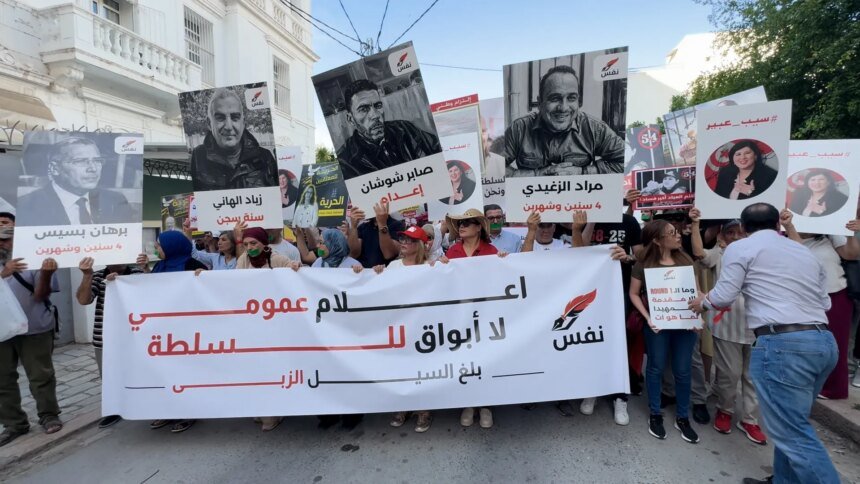
Tunisia- A silent march organized by dozens of politicians, human rights activists, and activists, today, Friday, in the heart of the capital, Tunis, brought back scenes of protest movements that had declined during the recent period, in order to denounce what they described as increasing restrictions on public freedoms, and to demand the release of political detainees and the cessation of Decree 54.
The march witnessed the presence of parties from different political movements, including the Ennahdha Movement and figures from the Democratic Constitutional Family, in a rare rapprochement between parties that had been in deep disagreement for years, but this time they met on issues related to public freedoms and the independence of the judiciary.
The leader of the Ennahda Movement, Imad Al-Khamiri, told Al Jazeera Net that this movement expresses a collective feeling of a decline in freedoms and a narrowing of the public sphere, indicating that the expansion of participation reflects growing anxiety about the political situation. He added that the protesters are demanding the release of political detainees and the cessation of Decree 54.

Rejection message
Last September, President Kais Saied issued Decree 54 regarding crimes related to communication and information systems, imposing penalties on those spreading rumors and false news, in a move that raised widespread concern among journalists and human rights activists.
For her part, human rights activist Naila Al-Zaghlami considered that the march represents a message of rejection of what she considered to be continued restrictions on various groups of society, saying – to Al Jazeera Net – that “everyone is feeling the weight of these circumstances and the increasing restrictions on freedoms.”
These moves come in light of an ongoing controversy regarding the status of freedoms in Tunisia, at a time when the authorities are facing criticism from human rights organizations and opposition parties due to the prosecutions and arrests of politicians, journalists, and activists in recent years, while the authorities confirm that these measures are taking place within the framework of enforcing the law and protecting state institutions.
The state of tension extended to professional sectors, as the recent period witnessed protest movements by lawyers who carried out strikes to demand ensuring the independence of the judiciary and improving working conditions within the courts. The Tunisian Judges Association also expressed its rejection of what it considered an attack on the independence of the judiciary.
Different moves
The protests were not limited to political affairs, as the country has been witnessing social and trade union movements for months against the backdrop of difficult economic conditions, high costs of living and declining purchasing power, in light of the continuing disagreements between the government and the Tunisian General Labor Union over wages, social dialogue and economic reforms.
The participants in the march chanted slogans denouncing what they described as the Ministry of Justice’s control over the judicial facility, including “Freedom, freedom, oh judiciary of instructions.” They also expressed their rejection of what they considered to be an escalation in the pace of prosecutions against opponents, chanting slogans against repression and tyranny.
The march traveled through the streets of the capital, Tunis, reaching the headquarters of the chemical complex, where the protesters raised environmental demands, especially regarding the right of the residents of Gabes Governorate to a healthy environment, in protest against “toxic gases emanating from the chemical complex located in the region.”
Expansion of discontent
In this context, political activist Ahmed Al-Ghiloufi told Al-Jazeera Net that “the street has begun to regain its vitality after the worsening economic and social crises and the escalation of what many consider to be manifestations of restrictions,” stressing that the increase in protests reflects the expanding state of discontent among Tunisians.
Observers believe that the importance of this march is not measured only by the number of participants, but also by the nature of the forces that came together during it and its coincidence with escalating professional and social movements.
While the authorities confirm their adherence to their political options, indicators of tension appear likely to continue in the absence of a comprehensive dialogue capable of absorbing the accumulated differences and responding to demands related to freedoms and living conditions.