Gaza- In Gaza, wills are not written for the living alone. Here, where loss intersects with memory, a person may find himself writing his will because he fears loss more than himself.
In a moment of displacement filled with fear, Omar Hamad sat writing down short words that he addressed to his books, as if he was bidding farewell to a living part of his soul. It was a final attempt to protect what remained of written memory, in a place where things quickly dissipate.
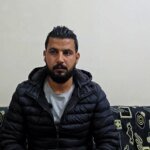
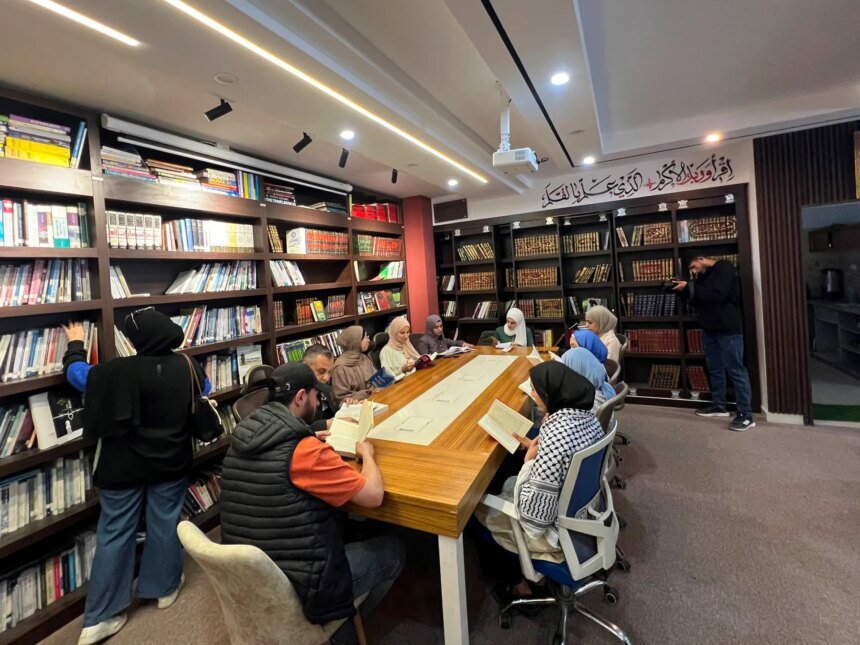
At the opening of the “Phoenix” library in Gaza City, the day before yesterday, Tuesday, books were quietly lined up on wooden shelves that had been painstakingly collected in a sector where the necessities of life had been depleted, and between those shelves, the founder of the library, Omar Hamad, seemed drawn to his books, which had been displaced with him 13 times, before they finally found a place to settle.
The young Gazan man opened his arms towards the shelves and said: “They are part of my personality, my being, and my soul, and finally I have given them a special place that suits them.”

The library is an act of resistance
During the war of extermination on Gaza, the relationship between man and books entered a very harsh phase, imposed by the daily conditions of survival in light of the lack of fuel and the intensification of the siege. Paper became a means of lighting fires, and books arrived on the sidewalks to be sold by the kilo, after they had been acquired for reading and knowledge.
This scene bears a painful indication of the extent of the disruption that has befallen people’s lives, when the tools of awareness are relegated to the status of urgent needs under the pressure of hunger, cold, and fear.
One of the participants in establishing the library, Hossam Hamad, says that the opening of the library carried a meaning that transcended the boundaries of the place, as it reflected the presence of a segment of society that still clings to culture and knowledge despite the weight of reality.
In Gaza, opening a scientific library becomes a cultural act of resistance, and a conscious attempt to keep the mind present in the face of circumstances that exhaust a person and put pressure on his awareness and daily life.
The Phoenix Library seeks to deliver real and honest knowledge that reflects the image of the people of the Gaza Strip and their role in society, at a time when Palestinian culture and history are under constant attack.
In this context, the book acquires a function that goes beyond reading, as it turns – as Omar describes it – into a psychological therapist that opens a window to a broader reality, and gives the reader a space in which to breathe away from the pressure of war.

Gazan literature is dominated by 6,000 books
Today, the library includes more than 6,000 books, ranging from scientific, linguistic, journalism, media, education, management, accounting, and economics in Arabic and English, in addition to books on medicine, mathematics, law, and history.
It also contains major books on jurisprudence and hadith sciences, series of authentic hadiths and their explanations, books on the sciences of the Qur’an, interpretations and doctrine, as well as Arabic literature translated from several languages, including Spanish, English, French, Russian and Japanese, in addition to Arab and international novels, Palestinian literature in general, and Gazan literature in particular.
It does not miss books on politics, sociology, social service, and human development, in an attempt to create a comprehensive library that addresses various readers and serves all segments of society.
However, this diversity did not form easily. In a city still under the weight of war, books arrived at an exorbitant cost, amid high prices and difficulty obtaining them.
However, individual initiatives and donations made by citizens for the souls of the martyrs contributed to supporting the establishment of the library, making the Phoenix the result of a collective effort, in its details, carrying a clear insistence on protecting knowledge amidst this devastation.
Books recovered from under the rubble
In the context of expanding its impact, the idea of free lending came in response to a stifling economic reality that limits the ability of many to access books. Hossam Hamad says: “We seek to be a constructive resource for members of society, even to a small extent, by making knowledge available to those who need it and cannot find a way to it.”
The library also includes a remarkable collection of books that were rescued from destroyed libraries. Scientific, historical and cultural, in addition to a special collection on the history of Gaza, including a rare collection entitled “The Museum of the Glory in the History of Gaza”, which arrived at the library as a donation from the family of one of the martyrs, to form an important part of the attempt to preserve the historical narrative of the city.
Those in charge of the library confirm that the books that received contributions about the souls of the martyrs constituted a primary motivation for its establishment, and contributed to enabling it to continue and expand its content, while the other part was provided through the acquisition of books at high costs, in light of the scarcity of resources and the high prices during the war.

Reading is a long-awaited freedom
With its opening, the library attracted patrons who saw it as more than a place to read. Nuniyaz Abu Ras (21 years old), a computer systems engineer and one of the first visitors to the library, says that the presence of this place at a time burdened with all this devastation opens a door to hope.
She believes that knowledge and writing are a “limitless weapon,” and that once a person begins reading and writing, he approaches a long-awaited freedom.
She adds that much is stolen from people in war, but thought remains the deepest space that remains difficult to confiscate, and preserves a person’s belonging, awareness, and connection to himself.
In a tone mixed with certainty and appreciation, Nuniyaz believes that the emergence of a place like this in Gaza remains a present possibility as long as there are people full of knowledge and will there.
She says that places are not made by walls alone, but are also made by people who carry this amount of meaning in their hearts, and who give knowledge a place to reside, even in the midst of rubble.

A window to connect with the world
Nuniyaz recalls her relationship with books during the war as a relationship that became deeper and more urgent. She is, as she describes herself, a lover of knowledge in all its forms. In video and audio clips, and in books in particular.
The war gave many people excess time to read, and the internal need for knowledge increased, at a time when access to paper copies became more difficult, and the longing for paper, ink, and the feel of pages increased.
Hence, the presence of a library like Phoenix seemed to her to be a particularly comforting experience, because it restores both her sensory and emotional presence to reading.
When Nuniyaz talks about reading during wartime, she sometimes sees it as a light respite, like a novel that puts a smile on faces in the midst of harsh days, and at other times she sees it as a door that leads to a deeper awareness of reality, and a source of knowledge that people need in their daily battle to persevere and try. In both cases, reading gives a valuable sense of connection to the world, a feeling that many in Gaza sought to cling to through any possible outlet.

A quiet space to meet and read
As for Nilofar Abu Ras (25 years old), she describes her first entry into the Phoenix Library as if she were crossing from the noise outside to a quieter and more spacious space.
She says in a tone that mixes discovery with amazement: “I did not understand the idea of the library… What we found was much greater than our expectations.”
She paused at a special moment between the shelves when she found a novel bearing her name, saying with a slight smile: “It was a strange and beautiful feeling at the same time.”
From that moment on, the place became for her a constant space for meeting and reading, which she describes as a “quiet and elegant place” that brings together people whose interests intersect, and gives them a feeling of comfort and belonging.
Niloufer talks about the impact of reading on her amid the pressures of daily life. She says: “As a person, I have many responsibilities. Whenever I start reading, I forget everything again,” noting that the library gave her a real opportunity to return to this feeling.

Escape to the “Phoenix”
The young Gazan woman believes that the role of “The Phoenix” goes beyond culture to the psychological aspect, in light of what the people of Gaza are experiencing, adding: “When you get lost among books, you forget everything… you come back to remember the sweetness of reading.”
Speaking about reading during wartime, Nilofar says that it gave it an existential meaning that is related to life itself. After the hardship people experienced in moving under the pressure of hunger and harsh conditions, reading comes to bring a person back to himself, and reminds him that knowledge is one of the most important things that helps him advance and develop himself.
From a will that was written to books that were abandoned out of fear, to shelves that were filled again, the story stretches like a thin line between loss and hope, and in each book a small space is opened and consciousness is restored, a window opens for salvation, and a memory that insists on survival. In Gaza, life may be narrow with everything in it, but one page is sometimes enough to keep a person alive.