Gaza – In Gaza, the journey of a bag of blood begins from the arm of a donor, then passes through a precise series of examinations, separation and preservation, before it reaches a patient waiting for it in an emergency department, treatment bed, or chronic diseases unit.
Between the donor, the blood bank, and the patient, this trip reveals the extent of the pressure the health system is experiencing, as units of blood and its components have turned into an urgent daily need with the increasing number of wounded and sick.
Youssef Abu Halabiya treats blood donation as a fixed appointment and a humanitarian duty that he undertakes every 3 months, believing that every unit of blood he provides may reach a wounded or sick person who needs a new chance at life.
Youssef says: “The moment of donation gives me a deep feeling of belonging to my people, amid daily bleeding and increasing need in hospitals.” He adds that donating blood has become for him a national and humanitarian contribution at the same time, through which he feels close to the sick and wounded and actively participates in supporting them.
During the period of famine, Youssef experienced a severe feeling of grief as his ability to donate declined as a result of his poor physical condition and lack of food. This is an experience that made him realize that the donor needs a degree of strength in order to be able to support others.

The only device in the Gaza Strip
Inside the blood bank at Al-Shifa Medical Complex, Taghreed Al-Dalu, head of the blood separation department, explains the next stage of the blood unit’s journey after it leaves the donation department. One bag, as she explains, can be transformed into more than one component that serves more than one patient, by inserting it into the centrifuge according to a specific protocol, in preparation for separating it into concentrated blood, plasma, and platelets.
The centrifuge represents the backbone of the work in the blood separation department, as it became available for this task after the northern Gaza Strip had 4 machines.
The effects of war appear in the daily work details. The door of the device is opened and secured with a piece of cork to support it and prevent its sudden closure, after the hospital was subjected to a burning and siege that damaged the structure and equipment.
Describing the amount of pressure on one device, Al-Dalu says: “We are faced with two options: either stop the service or put intense pressure on the employee in the task of serving the patient and providing a helping hand to everyone.”

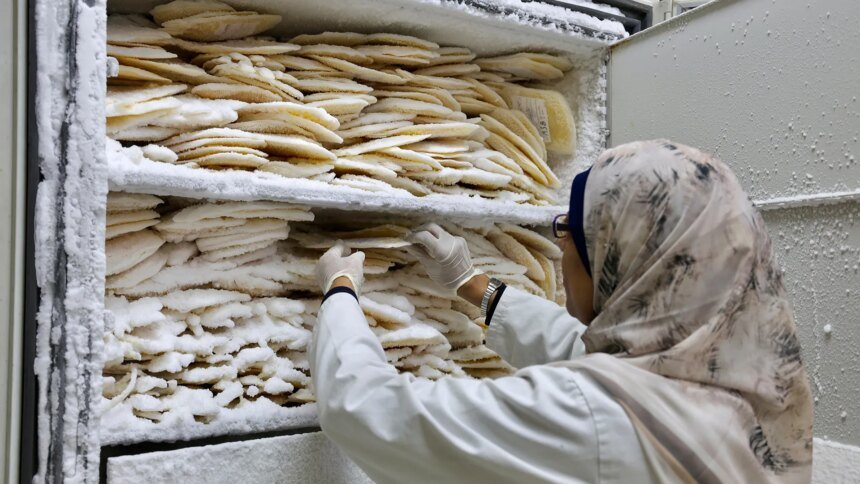
After the separation process, the blood components are preserved pending the release of the results of the Virus Department, then the plasma is transferred to the only remaining freezer in the department, at a temperature ranging between 70 and 80 degrees Celsius below zero.
Al-Dalu recalls the extent of the loss that befell the blood bank, as the hospital included 12 freezers containing a surplus of plasma exceeding 5,000 units, which was lost during the war on Gaza and with the cessation of the electricity supply that these devices need for continuous operation.
As for the units being tested for viruses, they are kept for 24 hours in a freezer divided into drawers according to blood types, such as A+, A-, AB, O+, and O-. This stage is of special importance, because the blood components separated in this way are available in Al-Shifa Hospital due to the presence of a centrifuge in it.
After the test results are issued, the units are transferred to the daily storage freezers, where they are arranged according to the date of donation and the type of species, in preparation for their delivery to departments and patients according to medical need.

40% of business declined
Dr. Wael Al-Laithi, head of the blood bank department at Al-Shifa Hospital, says that before the war, the department constituted about 40% of the Ministry of Health’s blood stock, and it received between 1,200 and 1,500 units of blood from donors monthly, which made it one of the most important centers for supplying blood and its components in the Gaza Strip.
With the war, this role declined as the hospital lost most of the components of health and therapeutic work, and the laboratory was damaged and its equipment was lost, which was directly reflected in the ability of the blood bank to receive donors, examine units, and provide them to patients.
Al-Laithi points out that the shortage of laboratory equipment has become one of the most prominent challenges, especially the gel testing device for blood units, which prompted crews to resort to manual testing to ensure continuity of service.
He also describes the electricity crisis as the biggest challenge facing blood banks, as blood units and their components need refrigerators and freezers that operate around the clock, and any power outage threatens to damage the stock and lose valuable units in light of the current pressure.
He adds that the hospital witnessed periods when the patient or his family were required to search for a donor themselves, in one of the harshest forms of crisis within the health system.
Al-Laithi recalls among the most difficult situations the case of a thalassemia patient who came to the hospital at a time when blood supplies were almost depleted, which reveals the fragility of the situation for patients who need frequent blood transfusions to survive.

Drawing blood without procedures
The head of the blood bank department at Al-Shifa Hospital explained that accepting a donor in normal circumstances is subject to strict health conditions, most notably that he is in good health and free of diseases, and that the blood percentage is above 13 for men and 12 for women, with an initial examination and measurement of vital signs in order to preserve the safety of both the donor and the patient.
During the war, the urgent need for blood imposed an exceptional reality on the department, as crews were sometimes forced to withdraw blood units before completing the usual initial examinations, amid the pressure of injuries and the deterioration of the nutritional status of many donors.
In light of the increasing need for blood during the war, community campaigns emerged aimed at supporting blood banks and enhancing their stocks, at a time when hospitals faced mounting pressure due to the number of wounded and sick, which was reflected in the volume of demand for some initiatives that achieved remarkable results.

In numbers: the collapse of blood banks since October 7
Deeb Jumaa Al-Rai, head of the Primary Care Laboratories Department in the Laboratory and Blood Banks Unit, and supervisor of the external blood donation campaigns project, explains that donation campaigns are organized at a high monthly rate in the governorates of the Gaza Strip, with between 25 and 30 campaigns being implemented per month, in an attempt to cover part of the increasing need for blood and its components within the facilities of the Ministry of Health.
Al-Rahi points out that the number of blood units withdrawn through the Ministry of Health facilities and external campaigns ranges between 3,000 and 3,500 blood units per month, while the volume of blood components dispensed is between 5,500 and 6,000 units per month, which reveals a clear gap between the quantities that are provided and the size of the actual need within hospitals.
He confirms that the negative types remain the most in demand, most notably the O- blood group, which blood banks suffer from a severe shortage, as a result of the high demand for it in emergency situations and the large number of infections, as it is one of the types that are quickly resorted to in critical cases.
According to data from the Palestinian Ministry of Health on the occasion of World Blood Donor Day, the numbers of blood banks in the Gaza Strip during the period extending from October 7, 2023 until December 31, 2025 reveal the extent of the pressure to which the blood system and its derivatives were exposed during the war. The number of blood banks operating in the sector declined from 14 banks before the war, including 11 banks affiliated with the Ministry of Health and 3 banks affiliated with the Blood Bank Association, to only 5 banks after the war, including 4 banks affiliated with the Ministry of Health and one bank affiliated with the Blood Bank Association.
Statistics indicate that the volume of blood donations in the blood banks of the Ministry of Health and the Blood Bank Association amounted to 101,664 units, while the volume of disbursement of blood units and its derivatives amounted to 217,324 units, which reflects a large gap between what is available and what is required.

Over the years, the number of units of blood and its derivatives dispensed reached 75,046 units in 2022, compared to 39,184 units drawn, and the expenditure rose in 2023 to 84,435 units, compared to 55,065 units drawn. In 2024, 66,099 units were disbursed against 33,155 withdrawn units, while 2025 witnessed the highest level of disbursement at 115,382 units against 56,177 withdrawn units.
In the context of the field response, 194 blood donation campaigns were implemented in partnership with Medical Aid for the Palestinians (MAP), in addition to 160 donation campaigns implemented by the Blood Bank Association.
Blood banks also received external support to enhance their stocks, which included 19,035 blood units and more than 12,000 plasma units from the West Bank under the slogan “Our Blood is One,” in addition to more than 6,000 blood units from the Hashemite Kingdom of Jordan.
These numbers provide a condensed picture of the reality of blood banks in Gaza, as the decline in the number of operating banks coincided with the high demand for blood and its derivatives, and the continued need of the wounded and sick, especially those with chronic diseases and conditions that require frequent blood transfusions, for safe and timely blood units.