


Published On 9/7/2026
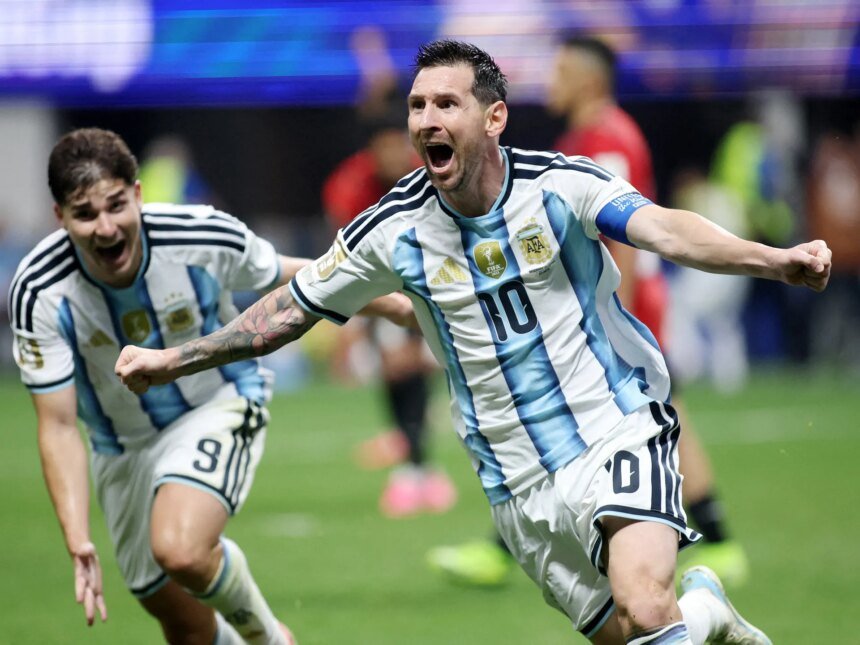
Argentina continues its journey in the 2026 World Cup in search of maintaining its title, but its path was not as easy as some expected, as the team needed difficult victories in the qualifying rounds, most notably the victory over Egypt with a score of (3-2) after falling behind by two goals.
But the Pharaohs’ confrontation did not end only on the field, as it opened the door to controversy after the Egyptian side’s protests against the arbitration decisions, accusing it of preferential treatment in favor of the world champion and its first star, Lionel Messi.
Read also
list of 2 itemsend of list
Is there evidence that Argentina has benefited arbitrarily?
It is easy to understand the Egyptian team’s anger after the dramatic exit, after they were ahead (2-0) with only 11 minutes left in the match, before Argentina turned the score around and scored the winning goal in stoppage time.
The Egyptian Federation considered that the decisions of French referee François Letexier and his crew affected the outcome of the match, especially after canceling a goal by Mostafa Zico following the intervention of video technology (VAR), in addition to calling for two penalty kicks before Enzo Fernandez’s decisive goal.
Zico’s goal was canceled due to a foul being awarded to Marwan Attia after he intervened on Lisandro Martinez at the beginning of the attack, a shot that sparked controversy, but it came at a time when Egypt was ahead by one goal, and was able to score a second goal later.
As for penalty kicks, Egypt protested Mohamed Salah’s challenge with Julian Alvarez, in addition to Hamza Fathi’s shot with Alexis McAllister, but the replays did not prove that there was a clear violation that required a penalty kick. Although some decisions were debatable, they do not provide evidence of a conspiracy or deliberate preference for Argentina, according to the analysis.
An all-Argentine refereeing team against France
The controversy returned again after Argentine referee Facundo Tio was appointed to manage the confrontation between France and Morocco in the quarter-finals. For the first time in the 2026 World Cup, the entire refereeing team will be from one country, as it includes the main referee, his assistants, the fourth official, and the reserve referee from Argentina.
Some believe that this decision may raise questions due to Argentina’s presence in the tournament, and the possibility of it facing France or strong teams later, even though referee Tew is one of the well-known international referees and it will not be in his interest to influence any match.
Messi’s shot and a red card were not counted
Among the cases that brought back talk about Messi’s benefit, it goes back to a snapshot during the group stage against Algeria. Messi interfered with Algeria’s captain, Issa Mandi, in a shot that some considered worthy of a red card after reviewing the video, but he did not even receive a yellow card.
This came days before American Folarin Balogun was expelled against Bosnia in a similar incident after video technology intervened. If Messi had been sent off against Algeria, he would have missed subsequent matches, which would have prevented him from scoring five of his eight goals in the tournament so far.
Do Argentina receive fewer cards compared to their mistakes?
The figures show that Argentina committed a greater number of fouls than some rivals, but received fewer cards. Argentina received one yellow card for every 19.7 violations it committed.
On the other hand, England received a card for every 7.7 violations, making it one of the teams most exposed to penalties compared to the number of errors. These numbers indicate that Argentina may have benefited disciplinary wise compared to some teams, although the interpretation of this remains linked to the nature of the violations and the referees’ decisions.
The World Cup path seems less difficult
Another aspect that has sparked debate concerns Argentina’s path in the tournament. After amending the lottery system, the top four teams in the FIFA classification (France, Argentina, Spain and England) were placed in different sides of the table, to avoid early confrontation.
After topping its group, Argentina found itself on a path that allowed it to avoid the major teams until the final rounds. In the first two elimination rounds, Argentina faced Cape Verde and Egypt, before facing Switzerland in the quarter-finals, which are lower-ranked teams than some of the other competitors. On the other hand, Spain faced more difficult matches against Portugal and Belgium, while France faced Morocco, ranked seventh in the world.
Penalty kicks…a continuous advantage?
Since its victory in the Qatar 2022 World Cup, Argentina’s name has been associated with a large number of penalty kicks. During the 2022 edition, it won five penalty kicks, which is a record in the history of the tournament, and in the 2026 World Cup it also tops the list of teams that have taken the most penalty kicks with three so far.
But Lionel Messi missed two of those kicks against Austria and Egypt. While there is no evidence to prove that there is a deliberate preference for Argentina, the combination of several factors, from controversial refereeing decisions to the card numbers and the course in the tournament, put Messi’s team under discussion during the 2026 World Cup.