

Published On 9/7/2026
|
Last update: 19:48 (Mecca time)
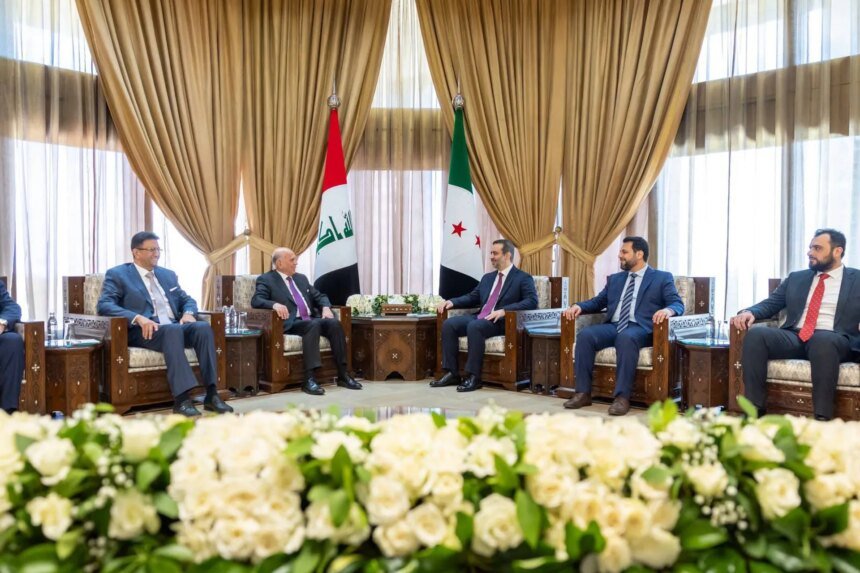
The visit of Iraqi Foreign Minister Fuad Hussein to Damascus at the end of last month opened the door to a new phase in relations between the two neighboring countries, primarily through political, security, and economic interests.
The visit, in which the Iraqi minister met with Syrian President Ahmed Al-Sharaa and Foreign Minister Asaad Al-Shaibani and Energy Minister Muhammad Al-Bashir, was not limited to presenting general headings for the frameworks of new relations, but rather discussed specific steps, and resulted in an agreement to form a joint committee in the fields of energy, agriculture, water, transportation, and border crossings.
Accelerated convergence
The visit was the culmination of a gradual path of rapprochement between Damascus and Baghdad over the past months. Among its most prominent recent indicators is the letter sent by Iraqi Prime Minister Ali Faleh al-Zaidi to President Ahmed al-Sharaa, and carried by the head of the Iraqi Intelligence Service, Hamid al-Shatari, on June 10, including an emphasis on strengthening economic and security cooperation.
On the ground, talk began about hundreds of Iraqi oil tanks crossing daily through Syrian territory, as part of an Iraqi plan to raise the quantities to about 50,000 barrels per day, in parallel with the restarting of the Al-Yarubiyah-Rabiaa, Al-Tanf-Al-Walid, and Al-Bukamal-Al-Qaim crossings, to enhance transit and trade movement between the two countries.
Geography and economic integration
This movement between Damascus and Baghdad, if it continues “within an institutional framework and turns from mere political meetings to executive agreements,” could constitute a starting point for rebuilding economic relations between Iraq and Syria, according to what Iraqi economic expert Ali Daadoush believes.
In an interview with “Syria Now”, the same speaker considered that geography imposes a kind of economic integration between the two countries, as Iraq represents an important outlet for the flow of goods and energy, while Syria constitutes a strategic corridor towards the Mediterranean Sea and regional markets.
Syrian economic academic Imad al-Din al-Musabeh agrees with the possibility that the recent diplomatic movement constitutes “a serious entry point for rebuilding economic relations, because official movements have now clearly linked security, opening crossings, revitalizing trade, and energy pathways.”
Al-Musabah added to “Syria Now” that this return is not only read as a bilateral improvement in relations, but rather as “a gradual revival of a natural economic space linking Iraq to the Levant via land borders and sectoral committees concerned with trade, energy, oil and water resources. In 2010, trade exchange numbers between the two countries were close to two billion dollars, which means that the talk is not about a relationship starting from scratch, but rather about revitalizing a previous economic base.”

(Syrian Ministry of Foreign Affairs)
Mutual benefits
It seems that the efforts to restore relations between Damascus and Baghdad are driven by different gains for each party, but they converge on common strategic interests capable of achieving mutual benefits.
Dr. Imad al-Din al-Musabah believes that “Baghdad’s interest lies in diversifying its commercial outlets and energy paths, as it has resorted to using Syrian lands to export oil. Cooperation with Damascus has also been linked to the development road project and the opening of crossings that give Iraq an additional corridor for regional trade.”
On the other hand, Syria sees Iraq as “a broad market and an important economic outlet, with an opportunity to restore its agricultural, food, and industrial exports, attract Iraqi capital, and benefit from oil supplies and derivatives to ease energy bottlenecks,” according to Al-Musabah.
Ali Daadush agrees in the same context, considering that “Iraq’s interests are to diversify its commercial outlets and reduce dependence on specific routes, as well as enhancing the security of its western borders, and expanding opportunities for its companies to invest in transportation, energy, and reconstruction projects.”
As for Syria, it is looking to “restore part of its economic activity, attract investments, increase trade activity, and benefit from the Iraqi market, which is one of the largest import markets in the region,” according to Daadoush.
From the viewpoint of the same speaker, the two parties are linked by strategic interests related to connecting land transport networks, reviving the Baghdad-Damascus road, and developing cooperation in the fields of electricity, energy, and agricultural and industrial products, which are files that can achieve economic gains for both parties if they are managed according to purely economic principles.
Security challenges
Syria and Iraq share a border extending about 600 kilometers, and in this geography there are multiple challenges to the development of economic relations, the most prominent of which is the security file and the threats to which trade convoys may be exposed, as well as the need for a stable legal environment that allows the expansion of economic cooperation.
Iraqi economic expert Ali Daadoush believes that “this file suffers from fundamental challenges that must be dealt with,” including the consequences of “international sanctions on Syria, which limit the ability of Iraqi banks and companies to carry out financial and investment transactions,” as well as “weak logistical and border infrastructure” in Syria after years of war.
The high security and insurance risks will also increase the cost of trade and investment, amid the absence of an effective banking system linking the two countries and providing safe means of payment and financial settlement, according to Daadoush, who spoke of the necessity of providing legal and judicial guarantees to protect investors and capital between the two countries.
Meanwhile, Syrian academic Imad al-Din al-Musabeh believes that “the security file tops the list of challenges, because any actual economic expansion remains conditional on securing the borders, combating armed organizations, and ensuring the stability of the crossings and eastern regions in Syria.”
The second challenge, according to Al-Musabeh, is “moving from political intentions to sustainable economic implementation, that is, maintaining regular transit, overcoming the obstacles that have hindered exchange for many years, and dealing with the disruption of supply chains and regional crises that originally prompted the search for new alternatives.”
Internal structure and Iran
The future of Syrian-Iraqi relations is not limited to economic and security considerations, but is also affected by internal Iraqi balances, most notably the size of Iranian influence, which researchers believe will remain one of the factors influencing the expansion or limitation of cooperation between Damascus and Baghdad, depending on Tehran’s interests and developments in the regional scene.
In this context, researcher and political analyst Ibrahim Qaysoon told “Syria Now” that “Iraqi Prime Minister Ali al-Zaidi, despite his background as a businessman, has strong relations with Iran,” considering that the course of Syrian-Iraqi relations will remain intertwined with Tehran’s calculations, which may push towards strengthening this cooperation or obstruct it according to what its interests impose.
Meanwhile, Turkish researcher Mahmoud Yasar believes in an analysis published by the Center for Humanitarian and Social Research (INSAMER) that portraying Al-Zaidi as “Washington’s man in Baghdad” is completely misleading, as portraying him as merely an extension of Iran.
The researcher says that the Iraqi armed groups loyal to Iran, because of their “implementation of actions on behalf of Iran during the war with the United States, undermined the foreign policy of the government of (former Prime Minister Muhammad Shia) of Sudan,” which sought to “achieve balance” with neighboring countries, by establishing relations based on border security and economic interests.