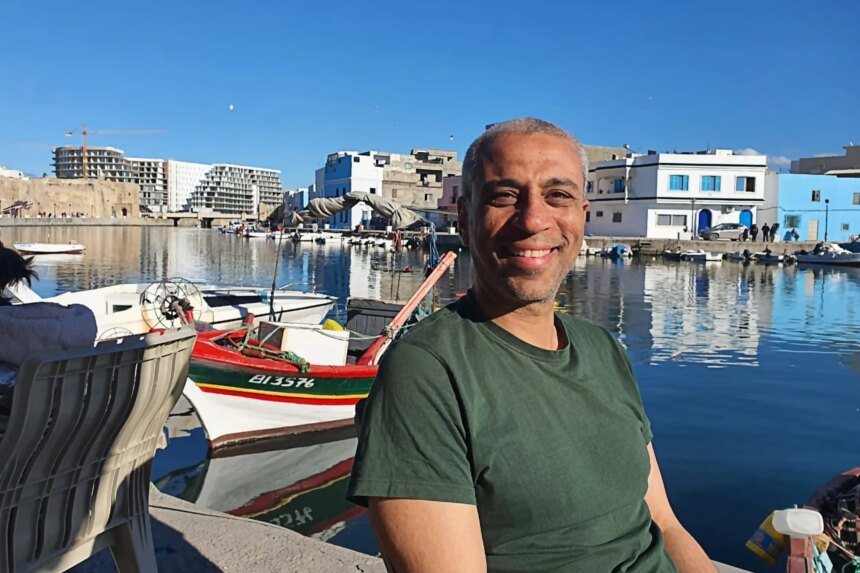
The Egyptian writer Shadi Lewis began writing late, as he says, and he is from the “Ain Shams” neighborhood of Cairo, and from this dual position, a stranger in his country and a stranger in his exile, he writes about the individual trapped by the institution. The church and police station in “The Ways of God,” the boarding house and hospital in “On the Greenwich Line,” and the family with its internal violence in “A Brief History of Creation and East Cairo.”
The translation of his novel “On Greenwich Line” into English recently won the British “James Tait Black” Award.
Read also
list of 2 itemsend of list
He told Al Jazeera Net that “the authority is a network expanding in all directions,” and that he is concerned with this siege. His characters are all defeated, or at least not victorious, but they continue to resist; In the footsteps of Foucault, who does not depart from his three novels, as long as there is authority, there is resistance.
In this dialogue, he talks about expatriation as a foundational condition for writing, about the Coptic experience as a site for reading authority rather than a prison that confines him, and about his fluctuating position on awards, between his withdrawal from the list of the Arab World Institute in protest against France’s position on Gaza, and his acceptance of a Scottish award voted on by graduate students.
-
You started writing literature late, and you were not published until you were forty. Does that make you feel any regret?
I started really late, and I envy those who start at twenty. I wrote my first novel when I was forty. But I never aspired to become a writer, and it was not in my imagination at all. But I was always a reader, and I still see myself that way. I started spontaneously when I started publishing articles for the “Al-Modon” website, and I began to deal with writing and its keys very slowly. The first five years were very difficult, and simply writing an article was a painful and stressful process, psychologically and mentally.
Writing the novel came later through my contact with academic writing while preparing for my master’s degree on the Egyptian Revolution and its relationship to Foucault’s concept of discourse. This was accompanied by a feeling of fading memory associated with my life in Cairo. I began my first novel as an attempt to document this experience for myself before any reader would. I see now that my delay was useful.
-
“Foucault on Liberation” was your first publication, a master’s thesis, and Foucault’s presence remained very clear. In all of your novels there is the individual, the institution, the building, and the forms of authority, from the church, the police station, and the workplace in “The Ways of God,” to the social care center and hospital in “On the Greenwich Line,” and finally in “A Brief History of Creation and East Cairo,” there is the institution of the family with all its violence directed against its members.
A correct observation: French post-structuralist philosophy is an intellectual adventure that has many supporters in Arab culture, even if it has become obsolete in other places. It is an inspiring philosophy at the level of language, ideas, and perceptions of power relations, concerned with power, but it is written in literary language, and concerned with talking about language itself as a space and space for exercising power.
I do not deviate from this great influence by this school. Coincidentally, when I later studied psychology, my thesis supervisor was a feminist and Foucauldian psychology professor, and she had a great influence on me. The individual’s confrontation with the tyrannical authorities around him is a theme that Arabic literature has dealt with a lot, often from an individualistic standpoint: there is the authority of the state, and there is an individual who wants his freedom. But the difference in the French post-structuralist school and its ramifications in American thought is that it does not see power only as a hierarchical relationship; Where the state, the ruling authority, and the tyrannical father exist, you see them distributed in a network that comes from all directions, in the language we speak, in daily practices, in gender roles, and others. In my three novels, I am concerned with the forms of this siege and the expansion of power in different regions.
The elements of power that impose themselves on refugees and migrants do not come only from above; It is not necessarily practiced by a white majority, or by racists against victims, or by an oppressive state. On the contrary, it may come from the welfare state that we defend and aspire to in our country, and then it is practiced by refugees, immigrants and minorities against each other.
In the novel “The Ways of God,” for example, the hero is not only a victim of the Muslim majority or the political system, despite the presence of these elements, but he is also a victim of the church itself, and of the relations of oppression and subjugation that appear, for example, in the ritual of confession. There are also unbalanced colonial relations in the love relationship between him and his German lover. As for “On the Greenwich Line,” the authority is located in the temporary shelter building. A place that produces specific experiences, performances, personalities, possibilities, and possibilities for existence and behavior. The elements of power that impose themselves on refugees and migrants do not come only from above; It is not necessarily practiced by a white majority, or by racists against victims, or by an oppressive state. On the contrary, it may come from the welfare state that we defend and aspire to in our country, and then practiced by refugees, immigrants and minorities against each other.
In the last novel, my main question concerned the language produced by American Protestant missionaries in Egypt, how it introduced the language of the Bible, and how this affected the Copts, their imagination, their feelings, and their relationship with their compatriots who spoke a slightly different Standard Arabic. How linguistic hegemony becomes present within the narrative text itself, and we see it at different levels.
-
Well, what then is the mother concern or question from which all your complex questions are born?
The main question in the three novels is: Is resistance, as individuals and groups, possible? Or are the system’s mechanisms highly invasive and elaborate, distributed within a horizontal network that controls everything? I do not see the solutions as individual or subjective at all.
I am often told that there is a sense of defeat present in my writing, and to some extent this is true; The reality around us does not indicate that victories are possible soon. Rather, it is a long historical process in which we must engage within groups that cross borders, and whose victories are cumulative. The important thing is that my main characters are all defeated, or at least not victorious, but they still resist; As Foucault says: As long as there is power, there is resistance.
I am often told that there is a sense of defeat present in my writing, and to some extent this is true; The reality around us does not indicate that victories are possible soon. Rather, it is a long historical process in which we must engage within groups that cross borders, and whose victories are cumulative. The important thing is that my main characters are all defeated, or at least not victorious, but they still resist; As Foucault says: As long as there is power, there is resistance.
-
In your works there is a constant state of incomplete integration, not only in London, where you live today, but even in Cairo, but also in your family. There are lives that exist entirely on a series of interruptions and discontinuities, fragile friendships, dismissals from work, and relationships that exist but are destined to end:
There are many answers to this, on more than one level. There is the romantic response associated with literature since the Romantic era, which has continued its presence with us in some way; The idea of alienation is a foundational condition for the act of writing. The writer is lonely and strange, and so are his characters, and there was an elevation of this perception related to individualism.
On a personal level, I belong to a Christian minority in a predominantly Muslim country, and I belong to a small sect within the larger Christian minority. This was followed by my migration to a place where I was considered a brown or Arab person, as there was a subjective experience rooted in a political and geographical reality that did not allow imagining the world outside this alienation.
The final level is that we live in this hyper-capitalism in which we witness the breakdown of traditional relationships and familiar affiliations, whether national, gender, or family identities, and impose a violent form of alienation. The writer also writes from the position of a stranger, and this has many advantages; This allows him to separate from what can see and express the world differently.
-
Are you writing about the Coptic experience and Coptic history for the sole purpose of writing it, or is it a site that allows you to read about power, violence, discrimination, and the current reality?
The experience of writing begins from our location in the world, from material facts, geographical space, and a historical era, and our literary production is necessarily influenced by this. I am the son of the fact that I was born Coptic; For example, I am exposed to biblical stories that enter my imagination, and how the story is told, and I was influenced by the colloquialism that we used to hear in church, and the language of the Bible in the version of Van Dyck and Peter the Gardener. It has to do with family stories and feelings of inherited injustice, whether real or imagined.
I am also a son of political realities. I grew up in the “Ain Shams” area in the 1980s, where there was what was known as the “Emirate of Ain Shams,” and the influence of Islamic groups was strong there. I witnessed churches being burned and attacked, and gold shops owned by Copts were the target of repeated incidents, and I was aware of them. Terror, fear, fragility, and discrimination were abundant elements in my childhood, and there is no doubt that this affects the form of my writing directly and indirectly.
But I am not a prisoner of this site, and there is an ironic contradiction in this topic. For example, my articles in which I express my political positions are why I am always accused of being a “leftist who loves Islamists” and a “self-hating Coptic.” On the other hand, when my novels are read, there are those who see that I am entrenched within the narrow space of the Coptic subject. The Coptic experience is a deep, problematic, and complex experience, and it contains many elements that should be written down literaryally. Anyone can find themselves in it. The most beautiful comment I heard on “The Ways of God” was from a reader who said that the novel reminded him of his experience joining an Islamic group in the 1980s when he was a boy.
-
Whoever reads your three novels feels that there are big leaps between each one and the next, and rapid development at the level of language, formulation, narration, and construction. Tell us what’s your secret?
Each one was written in a different context, and the clear contrast is a result of these contexts. As a result, in the beginning I was feeling my way and experimenting; In “The Ways of God,” I did not know if I could write a novel, if what I was writing at all was a novel, and whether there was anyone who could publish it. I set myself a narrative plan and a timetable for writing it despite all that. Today when I take it back I feel very ashamed, if not ashamed.
As for “The Greenwich Line,” I wrote it and signed a publishing contract before “The Ways of God” was published. I had a feeling that my confidence was better and that I had a publisher.
The concept of revelation or inspiration applies to it. I actually saw the first section of the novel written in front of me. I wrote it, and I kept writing continuously and without a plan at all, and I finished it in two and a half months. As for the last novel, I wrote it after I received good reactions to my other works, and I was convinced that I had a literary project, and that I had to consciously hone my tools. It took me ten months of full-time work, eight hours a day, and layers of writing, character work, and rewriting.
My position on awards is the same as that of any professional: to have ethical, administrative and other rules in the form of partnerships they wish to form. Obtaining the award means a process of material and moral exchange, but there is a name that is linked to another name for life. When it is said that such-and-such writer won the King So-and-so award, a relationship arises in the mind between this writer’s literature and the political system that this king represents. Or if the award bears the name of an institution or businessman, this means that your name is linked to the name of this institution. The questions I ask are: Is this ethically appropriate? Is this politically acceptable? This decision is not fixed; There are awards that are not acceptable to me at all, and there are awards whose context changes.
-
Your name has always been associated with protesting against awards, your valid criticism of them, and your rejection of some of them, but you accepted the “James Tate Black” award. The thing is that the writer also needs to feel some kind of appreciation, and he also needs the financial support that these awards provide. How do you think a writer should handle this kind of appreciation?
My position on awards is the same as that of any professional: to have ethical, administrative and other rules in the form of partnerships they wish to form. Obtaining the award means a process of material and moral exchange, but there is a name that is linked to another name for life. When it is said that such-and-such writer won the King So-and-so award, a relationship arises in the mind between this writer’s literature and the political system that this king represents. Or if the award bears the name of an institution or businessman, this means that your name is linked to the name of this institution. The questions I ask are: Is this ethically appropriate? Is this politically acceptable? This decision is not fixed; There are awards that are not acceptable to me at all, and there are awards whose context changes.
During the war in Gaza, for example, the French translation of “On the Greenwich Line” was shortlisted by the Arab World Institute, and it was withdrawn from it. The French position on the ceasefire was disgraceful, like most Western governments. Two years later, I was again shortlisted for the same award. France had changed its policies towards Gaza and participated in efforts to recognize a Palestinian state. I did not refuse to participate in an event at the institute, and a Palestinian novelist won the award, and I was happy about that.
There are awards given by an institution, but they bear the name of the businessman who runs them. In my opinion it should not bear his name, at least for aesthetic reasons. As for this award, it is awarded by the Department of English Literature at the University of Edinburgh, and bears the name of a famous British publisher, and his family is the one who awards it. The committee is made up of university academics, and graduate students vote on the winning work. The head of the committee specializes in postcolonial studies, and her thesis is on Palestine, and the value of the award is modest, divided between the writer and the translator. Therefore, I had no choice but to be happy with this award.