

Published On 7/6/2026
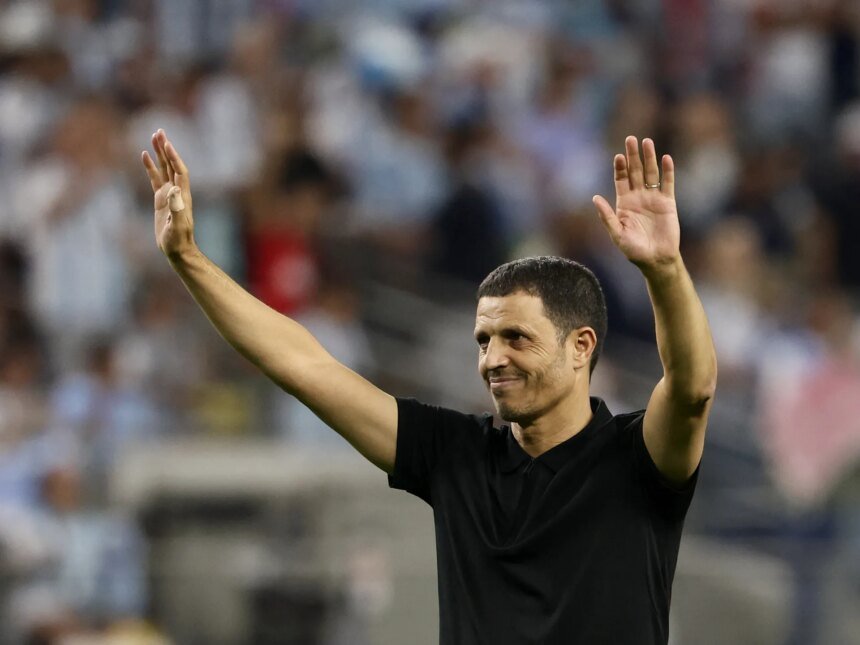
With the curtain coming down on the career of Moroccan coach Jamal Al-Salami with the Jordanian national team, controversy has returned strongly to social networking sites regarding the identity of the next coach for “Al-Nashama”.
Among those who call for the continued use of foreign training schools, others demand that a national coach be given the opportunity, citing successful Arab experiences, such as Egypt and Morocco, in the 2026 World Cup.
Read also
list of 2 itemsend of list
Prince Ali bin Al Hussein appreciates Al Salami’s achievements
Prince Ali bin Al-Hussein, President of the Jordanian Football Association, announced the end of the career of national team coach Jamal Al-Salami, appreciating his great role in achieving Jordan’s historic qualification for the World Cup finals.
Prince Ali confirmed, in a post on his account on the “X” platform, that Al-Salami’s experience with the Jordanian national team was exceptional, indicating that he will remain “a dear son of Jordan,” because of the loyalty, professionalism, and leadership spirit he demonstrated throughout his work.
Demands for a “national coach” similar to Arab experiences
Exempting the Moroccan coach opened the file of the coach of the next “Nashama” national team. Jordanians expressed their aspirations and hopes that the Football Association would make the right decision to choose a national coach, following in the footsteps of Egypt and Morocco, and the achievements achieved by the two teams in the World Cup.
The Jordanian sports street aspires for the selection of the new coach to ensure the preservation of the gains the team has achieved in recent years, and to build on them in preparation for future achievements, most notably the historic first participation in the World Cup Finals.
In this context, one of the bloggers thanked Al-Salami, saying: “Thank you, the son of Morocco. Now we need a national coach and an entire national cadre. The team and the players need a coach of their type and who knows them well, and we have seen this situation with Egypt and Morocco, especially in major tournaments.”
Technical criticisms and reservations about the digital tally
On the other hand, blogger Moatasem Momani believes that the technical tally of the team under the leadership of Al-Salami did not live up to the level of ambitions, based on the team’s record over two years, which included 34 official and friendly matches, during which it achieved 11 victories compared to 11 draws and 12 losses.
Moumni considered that the mistakes that appeared in the World Cup required a change at the head of the technical staff.
Moumni pointed out that his call does not detract from Salami’s standing or what he presented, but rather stems from concern for the national team’s interest and the necessity of building on the current generation, which he describes as the “golden generation,” calling for hiring a coach capable of investing in the players’ potential and achieving better results.
For his part, sports writer and journalist Mohamed Awad said: “We must thank Jamal Al-Salami for his time with us and the thought he added to our national team that can be built upon later by the next coach. We lived beautiful days with him, and we will preserve this beauty for him. I certainly hope that his replacement will have experience in the culture of the region, be able to develop some details, especially set pieces, and have flexibility in tactical ideas.”
Warnings about the risks of decline and the timing of the decision
On the other hand, bloggers believe that the departure of Moroccan coach Jamal Al-Salami marks the end of a phase described as one of the most prominent stations in the history of the Jordanian national team since the era of the late coach Mahmoud Al-Gohary, expressing their astonishment at the timing of the decision, which came a few months before the start of the Asian Cup finals.
Defenders of Al-Salami’s career pointed out that he succeeded in building a broader base for the national team, by expanding the circle of technical options and preparing a large group of players capable of representing Jordan, despite the limited local football structure compared to other teams.
They added that the coach contributed to consolidating the presence of football in the Jordanian sports scene, amid warnings that terminating his contract may carry the risk of decline if the alternative is not chosen well.
A career full of historical achievements for “Al-Nashama”
It is noteworthy that Jamal Al-Salami took over the training of the Jordanian national football team in June 2024, succeeding Moroccan citizen Hussein Amouta, after the latter’s historic success in leading “Al-Nashama” to the 2023 Asian Cup final.
During his leadership period, Al-Salami continued to build on this achievement, and led the Jordanian national team to achieve the most important milestone in its history by qualifying for the first time to the 2026 World Cup after distinguished results in the Asian qualifiers, becoming the first coach to lead Jordan to the World Cup, despite later exiting from the group stage.
Also under his leadership, the Jordanian national team played a series of official matches in which it achieved positive results, and reached the final of the Arab Cup (FIFA Qatar 2025) after a remarkable series of victories in the qualifying rounds.