


Published On 5/7/2026
|
Last update: 16:44 (Mecca time)
The return of rockets and spacecraft to Earth is no longer just the end of a space mission, but has become a scientific phenomenon that attracts the interest of researchers in atmospheric sciences and environmental chemistry.
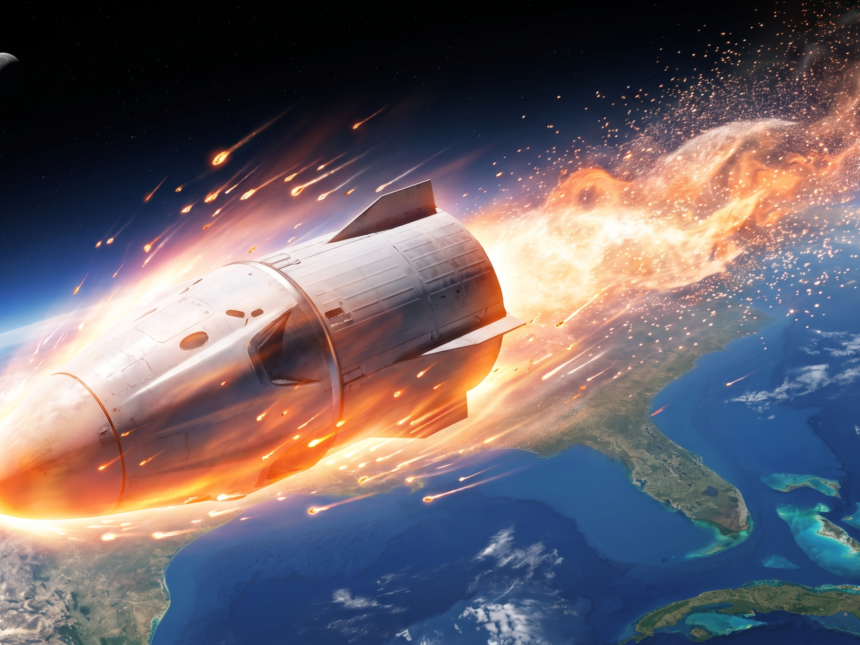
During the last seconds of the return journey, metal structures are exposed to exceptional conditions of heat and pressure that lead to a complex series of physical and chemical transformations, which make the metals not disappear as they appear to the eye, but rather transform into tiny nanoparticles that remain suspended in the upper layers of the atmosphere.
Read also
list of 2 itemsend of list
With the unprecedented expansion in the launch of satellites and rockets, scientists today seek to understand the fate of these materials and their potential impact on the composition of the atmosphere. This is a new field of research in which space science, atmospheric chemistry and climate science intersect, and it becomes increasingly important as humanity enters the era of intensive use of space.

This scene may raise a common question: If spacecraft burn up when they return to Earth, why don’t they melt in space despite being exposed to sunlight?
The answer is that space itself is almost a vacuum, and there is no air that transmits heat as it does on Earth. Therefore, vehicles rely on thermal radiation to get rid of excess heat. Their structures are also made of advanced alloys such as aluminum, titanium, and composite materials, and are covered with special heat shields that can withstand high temperatures.
As for the bright flames that are seen during the return, they do not result from the direct combustion of the vehicle’s body, but rather from the violent compression of the air in front of it, which turns it into a very hot plasma surrounding the vehicle, while the thermal protection layers begin to gradually erode in what is known as the phenomenon of thermal ablation, which carries the heat away and protects the internal structure until the landing process is complete.
From metal to dust…the journey of transformation within the atmosphere
When the missile enters at a speed exceeding 25,000 kilometers per hour, it is exposed to enormous dynamic pressure and temperature that may exceed 1,600 degrees Celsius, which are conditions that exceed the melting point of iron, which leads to the disintegration of its solid structure and its transformation into liquid metal droplets that disintegrate under the influence of violent air flow.
As these droplets are exposed to oxygen, an immediate oxidation process begins, transforming the metals into dark compounds of oxides, before they quickly freeze in the cold upper layers of the atmosphere to turn into fine nano-dust suspended in the air, which completely loses its original mechanical properties and becomes microscopic spray that may remain suspended in the sky for years.
Professor Hanspeter Schoppe from the University of Colorado Boulder, who specializes in the dynamics of space debris, explains that spacecraft upon their return to the atmosphere go through a complex physical stage of thermal and mechanical disintegration as a result of the extreme increase in pressure and temperature.

He points out that these harsh conditions lead to the collapse of the missile’s metal structure and its gradual transformation into fine particles of metals and oxides, which are dispersed in the upper atmosphere before settling later in the form of fine nano-dust.
On the other hand, Professor Daniel Chitzo from the Massachusetts Institute of Technology, who specializes in atmospheric chemistry and aerosols, explains that the combustion of rocket components during return to Earth is not limited to mechanical disintegration only, but rather releases minute quantities of metallic particles that immediately interact with oxygen in the upper layers of the atmosphere.
He confirms that these reactions lead to the formation of very fine metal oxides that are later transformed into nanoparticles suspended in the stratosphere, which can remain for long periods, even if they are in small quantities compared to natural sources such as cosmic dust and meteorites.
Thus, the process of returning to Earth turns from a mere technical end of space missions into a complex chemical and physical chain that reshapes the same matter within the atmosphere.
A new mineral signature in the stratosphere
The results of a recent study published in the Proceedings of the National Academy of Sciences in the United States of America (PNAS) indicate that the effect of spacecraft returning to the atmosphere is no longer just a theoretical assumption, but has become directly measurable within the stratosphere.
Measurements have shown clear traces of metallic elements such as aluminum, copper, and lithium within aerosol particles, with about 10% of these particles recorded as bearing fingerprints resulting from the combustion of missiles and satellites.

The study also revealed more than 20 elements originating from alloys and industrial components, and not just cosmic dust or meteorites, indicating a gradual shift in the chemical composition of the upper atmosphere.
Future models show that this proportion may rise as satellite launches increase, reaching about 50% of particles over the coming decades, opening new questions about the impact of human space activity on stratospheric chemistry.
Mass balance…the Earth does not lose its minerals
This mineral dust suspended in the stratosphere eventually descends very slowly to the surface and oceans with rain and snow without anyone noticing it, remaining part of the matter cycle within our planet.
Regarding the belief that the Earth loses part of its metals with every space launch, NASA reports confirm that the planet does not lose its iron, but rather receives annually additional quantities of metals coming with cosmic dust and meteorites, which makes the material return to Earth in a different form instead of leaving it permanently.

The study of the fate of these space minerals reveals a deep human and philosophical story that reflects man’s passion for exploration and continuous scientific research. The iron that we extract from the mines of the Earth and melt it with our minds to become rockets that embrace the stars, returns again to the soil of the Earth in the form of microscopic nano-dust, in a cosmic cycle that combines human industry and the laws of nature.
Between the burning of metals in the atmosphere and their fall as fine dust to the ground, a continuous cycle is embodied that reminds us that exploration is not a separation from the Earth, but rather an extension of it. Thus, science remains a bridge that reshapes our understanding of the world, and makes every end a new beginning in the journey of knowledge.