Published on 6/30/2026
|
Last update: 14:03 (Mecca time)
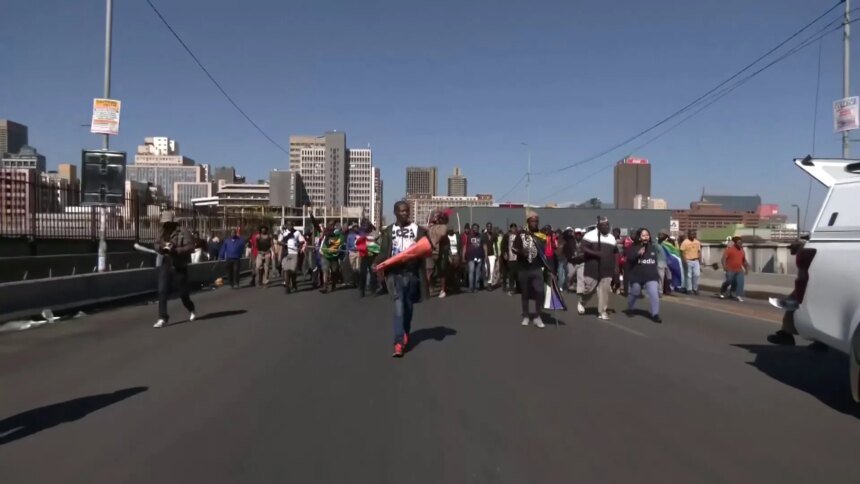
South Africa is witnessing escalating tension with the arrival of June 30, the date set by the “Marsh and Marsh” movement and anti-immigration organizations as a deadline for “irregular” foreigners to leave the country, while the government confirms that it is a “normal working day” without a “national lockdown.” Below are four questions to understand the dimensions of the crisis.
1. What are the motives of anti-immigration campaigns and what are the dimensions of today’s deadline?
According to the Institute for Security Studies (ISS), the campaign is led by the Marsh & Marsh movement and Operation Dodola among more than 20 anti-illegal immigration organizations, and Marsh & Marsh has called for a “national lockdown” today, in addition to calling on “irregular” immigrants to leave before that date.
In his speech on the 7th of this month, President Cyril Ramaphosa linked the escalation of these fears to the rise in unemployment, especially among young people, and to pressures on jobs, public services and security, stressing at the same time that “illegal immigration is not the cause of all our economic challenges.”
The Institute for Security Studies adds that those targeted in practice often include anyone who is seen as an immigrant of African or Asian descent, whether their status is legal or not. The institute cites data from the Statistics Authority (2022/2023), which estimates the number of documented and undocumented immigrants between 2.4 and 3 million people.
2. How did the government and the legal system confront calls for closure and random inspections?
In his speech, Ramaphosa stressed that “the responsibility for enforcing immigration laws rests solely with the state,” and that “no one else has the right to stop someone in the street and ask them to prove their citizenship.”
The Council of Ministers announced the adoption of a “comprehensive approach to immigration management,” which includes establishing courts dedicated to expediting the deportation of irregular immigrants, employing 10,000 labor inspectors, and tightening penalties for violating employers, with the state’s commitment to protecting “the human rights of all people in our country, whether citizens or foreigners.”
According to the government news agency, the government announced that the designated day is a “normal day” and not a “national closure,” and that schools, services and businesses will operate as usual according to the “no work, no pay” rule.
Despite the government’s assurances, many migrants treated the deadline as a real warning. Ibrahim Musa, an immigrant from Malawi, confirmed that he decided to leave the country because he felt afraid of threats from anti-immigration organizations.
3. What security measures have been adopted by the authorities and private companies?
According to a government statement, Acting Police Minister Firoz Cachalia expressed his “satisfaction” with the police’s readiness to secure the demonstrations, stressing that “while the constitutional right to peaceful protest will be respected, no acts of lawlessness, violence or intimidation will be permitted.” The statement indicated expected meetings with the Minister of Defense, the governors of the nine regions, and representatives of the private security sector.
The Institute for Security Studies reports that the special security operation cost more than 600 million rand (about $36.5 million), that police leave has been suspended, and that Defense Minister Angie Motshekga said the army would be mobilized “if things get out of control.”
The institute adds that the private security sector will act as a “force multiplier,” and that the “Fidelity” security services company has expressed its willingness to provide individuals, armored vehicles, helicopters, and drones, while using drones and cameras to deter, and work to ensure that the demonstrators are free of weapons after some of them previously carried whips, sticks, and spears.

4. What are the human rights implications and concerns surrounding the safety of migrants?
According to the Institute for Security Studies, three foreigners were killed following anti-immigrant protests, journalists were assaulted, and foreigners were evicted from their homes by “locals,” prompting many to flee.
The Institute recalls the violence of May 2008 (which led to 62 deaths and more than 100,000 displaced people) and the unrest of July 2021 (which led to 350 deaths) to warn of the danger of renewed violence.
According to the government news agency, Malawi, Ghana, Nigeria, Mozambique, Zimbabwe, Kenya and the Democratic Congo have requested the return of their nationals voluntarily and at their expense, with the support of the United Nations High Commissioner for Refugees, the International Organization for Migration and the Red Cross. According to the Institute for Security Studies, labor unions and civil society organizations have expressed their rejection of the anti-immigrant campaign.