Many countries are currently reviewing the priorities for building their air forces in light of the current transformations in the military aircraft market. Since the outbreak of the Russian war in Ukraine in 2022, the realization has deepened that modern conflicts may turn into extended battles of attrition, in which success is not measured by pure technical superiority as much as it is tested by the ability to quickly compensate and sustain military operations, as air control is no longer limited to possessing the most advanced platform only.
In addition, the supply chain crisis – which began with the Corona pandemic and was deepened by the Russian-Ukrainian war – exposed the fragility of complex defense programmes, which was evident in the delayed delivery of many deals of modern fighters as a result of a lack of components, which pushed many armies towards searching for platforms that are less dependent on complex supply networks, and more flexible in production lines.
“Air control is no longer just about having the most advanced platform.”
At the same time, increasing material pressures resulting from inflation and the necessity of rapid rearmament to compensate for losses have limited the ability of countries to build entire fleets of expensive stealth aircraft, which has led to the adoption of the “hybrid fleet” concept, which combines a limited number of high-cost, specific platforms with larger numbers of economic fighters that undertake air defense and routine patrol tasks.
Read also
list of 2 itemsend of list
Industrial and political dimensions have also become a decisive pillar in purchasing decisions. Countries are no longer satisfied with merely importing aircraft, but rather require technology transfer, assembly or local manufacturing to build a national industrial base that enhances their strategic independence. In this context, European alternatives emerge with greater flexibility compared to the strict US restrictions associated with export regulations and control of sensitive technologies. Washington’s conditions, whether in sales licenses or control over software and updates, push some countries to search for partners that allow them greater sovereignty in operating, maintaining and developing their fleets independently.
“Gripen today operates in Sweden, the Czech Republic, Hungary, Thailand and Brazil, with confirmed orders in Ukraine and Colombia, as well as growing interest in promising markets such as India and Canada.”
Given these data, the increasing demand for the Swedish fighter “JAS 39 Gripen” seems logical, even though not a decade ago this project exceeded the limits of the modest national bet. When the Swedish government approved in 2013 the purchase of 60 Gripen E fighters, the program seemed at that time directed to modernizing the local fleet, not to be a platform for global competition. However, the following years brought a remarkable transformation, as the program achieved a spread that exceeded expectations, as the aircraft is now operated (in different versions) in Sweden, the Czech Republic, Hungary, Thailand and Brazil, with confirmed orders in Ukraine and Colombia, as well as growing interest in promising markets such as India and Canada.
Do these growing orders reflect a passing wave imposed by the circumstances of war and current pressures? Or does it establish a long-term trend that will redraw the map of the global fighter market? More importantly, what motivates many countries to invest in Gripen specifically, despite the availability of other affordable alternatives, including Chinese fighters that are distinguished by their escape from the constraints of American technology and their freedom from the complexities of Western licensing networks?
A fighter jet takes off from public roads
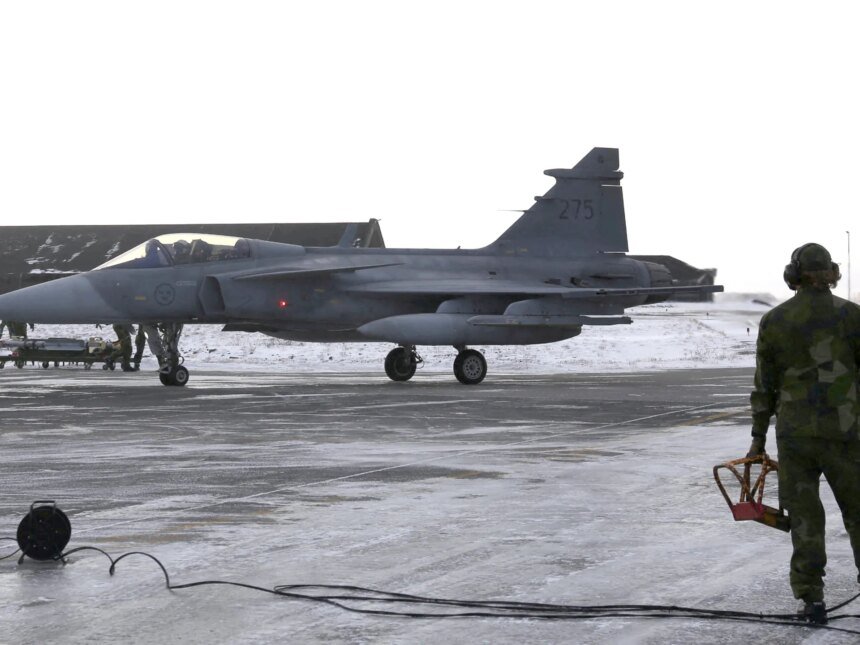
Perhaps the most prominent feature of the Swedish fighter is the philosophy on which it is based, which is represented by the concept of “decentralized deployment.” That is, the ability to operate from small bases, and even from temporarily prepared public roads, in case major air bases are exposed to early attacks in any large-scale conflict. This philosophy is linked to a defensive doctrine that assumes that any adversary’s first strikes will target fixed infrastructure and runways.
The importance of this concept increased after the Ukrainian war, as Russian missile and drone strikes demonstrated the fragility of traditional air bases, prompting Kiev to distribute its aircraft and use alternative runways to reduce losses, and make the ability to take off and land from short distances and operate with a minimum of ground support an operational advantage.
In this context, Ukraine’s interest in “Gripen” seemed understandable, because it was originally designed to operate from runways approximately 400 meters long only, with a limited maintenance crew, and with the possibility of rearming within minutes. This model is not limited to Ukraine, as the geographical proximity of Eastern European countries to Russia makes their bases potential targets in the first hours of any confrontation, giving flexible, decentralized defenses decisive importance.
The manufacturer confirms in its official definition of the aircraft that “JAS”, which is the abbreviation of the aircraft’s name, represents the first letters of the words: attack, interception and reconnaissance in the Swedish language. The fighter is able to move between the roles of air combat and ground attack and collect intelligence information in one sortie. The aircraft’s preparation time is 10 minutes for air maneuvers and 20 minutes for combat maneuvers (close combat), which represents additional advantages for the fighter in terms of flexibility as well.
“The Gripen fighter is capable of transitioning between the roles of air combat, ground attack, and collecting intelligence information in one sortie.”
In addition, the aircraft can carry a wide variety of missiles, including long-range Meteor air-to-air missiles, in addition to short-range infrared-guided missiles such as Iris-T, and other munitions. In addition to an active electronic scanning array radar capable of detecting and tracking several targets simultaneously and over long distances, and an infrared search and tracking system to detect enemy aircraft through their thermal signature. The fighter also has traditional but decisive combat equipment, as it is equipped with an internal fast-firing Mauser cannon.
This weapons capability gives the fighter the ability to engage air targets from long distances, in addition to carrying out precise ground strikes when needed, while the fighter contains an early warning system that detects the approach of hostile missiles and alerts the pilot immediately, in addition to electronic jamming packages that confuse hostile guidance systems, and flare bombs that are launched into the air to deceive thermal missiles and mislead them away from the plane. With these multiple layers of defense, the aircraft does not rely on maneuvering alone to survive, but rather on an active protection network that surrounds it during combat.

An economical option…but
According to official data, the cost per flight hour of the latest Gripen models is about $22,000, including maintenance, fuel, crew and logistics expenses. For comparison, the flight hour of the American F-16 fighter costs approximately $30,000, while the flight hour of the F-35 stealth fighter costs about $46,000, which is more than double the cost of the Gripen flight hour. Meanwhile, the French Rafale remains the least expensive among its Western counterparts in terms of flight hour, as it amounts to only about $18,000.
According to the Defense Express website, the total maintenance cost of 100 Gripen aircraft over 37 years is estimated at about $21 billion, while maintaining a similar fleet of American F-15 fighters in the same time period costs about $34 billion. The site’s experts point out that the cost of maintaining the Gripen remains the lowest in its class, even when compared to European fighters, such as the Rafale and Eurofighter.
“The flight cost of the Gripen fighter is about $22,000, compared to $30,000 for the F-16, and $46,000 for the F-35 stealth fighter.”
However, the balance is tilted in favor of these competing fighters when other points of comparison are brought up. For example, the Gripen has a lower ammunition load and combat range compared to the F-35, Rafale, and Eurofighter Typhoon, making it suitable for countries that focus on regional deployment and local defense, rather than on remote operations or long-term heavy missions. At the sensor level, the “Raven” radar available in the Gripen provides good coverage, but it remains a traditional system, and does not reach the level of the F-35 system. Capable of integrating radar data, thermal sensors and electronic warfare into a single image.

However, the cost advantage that Gripen enjoys within the Western fighter market declines when compared to some Asian alternatives, most notably the Chinese Chengdu J-10 fighter. According to estimates circulated in defense reports, the price of the latest version of the Chinese fighter is approximately $60 million, and its operating cost is estimated at only $9,000 per hour, much less than the average operating cost of most Western fighters.
At the combat level, the two aircraft belong to the advanced fourth generation category (4.5), and both are equipped with active electronic scanning array radar and electronic warfare systems, and they have almost the same capacity to carry the same weight of ammunition, with a slightly higher maximum speed in favor of the “J-10”, which also has fewer export restrictions and offers flexible offers in terms of technology localization. In contrast, the “Gripen” is characterized by advanced Western “networking” capabilities and easier integration with NATO systems, in addition to a longer operational record and greater transparency. In technical data.

“Mixed fleet” strategy
However, we must mention that defense markets do not move according to the logic of need or technical efficiency only, but there is a complex network of political calculations as well, as some major powers work to protect the influence of their defense industries and preserve their customers in every way. In some cases, Gripen deals were subject to internal political reviews, as happened in the Czech Republic, when the government reconsidered its options between Gripen and the F-35, as the purchase decision carries political repercussions in addition to its military aspect. In addition, Gripen’s reliance on an engine produced by the American General Electric makes the issue of flexibility more complex than it seems. The presence of a major American component means that any export deal is subject to American controls and regulations regarding re-export.
“The Gripen is an enhanced fourth-generation fighter, and not a full-fledged stealth platform in the sense that fifth-generation aircraft represent.”
In the same context, the Gripen remains an enhanced fourth-generation fighter, and not a full stealth platform in the sense represented by fifth-generation aircraft. In complex combat environments that include advanced air defense systems, advanced stealth capabilities constitute a decisive factor in penetrating airspace and reducing the risks of early detection. In addition, the Gripen’s reliance on a single engine, despite its light weight and low operational cost, theoretically means a lower margin of safety if the engine is exposed to a malfunction or injury, compared to dual-engined fighters that provide a higher degree of continuity in severe combat conditions.
However, some analysts believe that Gripen will not lose its appeal in the medium and perhaps long term, as modern conflicts, which have taken the form of extended wars of attrition, raise the value of platforms that are less expensive and faster to compensate. This logic pushes some countries to adopt what is known as a “mixed fleet strategy,” that is, combining a limited number of advanced, high-cost fighters with a larger number of cheaper aircraft to perform daily missions.
The United States, for example, operates advanced stealth fighters, such as the F-22 and F-35, for high-risk missions and penetrating complex defenses, while there are less expensive fighters in terms of unit price and flight time, such as the F-16, which are used for routine patrols and air defense protection. Therefore, some NATO countries, such as Canada, view the Gripen as an economic option to complement the F-35 fighters, which gives the fighter a unique position even among countries with more advanced air fleets.