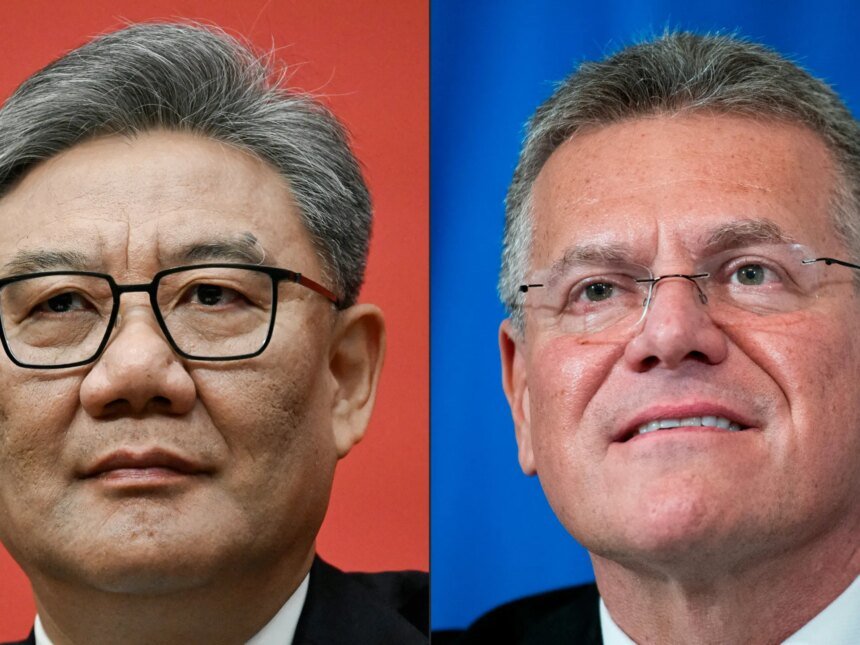
After months of intense preparations and the accumulation of disputes over the trade deficit, export restrictions, and intellectual property rights, a new mechanism for the ministerial dialogue between China and the European Union on trade and investment was launched to be the most prominent event and the optimal outcome of the first negotiating sessions.
The trade dialogue between China and Europe seems like an equation imposed on both sides, as they both realize that the cost of failing to control tension may be higher than the cost of making calculated concessions, but the difficulty may be in moving within a political and economic deadline before it is set.
Read also
list of 4 itemsend of list
Dialogue under pressure
The Chinese media dealt with this dialogue as a politically binding time frame, not just a new consultative platform, and the South China Morning Post indicated that European Commissioner Maroš Šefčović stressed the need to achieve tangible results by October 2026, in light of the agreement of the majority of member states’ capitals that Europe is suffering from a “China shock” that threatens Europe’s industrial base.
The agreement was reached at the first meeting –According to the Chinese News Agency (Xinhua), there are four main courses of action:
- Balancing trade and investment
- Export control
- Intellectual property rights
- Reform of the World Trade Organization
These axes reflect the common awareness of the nature of the fundamental points of friction between the two sides and their focus on China’s trade surplus, mutual restrictions on sensitive goods and technologies, and European companies’ complaints about weak protection of property rights in the Chinese market.
Chinese press reports also focused on the fact that the most symbolic step in this dialogue is the agreement to establish a joint mechanism to monitor trade flows, based on the exchange of unified data to monitor any sudden increase in imports that may exceed the permissible limit and require rapid escalation at the political level.
This arrangement opens the door to transforming the dispute over numbers – especially the worsening European trade deficit – from a subject of media controversy into an early warning tool that can be used to avoid hasty unilateral decisions such as imposing new fees or restrictions.
Wang Wentao:
China is not the root cause of the EU’s problems, but rather a partner in solving them, but the restrictive measures threaten to undermine global supply chains and normal cooperation between the two sides.
Between surplus and shock
The South China Morning Post quoted Shevcovic as saying that the trade gap is widening in an unsustainable way, and that the current situation is not an option, in light of the significant increase in the deficit with China in May alone, and the increasing concern of European capitals about a wave of Chinese imports at low prices driven by excessive production capacity and government support.
This European perception is matched by a Chinese position expressed by Trade Minister Wang Wentao and reported by China News Network when he considered that China is not the root cause of the European Union’s problems, but rather a partner in solving them, warning that the new European economic tools and restrictive measures imposed on China threaten to undermine global supply chains and normal cooperation between the two sides.
And it was The issue of export control related to rare earth elements is strongly present, as reports by the Global Times and China Daily newspapers indicated that the Chinese-European dialogue on vital minerals and other raw materials has achieved positive results, with the two parties pledging to continue exchanging information about their regulatory frameworks and licensing systems.
And it reflects This path is an attempt to limit the politicization of strategic resources used by both sides in renewable energy industries, such as electric cars and advanced technologies. China Daily quoted Michael Schumann, President of the German Federation for Economic Development and Foreign Trade, as saying, “Europe cannot be economically independent from the United States, nor from China, as our economies, technologies, supply chains, and security structures are very closely interconnected.”
Jian Jun Bu:
The trade dialogue between China and Europe is a platform for conflict prevention, which may make economic relations more stable and predictable
Trade organization bets
Official Chinese newspapers unanimously agreed that one of the most important goals of the new mechanism is to coordinate positions within the World Trade Organization and push for its reform in a way that enhances its authority and effectiveness.
Politically, this line provides a common discourse in favor of the multilateral trading system in the face of protectionist tendencies and blocs, but it also reflects the need of the two parties for an arbitration arena and controlling rules to avoid sliding into an open trade war, especially with the continuing dispute over Chinese industrial support and European countermeasures.

In his statement to the Global Times, Director of the Center for China-European Relations at Fudan University, Jian Junbo, believes that the new mechanism is a platform for preventing and limiting conflicts, which may make economic relations more stable and predictable, even if frictions remain in the short term.
On the other hand, the South China Morning Post warns that the political clock in Brussels does not stop; European leaders have given the Commission powers to protect their industry, with expectations of presenting a set of new tools to tighten policy towards China in the State of the Union address next September, which means that the October meeting will be a decisive test of the feasibility of the current dialogue in avoiding mutual escalation.
Away from the language of official statements, China Daily points out that economic circles see the continuation of the dialogue as an opportunity to keep the doors open for practical cooperation in the areas of green transformation, digital transformation, advanced manufacturing, artificial intelligence and modern infrastructure.
Schuman argues that companies cannot solve all political questions, but they are able to create practical trust and translate political understandings into joint projects, which makes the private sector a crucial element in transforming the dialogue from mere crisis management to a gradual redefinition of the terms of the Chinese-European partnership.
Under the deadline ceiling
In this sense, the trade dialogue between China and Europe appears to be a positive dialogue, but within a time limit. On the one hand; There will be a relatively short internal European deadline demanding measurable results before October. On the other hand, A broader deadline imposed by the pressure of transformations in the global economy and value chains, as both parties cannot bear the cost of a broad economic separation nor ignore the accumulated tensions at the same time.
The success of this mechanism will be measured by its ability to transform the joint monitoring mechanisms and the four courses of action into partial, cumulative solutions that help reduce the severity of the trade deficit, control the use of tools of export restrictions and protectionism, and maintain a common space between Beijing and Brussels within the international trading system, away from the logic of a new “shock” or reciprocal retaliatory measures.