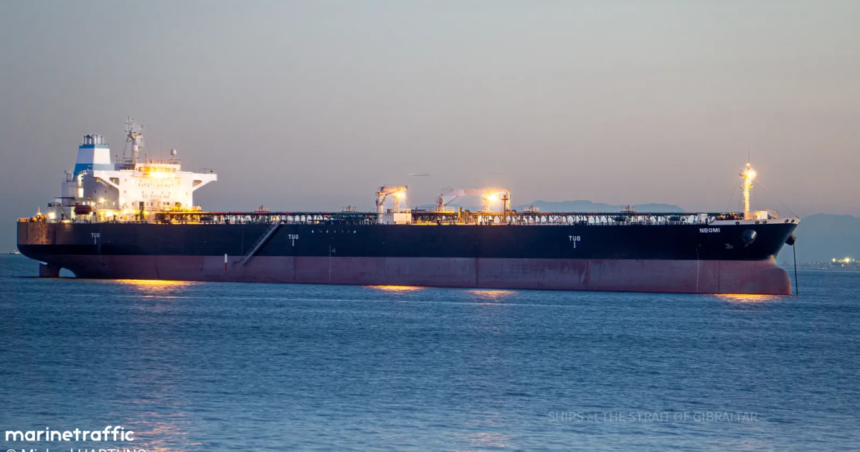
The crude oil tanker “INVICTA” stopped before crossing the Strait of Gibraltar, after a long route that turned west of the British Isles in the Atlantic Ocean, instead of crossing the English Channel, as it was moving from the Russian port of Primorsk towards the Suez Canal carrying a new shipment of Russian crude.
The current voyage places the tanker at the heart of a new test of European measures against the Russian shadow fleet, as it is not only sailing loaded with about 711,000 barrels of Russian crude, but it is doing so via a route away from the English Channel, where inspection and detention procedures have emerged during the recent period for tankers punished or linked to Russian oil exports.
Read also
list of 3 itemsend of list
This flight path makes it an indicator of a more complex stage in the pursuit of the Shadow Fleet, as the issue is no longer related to the inclusion of ships on sanctions lists only, but rather with the ability of European countries to monitor longer and wider routes, going beyond nearby passages such as the English Channel, and extending to the Atlantic and the roads leading to the Mediterranean and the Suez Canal.
Long path
Data monitored by the Al Jazeera Network’s open source unit, via the Kepler and Marine Traffic platforms, reveals that the tanker, which bears the international maritime identification number 9250543, loaded about 711,661 barrels of Russian Primorsk Mix crude on June 15, before departing from the Primorsk range towards the Suez Canal.
When last spotted, “Invicta” had been parked off the Atlantic coast of North Africa, before the Strait of Gibraltar, for more than 24 hours, and had not yet crossed into the Mediterranean Sea on its way to the Suez Canal.
This came after the tanker crossed a path from the Baltic Sea to the North Sea, then headed north and west along Norway, before circling the British Isles and descending south across the Atlantic, avoiding the shorter route through the English Channel.

Russian shipment
Kpler data, which specializes in shipping and energy data, indicates that the tanker’s current shipment is classified as “Urals” crude, and is linked to a loading from Primorsk, one of the most prominent Russian oil export ports on the Baltic Sea.
Marine Traffic data shows that the tanker’s announced destination is the Suez Canal in Egypt, with an estimated arrival date of next July 7.
The stopover before the Strait of Gibraltar adds a new dimension to the flight path, as this point represents the western gateway for crossing from the Atlantic Ocean to the Mediterranean Sea, and from there to the Suez Canal. Tracking data does not explain the reason for the stop, but it shows that the tanker has not yet completed its crossing towards the Mediterranean despite announcing the Suez Canal as its destination.
The data does not reveal the reason for the tanker choosing this route, but it shows that “Invicta” did not cross the English Channel, an area that over the past few days has turned into a European pressure point on tankers linked to the Russian shadow fleet, after some measures moved from legal sanctions to inspection and detention at sea.
The data shows that Invicta is in a loaded state, and at low speed at the last announced signal. Tracking data alone does not show the final destination of the shipment after the Suez Canal, but it shows that the tanker is taking a long route outside the direct European routes, at a time when maritime surveillance operations against sanctioned Russian oil tankers are increasing.
The current flight does not appear to be isolated from a previous pattern of tanker movement, as Kepler data shows that last December, Invicta transported a shipment from Primorsk to the Xinhai One terminal in China, and last April it carried a shipment from the Russian port of Shiskharis to the Mumbai refinery in India.
Variable record
The trip gains additional importance from the tanker’s changing record, as the Marine Traffic platform displays the ship with the Cameroonian flag, while the International Maritime Organization’s GIS system shows that its flag status has become “unknown” since last May, after it was previously registered under the flags of Cameroon, Guinea, Panama, Marshall Islands and Greece.
The Invicta flag conflict does not appear to be isolated from a broader crisis in the use of the Cameroon flag by ships linked to the Shadow Fleet, as the Cameroonian Ministry of Transport announced in an official statement that it had detected cases of fraudulent registration in the maritime registry through unlicensed applications, condemned the fraudulent use of the country’s flag, and decided to suspend the registration of ships and floating units intended to sail outside Cameroonian territorial waters until further notice.
Ownership data indicates that the tanker is operated by a Samoa-based company, an offshore ownership structure that is replicated in ships associated with the Shadow Fleet, where name changes, flags, and ownership and management companies overlap.
Sanctions haunt the tanker
The European Union included “Invicta” in the Annex of Sanctioned Ships in the list of sanctions related to the Russian war on Ukraine, on May 21, 2025, under the maritime identification number 9250543.
European restrictions on listed ships include a ban on entering ports, berthing areas and locks within the European Union, in addition to restrictions on providing maritime services, financing, insurance, provisioning, catering, and transferring cargo from one ship to another.
Britain also included the tanker under its previous name, “Nomi”, on November 25, 2024, as part of a sanctions package targeting 30 ships from the Russian shadow fleet.
According to British sanctions data, the tanker is accused of transporting oil or petroleum products originating in Russia, from Russia to a third country, in a way that benefits or supports the Russian government.
The British sanctions stipulate that the identified ship can be prevented from entering British ports, directives can be issued regarding its movement or entry into ports, it can be detained, its registration in the British ship registry may be refused or its existing registration terminated.
Open test
Between its long route away from the English Channel, its stop before the Strait of Gibraltar, and its changing record of names and flags, the “Invicta” voyage appears to be an example of the challenge that shadow fleet carriers pose to European oversight, especially when they move outside the corridors closest to traditional checkpoints.
The current shipment increases the importance of the trip, as it is not just a sanctioned ship, but rather a tanker carrying hundreds of thousands of barrels of Russian crude, and moving towards a road that leads to the Mediterranean and then the Suez Canal, at a time when European countries are trying to restrict the movement of oil tankers linked to Moscow outside the scope of ports and paper sanctions.
In this sense, “Invicta” is testing a question larger than the path of a single ship: Can Europe transform shadow fleet sanctions from legal lists into practical oversight of flexible and long sea routes, or will the sanctioned carriers continue to adjust their routes as the checkpoints become more severe?