Published on 6/29/2026
It may seem like a “ridiculous” idea on the surface for a few big players to face 100 young children on a football field, but the goal inside is more than just entertainment and may be mental and physical preparation for major confrontations in the future.
Three years ago, a famous video clip spread on social media in which three Japanese national team players, Hotaru Yamaguchi, Hiroshi Kiyotake, and Yusuke Ideguchi, appeared playing against 100 students, in charming clips, as The Athletic website described.
In that clip, it seemed surprising how these players succeeded in passing the ball to each other, avoiding the high possibility of an opponent blocking their way, even if it was by chance, and at the same time testing the accuracy of their passes when switching play to the opposite wing when one of them was unmarked.
Read also
list of 2 itemsend of list
This Japanese philosophy of “numerical superiority by transforming the game” will today face a real test to measure the effectiveness of this method, as Japan faces its counterpart Brazil in the round of 32 of the World Cup at 20:00 Mecca and Doha time.
Japan style
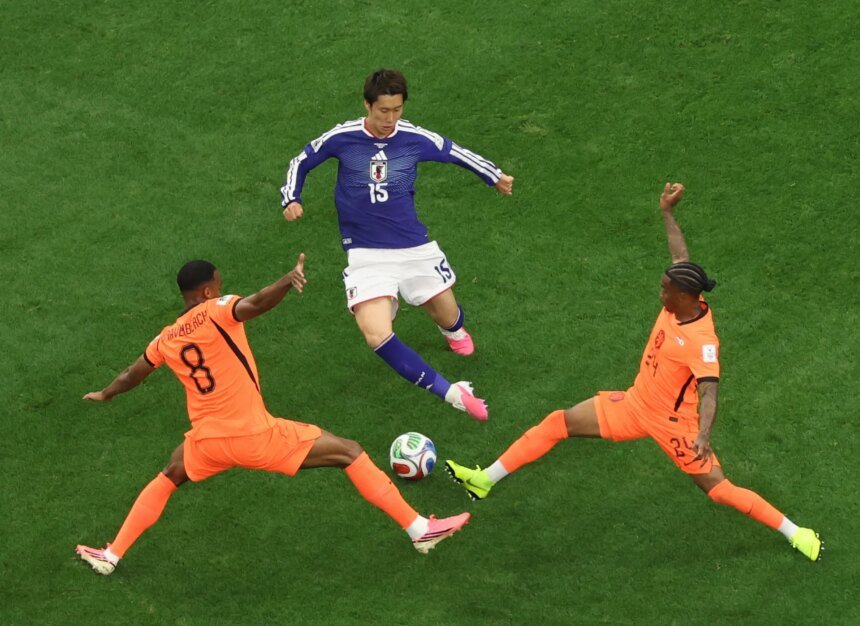
Japan relies on a 3-4-3 playing style, which in the attacking situation turns into a pressing attacking pentagon. The genius of the “Samurai Warriors” lies in attracting the opposing team towards one side of the field, leaving spaces on the opposite side, in which the required player moves completely freely and free of supervision.
Unlike traditional wingers, Japanese wide players are characterized by high tactical flexibility. Players like Ritsu Doan and Keto Nakamura have the dual ability to penetrate inside to shoot, or resort to smart diagonal passes to suddenly turn the tide of play.
Brazil: a crisis in the peripheries and a tactical gap
On the other hand, Brazil suffers from a clear structural defect in the full-back position, which makes it extremely vulnerable to Japan’s style of shifting the game long and wide.
In light of the invulnerability of the Brazilian center back with the presence of Marquinhos and Gabriel, Japan’s strategy is not to penetrate him, but rather to circumvent him and drop him from the equation through cross balls directed at the far post.
This method raises questions about how Brazil deals with this pressure. Will their coach Carlo Ancelotti sacrifice midfielder Casemiro to return as a fifth defender to stop crosses, similar to what the Netherlands did with Frenkie de Jong in the first round of the group stage (2-2)? Or will the Brazilian team remain exposed to the speed and accuracy of Japanese transformations?
A Japanese victory would not be surprising
The Athletic website believes that Japan’s victory over Brazil, if achieved, would not be a surprise, but rather would be an official announcement of the birth of a new global power capable of imposing its own style on any opponent.

From a tactical standpoint, if Japan succeeds in implementing the strategy of “shifting the game” as it did in its previous matches, “Brazil may fall resoundingly, on a night that could change the map of power in world football.”
In general, the match between Brazil and Japan will be a strong test for the latter, which now possesses the infrastructure, tactical discipline, and team harmony that impresses the greatest coaches, but despite this, it is still searching for its first victory in the knockout rounds of the World Cup.