

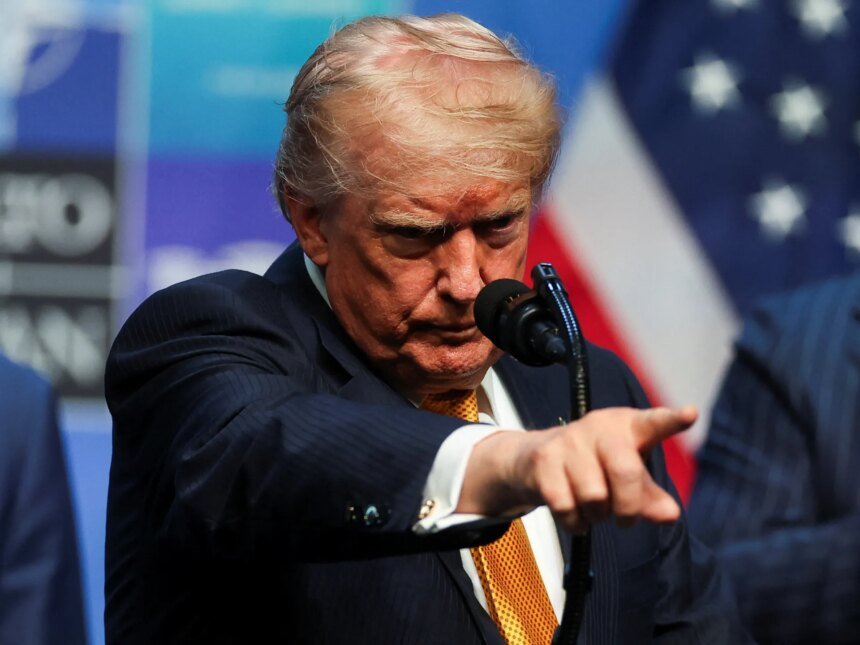
With his announcement of the end of the ceasefire with Iran and the return of US military strikes, US President Donald Trump opened the door to a new phase of confrontation with Tehran, amid questions about how his administration will deal with the crisis in the next stage.
While American analyzes talk about five possible paths ranging from military escalation, revival of diplomacy, and expansion of the conflict, analysts believe that Trump’s recent statements reflect a shift in the way Washington deals with Iran, going beyond the containment policy that has governed the relationship between the two countries for decades.
Read also
list of 2 itemsend of list
Below are five scenarios presented by American reports regarding the next stage.
First scenario: limited war
A report published by Newsweek magazine suggests that the collapse of the ceasefire will lead to the resumption of the military confrontation, but through a limited first phase, allowing both Washington and Tehran to continue escalation without sliding directly into an all-out war.
This scenario gives both parties an opportunity to present themselves as victorious, as Washington can confirm that it has regained deterrence power while Tehran says that it has faced force with force, with each of them retaining a margin to move and take the next step.
However, the report warns that the limited nature of the war does not mean its stability, as mutual strikes may continue with the exchange of accusations regarding the party that started the escalation, so that the confrontation in its first stage turns into a struggle to establish deterrence at sea.
In a related context, the magazine quoted retired US Admiral James Stavridis, who served as Supreme Commander of NATO forces in Europe, as telling CNN that Trump faces three main options after the recent US strikes on Iran.
The first option is to withdraw from the confrontation, an option he described as “a very bad idea,” while the second option is to launch broad and massive strikes against Iran. The third option is to intensify the strikes to force Iran to change its approach, stressing that “none of these options is good.”
Second scenario: a new deal
As for the second scenario presented by Newsweek, it assumes that the US President’s announcement of the end of the ceasefire may not mean the end of the diplomatic path, but rather it may turn into a pressure card that paves the way for the resumption of negotiations.
The magazine believes that this approach is consistent with Trump’s usual style of public escalation in rhetoric while leaving the door open to the negotiating path, adding that Iran also has motives that push it to combine escalation and negotiation at the same time, in light of its urgent need to reduce economic pressures.
The report indicates that even if the ceasefire agreement falls as a document, the understanding on which it was based, which is to ensure the security of navigation in the Strait of Hormuz in exchange for restrictions, relief of sanctions, or mutual recognition of interests, may remain in place as a necessity for both parties.
Third scenario: regional war
The third scenario – according to Newsweek – is that the region slides into a broader regional war, not as a result of a deliberate decision, but rather due to a series of mutual interactions, such as a strike carried out by one of the groups allied with Iran against an unintended target, or an American attack that results in a larger number of casualties than expected.
The magazine warns that the region already includes multiple points that could turn into gateways to a new conflict, considering that this scenario is the one that most worries markets, armies, and diplomats, because it may begin despite the leaders of both parties confirming that they are not seeking an all-out war.
In this regard, writer Irvan Fard believes – in an article published by The Hill website – that Iran has built over decades a regional system to expand its influence by destabilizing its opponents, adding that this strategy gave Tehran regional strength and influence, but at the same time it made it more vulnerable to risks.
The writer adds that the “strategic depth” that Tehran relied on gradually turned into a point of weakness, as it increased the possibilities of regional escalation, deepened its international isolation, and raised the risk of direct confrontation.

Fourth scenario: The economy forces calm
In the fourth scenario, the magazine moves from talking about military options to the impact of the economy and energy markets in shaping the course of the crisis, considering that economic pressures may become the most influential factor in the decisions of Washington and Tehran.
While neither the United States nor Iran wants to appear to be retreating, at the same time they are facing increasing economic pressures that may push them to contain the spiral of escalation. Newsweek believes that this path will not lead to permanent peace, but rather to a temporary truce imposed by economic necessities.
In the same context, the retired American admiral says, “The extent of Trump’s ability to exert real pressure on the Iranian economy will be the decisive factor,” indicating that economic pressure may be the most influential tool in shaping the next stage of the confrontation.
Fifth scenario: testing allies and a strategic shift
The fifth scenario expects that the renewal of the crisis with Iran may give the US President an opportunity to turn it into a test of the extent of the allies’ support, so that the issue of military strikes turns into a political question related to who stands by Washington when the policy of deterrence is at stake, and thus the collapse of the ceasefire may become a test of Trump’s foreign policy in his second term.
The report explains that the next stage will be determined according to a set of variables, including: the nature of the targets that will be struck, undeclared negotiating channels, pressures from the oil markets, the positions of allies, and Iran’s view of escalation as a pressure tool or a battle for survival, stressing that these five scenarios may overlap and do not exclude each other.
On a broader reading, Fard considered that Trump’s recent statements in which Iran threatened a harsher response to any new attack reflect a shift in the American view of Tehran, adding that Trump’s description of the Iranian regime as a “cancer” does not suggest the possibility of managing the threat through warnings or limited pressure, but rather represents a perception that the problem is structural and requires addressing its roots.
The author concludes that these statements may reflect more than just a passing escalation, as they may indicate that Washington is thinking about changing the structure of the Iranian regime, rather than just trying to modify its behavior.