


Published On 7/8/2026
The escalation near the Strait of Hormuz has brought global energy markets back into the circle of concern, after the repercussions of the confrontation extended to both oil and gas, at a time when Iranian exports are facing increasing pressure with Washington canceling exemptions that had allowed the sale of Iranian crude.
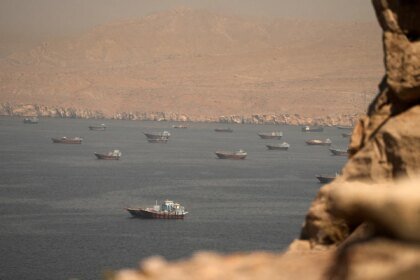
The crisis is not limited to a decline in potential supplies, but also extends to tankers carrying millions of barrels of Iranian oil that have become stuck at sea, amid uncertainty about their fate, in a scene that reflects the fragility of energy markets in the face of geopolitical tensions.
Via the interactive screen, colleague Mahmoud Al-Zebaq explained that oil prices rose by more than 5% after US President Donald Trump’s statements regarding the end of the memorandum of understanding, coinciding with strikes that targeted sites near the Strait of Hormuz, which included boats, radars, and command and control sites.
He pointed out that the escalation came after American accusations against Iran of attacking commercial ships near the Omani coast, while Tehran says that navigation movement through the strait must be carried out according to arrangements coordinated with the countries of the region.
According to the interactive presentation, Washington’s decision to stop the exemption granted to Iranian oil exports led to about 63 million barrels stranded in the seas, between shipments searching for buyers and others whose final destination has not yet been determined.
The dilemma of Iranian exports
These shipments face an uncertain future after the US administration canceled the license that allowed Tehran to continue selling its crude for 60 days, in a move that increases pressure on the Iranian oil sector, which relies heavily on Asian buyers.
Estimates reported by Bloomberg indicate that there are tens of millions of floating Iranian barrels, while 19 loadings of oil and petrochemical products have been observed since the signing of the memorandum of understanding, and more than 46 tankers loaded with crude have lined up off the Iranian coast.
In this context, oil and energy affairs expert Amer Al-Shoubaki explains that floating oil means quantities that did not find buyers and countries were forced to store it on board ships, due to full land reserves or difficulty reaching markets.
He added that the continuation of this situation imposes an additional cost on Iran, due to the expenses of renting tankers and disabling them, as well as the risks associated with ships remaining loaded at sea for long periods, noting that previous estimates spoke of larger quantities of floating Iranian oil.
Al-Shoubaki points out that during the recent period, Iran was forced to offer large discounts to attract buyers in a market suffering from an oversupply, pointing out that Tehran sold quantities estimated at about 50 million barrels during the period of passing the sanctions, but it did not achieve significant financial returns.
He added that a number of tankers have become “available to receive orders,” meaning they are loaded and ready to sail, but are waiting to determine the destination and buyer, which reflects the extent of the pressures that Iranian oil trade is currently facing.
Gas pays the bill
Although freezing these quantities puts pressure on the markets in the short term, the oil expert believes that a possible breakthrough in the Strait of Hormuz may push these barrels to the markets all at once, which may subsequently lead to an increase in supply and a decline in prices.
The impact of the crisis is not limited to exports, as Iranian oil wells face the possibility of reducing production if the blockade lasts for a long time and export traffic is disrupted, as Tehran may be forced to close more wells to maintain the stability of the sector.
On the other hand, liquefied natural gas has emerged as the most sensitive link in the energy market, as its prices have been exposed to greater increases than oil, due to limited alternatives and the difficulty of quickly replacing any lost shipments.
Al-Shoubaki confirms that stopping a single gas shipment affects the market more than stopping an oil shipment, because gas depends on limited transportation networks and fewer stocks, noting that gas prices rose by about 70% compared to pre-war levels.
This increase is reflected in importing economies, especially in Europe and Asia, where financial markets declined with escalating fears of rising energy costs, at a time when countries need larger quantities of gas during a season when demand for electricity and cooling is high.
As uncertainty continues, markets are monitoring the future of navigation in the Strait and the course of US sanctions on Iran, as these factors may determine the direction of energy prices in the coming weeks, between the possibilities of a shortage of supplies or the return of large quantities to the market.