



Published 06.15
A new type of implant reduces the risk of the hip ball dislocating by 70 percent. This is shown by a new Swedish-British study of just over 1,500 people.
Every year around 18,000 elderly people in Sweden, mainly women, suffer from a hip fracture. The reason is usually that the person lost their balance and fell.
Approximately 2,000 of those who break the neck of the femur have their broken hip joint replaced with an artificial, so-called full prosthesis. But for about eight percent of patients, the new hip ball dislocates, which is very painful.
“Two joints in one”
In the new study, 779 patients had a new kind of artificial hip joint implanted. They were compared with 787 patients who received a standard model implant.
The result? One year after the operation, 33 patients (4.2 percent) with the standard prosthesis had suffered from it dislocating. Among those who received the new implant, only ten people (1.3 percent) were affected, a decrease of 70 percent.
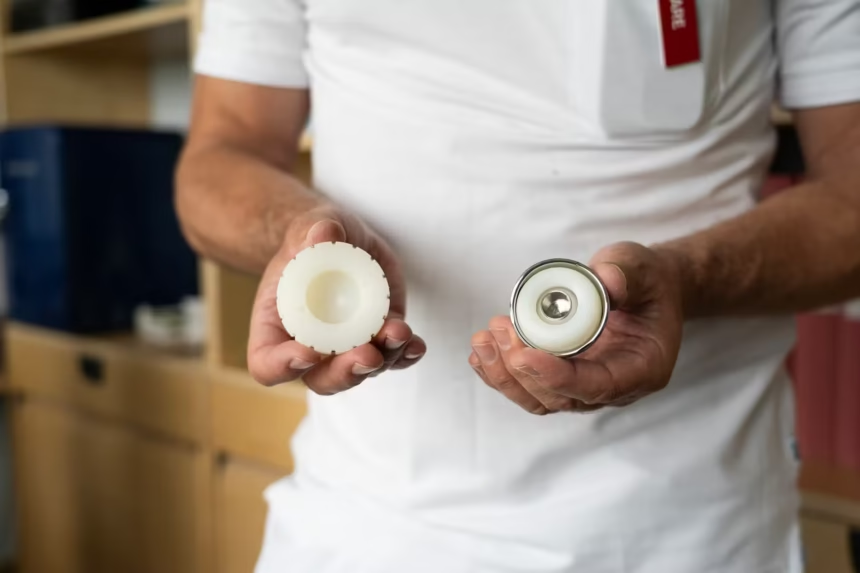
A standard prosthesis consists of a metal ball that is surrounded by a plastic joint cup. The new model instead has two balls, a small metal one that moves freely inside a larger plastic ball. The plastic ball can in turn move freely in a metal ball joint.
– It’s like two joints in one joint, says Nils Hailer, chief physician at the University Hospital in Uppsala and one of those who led the study.
Twice as expensive
Most of the patients in the study were operated on in hospitals in Sweden and around 200 in Great Britain.
The price tag differs between healthcare regions, but roughly speaking, a standard prosthesis, including all components, costs approximately SEK 10,000. The new model costs around 18,000.
In the group that received the new type of prosthesis, the risk of infections and other complications was also lower, according to the study.
The question is whether the advantages of the new type of prosthesis justify the higher price. Health economists at the University of Oxford will now try to find out.
It is clear that hip joint implants of the new type are much more expensive in Great Britain than in Sweden, according to Nils Hailer.
Above all benefits
– For the Swedish part, it looks like it could be cost-effective, he says.
The average age of the patients in the study is 76 years. In eight to ten years, the researchers intend to follow up on how they are doing.
– Those who are still alive and have the energy to show up for another follow-up, we will of course try to call, says Nils Hailer.
The study
The study, which was published in the journal The Lancet, was carried out in 24 hospitals in Great Britain and 20 in Sweden. The Swedish hospitals are in Borås, Eksjö, Danderyd, Gävle, Halmstad, Helsingborg, Kalmar, Karlskrona, Lidköping, Linköping, Ljungby, Lund, Nyköping, Skellefteå, Sunderby/Piteå, SU/Mölndal, Umeå, Uppsala, Västerås and Östersund.
The Swedish Research Council has financed the study with just over SEK 15.5 million.
The British equivalent, the National Institute for Health and Care Research, has contributed 433,000 pounds (equivalent to just over SEK 5.5 million).
Initially, 1,600 people were included in the study. 34 dropped out for various reasons, some because they withdrew their consent.