



Published On 7/6/2026
|
Last update: 7/7/2026 07:56 (Mecca time)
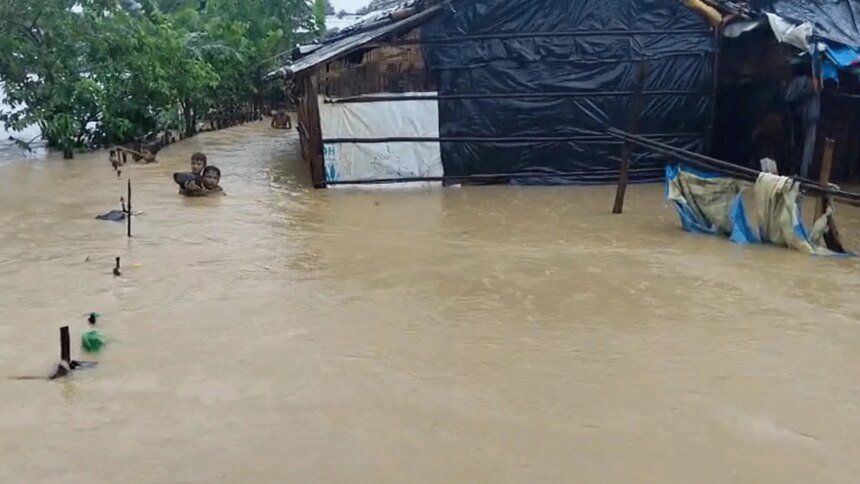
Cox’s Bazar- A statement issued by the United Rohingya Council said that at least nine Rohingya refugees, including a child, were killed in three separate landslides from Monday morning until this evening, following heavy rains on Rohingya refugee camps in Cox’s Bazar, southeastern Bangladesh.
Heavy precipitation continues with the beginning of the rainy season about a week ago in and around Bangladesh. Due to the fragility and nature of the clay plateau area on which the refugee wooden housing was built, and its distribution between highlands and valleys, it remains vulnerable to any floods, landslides, or soil slides.

Risks and damages
The victims were distributed among the camps, and hundreds of wooden and plastic homes inhabited by Rohingya refugees were damaged near the border with Rakhine State in western Myanmar, where they are originally from.
According to estimates by the Rohingya Humanitarian Initiative, the number of completely damaged homes exceeds 1,100 wooden homes, most of which are built of reeds, bamboo, and other types of wood available in the surrounding area. Their homes are not considered safe in various respects in cold, flood, or hot summer weather, nor do they protect them from any attempts at assault or any form of crime in the cover of the night.

The Rohingya refugees in the Cox’s Bazar area are not in one camp, but are distributed among 33 camps, with a population of 1.4 million refugees, and perhaps more. For months, the refugees have been facing a continuous decline in international aid allocated to them, in light of international promises to support them regarding their voluntary and dignified return to their villages in Arakan State.
Bangladeshi media sources confirmed that refugees were killed in landslides and floods, and the Bangladesh Meteorological Authority announced that rainfall exceeding 150 millimeters had been recorded in the Cox’s Bazar area during the past 24 hours.

Flood warning during July and August
Assistant meteorologist Mohamed Abdul Hanan said that the rainfall was caused by a clearly defined low pressure area over the Bay of Bengal located to the west of the refugee camps, along with active monsoon winds, adding that the heavy rains may continue for another two days.
Several Rohingya organizations called on non-governmental humanitarian organizations and international organizations alike to help Rohingya refugees cope with the rainy season, which is expected to witness continuous floods during the coming period in and around Bangladesh.
The Bangladesh Flood Forecasting and Warning Center had published a warning a few days ago that Bangladesh may witness floods in the Brahmaputra and Meghna river basins during July and August, due to heavy rainfall in the upper watershed areas of these two rivers.
Sardar Uday Rayhan, executive engineer at the Flood Forecasting and Warning Center of the Bangladesh Water Development Board, said in press statements to the Bangladesh News Agency on July 3, “Bangladesh is still at risk of floods in July and August for climatic reasons. During this period, heavy rains fall in the main river basins and areas upstream, leading to floods in the country.”

Periodic threat
Historical data indicate that this period, which coincides with the middle of the monsoon season, has caused the most damaging disasters in Bangladesh. During Bangladesh’s historic flood in 1988, heavy monsoon rains that peaked between August and September inundated nearly 82,000 square kilometers – nearly 60% of the country’s area.
Ten years later, other historic floods occurred in 1998 and lasted for more than two months during July and August, killing more than a thousand people, and making 30 million people temporarily displaced or stranded.
Experts point out that the simultaneous floods in these two major basins constitute the greatest danger. Seven years after those floods, in 2004, the severity of severe floods escalated significantly again when the water levels of the Brahmaputra and Meghna rivers coincided in late July 2004, which led to the inundation of approximately 30,000 square kilometers in the northeastern region of Bangladesh alone.

More recently, the Meghna River Basin floods of 2022 and devastating floods of 2024 combined affected more than 13 million people, highlighting the growing threat posed by heavy rainfall upstream.
Sardar Uday Rayhan said that the National Flood Committee can currently issue flood forecasts for inland river basins 10 to 15 days in advance, while forecasts for coastal rivers are limited to three days.

Regarding the current situation of rivers in the country, he said that low-lying areas in the Brahmaputra River basin are currently experiencing floods, and water levels are expected to stabilize after five to six days.
He added that the Meghna River basin is expected to remain stable during the next few days, as no heavy rainfall was recorded in the river basin and its source area, and there is an expectation that a depression may form over the Bay of Bengal this month, which may cause flash floods in low-lying areas in the coastal region of the country.