

Published 09.43

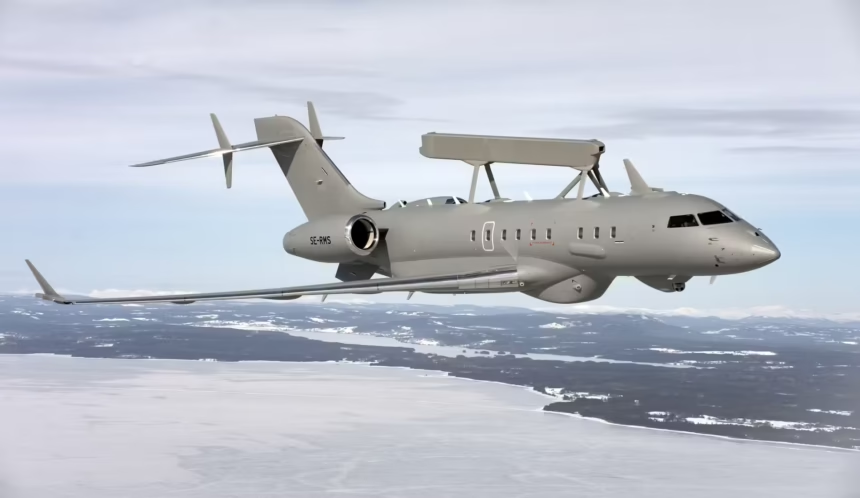
NATO moving to Globaleye in Europe means a tangible loss for the United States, which until now has been responsible for most of the military surveillance systems in our part of the world. This is the opinion of Johan Huovinen, lieutenant colonel and military expert at the Swedish Defense Academy in Stockholm.
– It will be a bit of a nose burn for the Americans, he says.
The current airborne radar and combat control system, Awacs (Airborne Warning and Control System), has been used since the late 1970s in custom-built Boeing aircraft.
It became familiar to the wider public during the Kuwait War when the plane cruised back and forth over Iraq, monitoring the airspace – but now it’s ripe for a more modern replacement.
– It is an old system. The newer systems see more and better, says Huovinen.
Best in war?
Those judged to be able to replace the old Awacs are either Globaleye or its American competitor Wedgetail. The question is which system is best. According to the expertise, Wedgetail is more powerful. The aircraft used, a modified Boeing, accommodates a larger crew with more operators, which is considered to be an advantage in a critical situation. With Wedgetail, in other words, you get higher combat management skills.
Globaleye, which will be placed in Bombardier aircraft, on the other hand, is said to be “more efficient” and have a longer range, as well as being more flexible in terms of different targets to be detected.
– Globaleye is used operationally by several countries. The various countries have probably already made an assessment of which system is qualitatively the best. And the cost is of course an important factor, says Huovinen.
Lack of aircraft
Another factor that comes into play is how compatible the system is with the countries’ air forces, since the radar system must be combined with combat aircraft that must be directed at different targets.
– Compatibility with aviation is important. Right now there are basically only two really modern fighter jets out there – the Americans’ F-35 and our own Gripen. The British have none, and neither do France or Germany. This matters when choosing a system, he says.
It is likely that new satellite systems will partially replace airborne radar in the short term. The US is putting a lot of energy into this.
– But we are not quite there yet. For example, a certain density of satellites is required, says Huovinen.