

Published On 7/6/2026
|
Last update: 00:36 (Mecca time)
Following the stagnation of political files, the security and military reality in the Gulf region witnessed a noticeable escalation, coinciding with a decline in maritime traffic rates and the exposure of commercial carriers to interference operations and anonymous radio messages.
In this context, Laila Al-Sheikhly discussed in the “Context of the Event” segment – on Al Jazeera – the issue of the international conflict of wills in the Strait of Hormuz, reviewing the mutual military threats between Washington and Tehran, and the new European moves to operate a joint naval force to clear mines and secure the flow of global energy supplies.
Read also
list of 1 itemend of list
“Funeral Truce”
US President Donald Trump told Axios that Washington and Tehran had agreed to “take a week-long break from talks” until the funeral ceremony for the late Iranian leader Ali Khamenei ends, while affirming the commitment of both parties not to shoot at each other during the funeral period.
In the same interview, the American President expressed his astonishment at seeing crowds of Iranians at the funeral, commenting that he was surprised to see them crying after he thought that the population did not support him.
He also said that the Iranians are begging to conclude an agreement, and that he is following Khamenei’s funeral ceremony, and that he can eliminate everyone, “but there will be no one left to negotiate with,” as he put it.
On the other hand, the Iranian response came from Deputy Foreign Minister Kazem Gharibabadi, who issued a warning to the Western coalition against the consequences of undertaking any military or security movement in the waterway.
Gharibabadi stressed that the coastal countries overlooking the Strait are solely and exclusively responsible for ensuring the security of navigation, stressing that the Strait of Hormuz will not be a military parade ground for non-regional powers.
Hidden mine weapon
On the interactive map, Salam Khader broke down the geography of the three sea routes that control traffic at the narrowest point in the Gulf, which are:
- Northern Blue Path Which is controlled by the Iranian Revolutionary Guard and passes around Lark Island, which is under the supervision of the Revolutionary Guard
- Southern Green Path The alternative corridor proposed by the Sultanate of Oman near its shores to avoid Iranian friction areas
- International track The internationally recognized landmark that passes through the middle of the Strait of Hormuz.
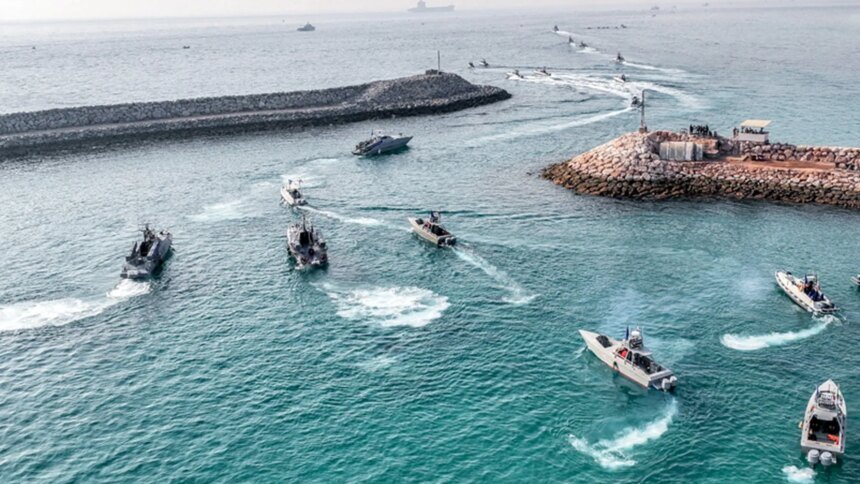
The military analysis highlighted the nature of the field threats facing navigation, most notably the “Mosquito Fleet,” which is the tactical name for a segment of the Iranian Navy’s fast gunboats designated for rapid interception operations.
The Revolutionary Guard warned through its statements that any alternative route would not be completely safe and might contain naval mines whose distribution maps only Tehran owns, pointing out that any random Western military move could spark a massive confrontation in the region. This coincided with the announcement by France and Britain, with German support, of their readiness to deploy a multinational naval force to clear mines and protect ships.
American dropper
In a political reading of the event, the academic and expert in Middle East politics, Mahjoub Al-Zwairi, stated that Tehran intends to use the Strait of Hormuz card extensively to compensate for the relative decline in its regional influence and to alleviate the pressures placed on its missile and nuclear programs, considering that the Strait is the last card that Iranian diplomacy holds to achieve political and security gains in any comprehensive negotiations.
Al-Zwairi pointed to the emergence of a mutual and controlling strategy for the conflict between Washington and Tehran called preserving the status quo, as the Trump administration refuses to make major economic concessions and is content with granting limited financial exemptions, which he described as the American train.
On the other hand, Tehran refuses to abandon the maritime pressure card, remove mines, and open the entire strait before obtaining real economic returns represented by lifting the comprehensive oil embargo and restoring assets held abroad.

The context of the event resulted in drawing two basic scenarios for the future of the waterway:
- The first scenario (continuation of the status quo and perpetuation of polarization): This scenario is based on the reality of the situation remaining as it is, with intermittent naval skirmishes and clashes recorded from time to time, with Iran insisting on restricting and protecting navigation within the Northern Blue Route, which it controls.
This option is considered a case of a daily mutual test of strength between Washington and Tehran, and it is the most likely scenario at the present time, with about 20 days having passed since the signing of the initial memorandum of understanding in Switzerland without any tangible progress.
- The second scenario (comprehensive navigational openness and return to international inspection)This scenario includes a complete return to the situation before security tensions, so that the strait becomes completely open in all its three lanes over a distance of 33 kilometers, without logistical or field obstacles or the imposition of individual Iranian duties.
This option remains postponed and is conditional on a real diplomatic breakthrough and fundamental progress on the terms of the comprehensive political negotiations scheduled for July 11.
Omani path
The Sultanate of Oman’s southern route, which extends 82 kilometers, is characterized by unique logistical and hydrographic characteristics that make it the safest corridor for international navigation at the present time.
Military experts explain that the water draft of the corridor ranges between 65 and 110 metres, which makes it the shortest, deepest and widest in the entire Strait of Hormuz, allowing the passage of all types of huge commercial ships and giant tankers, in addition to military naval vessels and large warships, giving it a tactical depth that ensures it is completely away from areas of friction and field tension.
The current flow of movement through the southern Omani corridor coincides with the growing intensity of US-Iranian disputes regarding transit mechanisms and the right to impose customs duties in the strait.
These security tensions prompted major global shipping companies and international alliances to divert their tankers towards Omani waters to avoid frictional threats, benefiting from continuous security coordination to secure the movement of energy flows, which redrew the map of maritime influence and control in the region outside the scope of routes that are subject to the direct supervision of the Iranian Revolutionary Guard.