


Published On 7/3/2026
|
Last update: 13:29 (Mecca time)
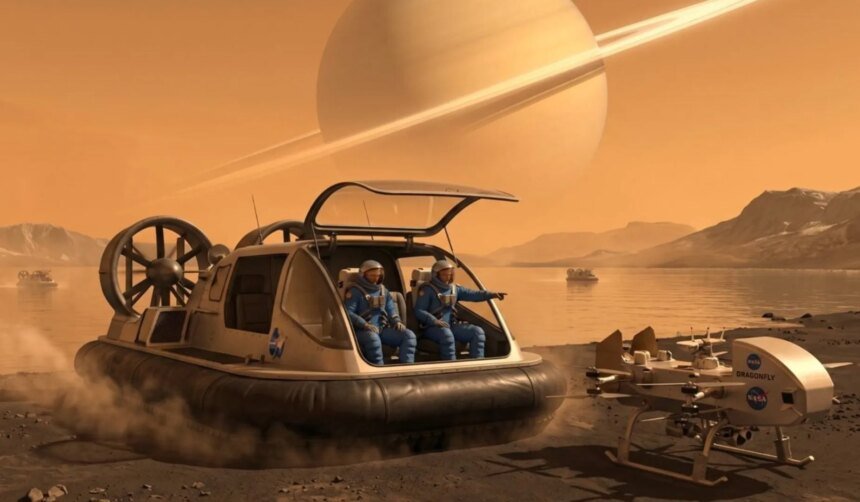
Since the American Cassini spacecraft and its European Huygens probe in 2005 revealed an amazing world hiding behind the dense orange fog of Saturn’s largest moon, Titan, this distant object has transformed from just a mysterious point in the sky into one of the most exciting scientific targets in the solar system.
Today, after decades of robotic studies, space scientists have begun to seriously discuss a step that until recently seemed closer to science fiction, which is sending humans to Titan in the future, after the moon and Mars exploration programs are completed.

This came during the “Humans to Titan 2026” summit, which was held on June 11 and 12 in the city of Boulder, Colorado, USA, with the participation of scientists and specialists in planetary science and space engineering, to discuss the scientific and technical requirements necessary to achieve this ambitious goal.
Read also
list of 2 itemsend of list
Why did Titan become a candidate for the next human journey?
Summit participants discussed the reasons why Titan is one of the most promising destinations for future human settlement and exploration, despite it being located more than a billion kilometers from Earth.
Amanda Hendricks, director of the Planetary Science Institute and head of the Explore Titan organization, explained that the idea is still far from being implemented, but it deserves to become a long-term goal.
She said: “Everyone realizes that achieving this is still far away, but it is important that thinking about Titan as a human destination becomes natural, because it represents a logical next station after Mars.”
She added that having a new future target helps maintain the momentum of space exploration programs for decades to come.
Titan is distinguished by its dense atmosphere consisting mostly of nitrogen, which provides better natural protection from many space radiations, an advantage that is not available on the Moon or Mars to the same level.
A different world that requires entirely new technologies
The summit sessions focused on studying the details of the possible daily life of astronauts on Titan, where experts discussed the design of special space suits, airtight housing, and appropriate transportation systems, in addition to the design of air isolation chambers.
Discussions also addressed poor lighting conditions, and the possibility of exposure to seasonal storms and floods resulting from a climate cycle that depends on hydrocarbons, and not on water as is the case on Earth.

The participants believed that “Titan” may become a launching station in the future for sending robotic or manned missions to other moons in the Saturn system, most notably Enceladus, which is considered one of the most prominent sites for harboring microbial life.
The researchers also indicated that the natural resources available on Titan, such as methane, nitrogen, and oxygen extracted from ice, may be used in the future to produce fuel and support missions deeper into the solar system.
A long journey…but the road to it has already begun
Scientists unanimously agree that the biggest obstacle is not landing on Titan, but rather the long journey to it, which takes many years, and the health, psychological and technical challenges that accompany it for the flight crew.
Amanda believes that the priority currently is to develop means that reduce flight time or find solutions that allow pioneers to endure long travel safely.
Before considering sending humans, robotic missions will provide essential data to better understand the local environment.

The European Huygens probe had previously landed on the surface of Titan on January 14, 2005 as part of the joint Cassini-Huygens mission between NASA and the European Space Agency, providing the first direct images of this distant world.
The next mission is NASA’s Dragonfly vehicle, which is scheduled to be launched – according to current plans – not before 2028. It will arrive at Titan after a journey that will take about six years, and then spend more than three years flying between multiple locations and collecting and analyzing samples.
Scientists… the issue is not impossible… but rather requires time and commitment
Scott Rafkin, director of the Space Studies Department at Southwest Research Institute and a specialist in planetary and atmospheric sciences, also participated in the summit.
He stressed that sending humans to Titan represents a very ambitious project, but it is based on clear scientific logic. He said: “Human exploration of Titan is not a matter of physics, but rather a matter of time, technology and commitment.”
He added that most of the scientific and engineering challenges have become known, and that every progress achieved today in the fields of space propulsion, energy, robotics, computing, life support systems and communications brings humanity one step closer to this goal.

Scott pointed out that some steps can be implemented already, such as sending a new orbiter to study the Titan system in more detail, while other technologies will require decades and perhaps generations of development.
He concluded by saying: “The summit was not intended to plan a space mission, but rather to launch a new scientific movement, because grand goals drive innovation in unpredictable ways.”
The second edition of the summit is expected to be held in conjunction with the launch of the Dragonfly mission in 2028.
Today, Titan may seem like a distant world covered in fog and hydrocarbon lakes, but the history of scientific exploration teaches us that the most daring dreams always begin with an idea that scientists discuss around the same table.
Every new space mission not only expands the boundaries of knowledge, but also expands the boundaries of human ability to cooperate, innovate, and believe that the future is built by science, research, and exploration, and that huge distances are not the end of the road, but rather its beginning.