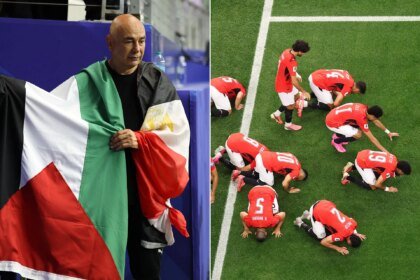


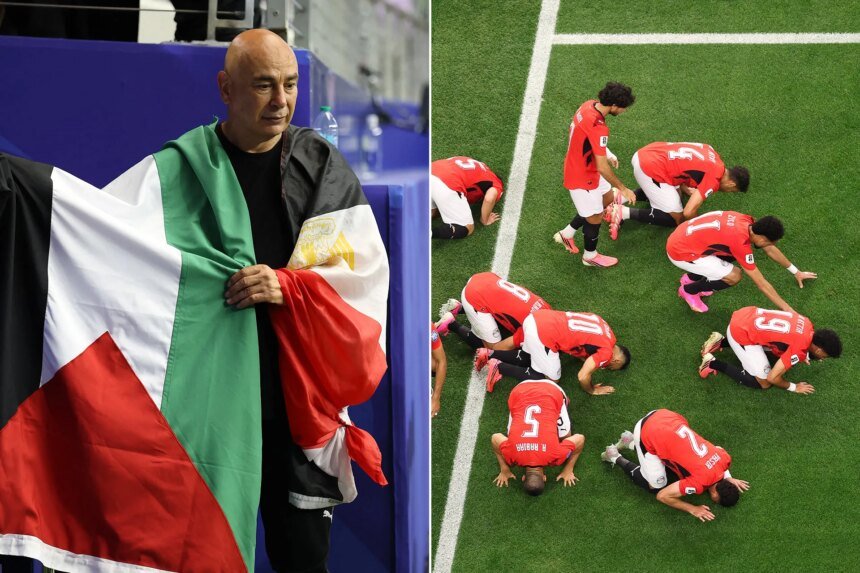
When Egyptian national team coach Hossam Hassan raised the Palestinian flag in the heart of the Dallas Cowboys Stadium, Arlington (Texas) after the victory over Australia, he created a symbolism that goes beyond football to broader horizons about belonging, identity, and harmony with a general feeling regarding the central Arab issue, according to the description formulated by the intellectual elite, and the general public voluntarily interacted with it.
This position, which angered Israel, raises a further question: If Egypt had been led in this match by a European coach, would he have taken this step?
Perhaps the only Western coach who has shown sympathy, more than once, with the Palestinian people is the Spaniard Pep GoARudiola, former coach of Manchester City. But, would he have raised the flag as Hossam Hassan did? Or is he satisfied with statements and comments on social media that reflect his remarkable position?
These and other questions open the door wide to other questions about the relationship of the local football team coach to the issues of his country, how does he use victory in matches to serve it, and how does he express an aspect of national identity? What symbolism does he and the team represent in this regard?
To begin with, at a time when England, the home of modern football, accepted that the coach of its national team be the German Thomas Tuchel, for the first time in history, and the country that won the most World Cup championships, namely Brazil, entrusted the command of its national team to the Italian Carlo Ancelotti – voices rose in some countries calling for the necessity of giving a man from among them the opportunity to coach their national team, in accordance with the wisdom that says: “A bereaved woman is not like a rented woman,” or “The people of Mecca know best its paths,” or even From the standpoint of saving expenses based on a popular proverb prevalent in Egypt that says: “What the home needs is forbidden to the mosque.” That is, the tax collector.
The national coach is more eager to achieve victory; Because he does not consider it only a personal glory, but a glory for his country. He is not a successful employee who performs his work sincerely, but rather a leader around whom the players rally, and who takes into account the feelings of the people whom the team represents.
But the issue, in the opinion of some, goes beyond simply referring to these prevailing wisdoms, searching for feasibility, and other ideas beyond the game itself, and compatible with intellectual or ideological paths, carrying political, economic, cultural, psychological, and historical perceptions that view the national coach as a symbolic expression of identity, a special development model, or modernization, as well as the extent of nations’ confidence in entrusting the management of their affairs to competent people of their own kind.
Here, football finds itself at the heart of major narratives that do not stop at the borders of the game, such as the concept of “self-development” or “independent” which has found supporters among the leaders of national liberation movements, followers of the school of criticizing dependency, those looking at post-colonial paths in thought, literature and politics, and those who have always called for the necessity of the independence of national decision-making.
The most prominent and influential narrative in the course of the game is that many teams have come to reflect the new demographic composition of countries that have lived for decades closed to their ugly residents. A closer look and application of statistics at the World Cup tournaments prior to the 1990s indicate that European teams, for example, were devoid of players originating from any other country, but now we see teams that have attracted particularly skilled players, until we found the President of the Senegalese National Assembly, Ousmane Sonko, saying before the Senegal-France match, “Whoever wins is a victory for all of Africa.”.
Two views confront each other in analyzing this situation. The first is an over-interpretation, when its proponents view this phenomenon as an extension of what happened in the past, when European countries brought an important part of their material sources of power from the colonies, where raw materials, cheap labor, and a guaranteed consumer market, at a time when football turned from a mere game for recreation, entertainment, and leisure time into industry and trade, or a tributary of the countries’ “soft power.”
As for the second, it believes that these mixed teams reflect the ability of European societies to uphold human values, in accordance with the rights and duties of citizenship, confront racist ideologies, and uphold the principle of entitlement and seriousness.AThe ability to digest subcultures and renew the demographic composition of European societies that were suffering from chronic aging.
Hossam came amid severe challenges, the first of which was doubting his technical abilities and accusing him of bias and emotionalism, and therefore many expected him to fail, but, so far, he has failed those who had these expectations and led the Egyptian team to an unprecedented achievement.
These two visions differ from each other. Their owners are largely consistent in viewing the national team – especially football – as a “national flag”, and hence it is better to train it by a coach from the same country, so that its presence and participation in major tournaments becomes an opportunity to give it a symbolic meaning.
Some of the comments of football fans and analysts may go as far in their enthusiasm for the national coach as considering this an approach that could join the declaration of rebellion by the “Third World” countries against the Western model of modernization, or their rejection of “Eurocentrism” from which this game has not escaped, on the basis that the largest local teams, in whose ranks the most skilled players in the world are involved, belong to the Old Continent, where Real Madrid, Barcelona, and Paris Saint-Germain are, and teams in England such as Manchester City and Liverpool, and in Germany such as Bayern. Munich, Borussia Dortmund, and others in the major leagues.
As these teams attract the most skilled, most famous, and most expensive players on the surface of the earth, they naturally produce competent coaches for the game, as there are capable sports academies that employ the data of modern science in training, honing talent, and developing effective plans to win in various matches, and in this regard, they offer coaches whose numbers exceed the needs of local teams, and their services become available to teams in Africa, Asia, the Americas, and Australia.
These people always represent a challenge to coaches who come from the ranks of old players who have experience in coaching, or who have studied this course in local academies, or who have obtained postgraduate studies in European academies, and some of them have become football symbols in their homelands, especially since some of them have achieved achievements with major local teams, or national teams, that have sometimes exceeded what foreign coaches have achieved.
They also face two other challenges. The first is that some teams with advanced world rankings are now led by foreign coaches. Of the 48 teams that entered the current edition of the World Cup, 28 were coached by people of other nationalities. The second is that most teams contain skilled players who were recruited from other origins.
This has become a normal thing, and there are those who praise it on the basis of the positive value it reflects within theses that tend toward “humanity” or the program adopted by the United Nations itself under the title “Our Common Future,” or those who look at the pleasure that is gained from watching football matches, regardless of the team that makes them.
This tolerant spirit of mixing in the formation of the national teams of many countries did not completely end the idea of many people’s bias towards the national coach, based on two things: The first is that all the teams that won the World Cup championship were led by national or local coaches, and no foreign coach for a team has ever been crowned in it throughout its history.
In 1934 and 1938, Vittorio Pozzo won the cup for Italy, then Juan Lopez Fontana for Uruguay in 1950, Sepp Herberger for West Germany in 1954, and the rope on the tractor until Lionel Scaloni with Argentina in 2022.
The second is that most of the teams that advanced to the second round (round of 32) in the current edition of the World Cup are led by national coaches.
The status and position of the national coach seem to be in line with “national identity,” and when he achieves tangible achievements, he is added to the national symbolism, as he becomes a public figure within his society.
Here a question arises: What makes a national coach more effective, according to the history of the game? Of course, the answer needs to look closely at all the reasons, and it is an issue that requires collecting and analyzing a lot of information, but, in light of a lot of data, the following can be mentioned:
1. The national coach is more eager to achieve victory; Because he does not consider it only a personal glory, but rather a glory for his country. He is not a successful employee who performs his work sincerely, but rather a leader around whom the players rally, who takes into account the feelings of the people whom the team represents, so he strives with all his ability to make them happy, and this is an issue that we see in the statements of the national coaches after every victory.
2. The national coach has a better understanding of the team, as he is familiar with the history of the game in his country, even if it is recent history, so his memory remains charged at all times with the various stages and stations that the national team has gone through, and he knows the potential of the local players well, and throughout the training period he builds a personal relationship with them, mixing the psychological with the artistic, and the historical with the immediate.
The status of the national coach and his position here seem to be in line with “national identity,” and when he achieves tangible achievements, he is added to the national symbolism, as he becomes a public figure within his community, whether he is leading the team from success to success or when he retires and participates in football and social life through other roles.
In the Arab world, there are many examples of coaches who have become social symbols, such as Mahmoud El Gohary and Hassan Shehata in Egypt, Amo Baba in Iraq, and Walid Regragui in Morocco, who took over the job before the current coach Mohamed Wehbe, who also holds Belgian nationality, and previously led the Moroccan youth team (under 20 years old) to win the World Cup in 2025.
Today, another Egyptian coach comes to lead his country for the first time to the round of 16 in the current edition of the World Cup. He is Hossam Hassan, and he has a distinguished history behind him. He is the all-time top scorer for the Egyptian national team with sixty-nine goals, and he is the top scorer in the African Cup of Nations, which his country won in 1998. Then he was the captain of the team when it also won it in 2006, and he played for the two most important teams in Egypt: Al-Ahly and Zamalek.
Hossam came amidst severe challenges, the first of which was doubting his technical abilities and accusing him of bias and emotionalism, and therefore many expected him to fail, but, so far, he has failed those who had these expectations, and led the Egyptian team to an unprecedented achievement, and proved that the national coach has many virtues and benefits, which cannot be denied.
The opinions expressed in the article do not necessarily reflect the editorial position of Al Jazeera Network.