

Every summer, heat waves recur, and with them comes the usual warning from health authorities regarding the need to be careful, drink water, and avoid going out at noon. But this repeated warning often goes unheeded by many, perhaps because most people consider the heat to be merely a passing seasonal inconvenience, not a real danger.
The truth is that some heat waves pass without any significant health impact, while others leave behind a number of deaths. What is the difference between them? What actually happens inside the body to make it reach this point?
The World Meteorological Organization defines a heatwave as a period in which the daily maximum temperature exceeds the normal range for the region by at least 5°C, for 5 or more consecutive days.
Temperatures record a gradual, noticeable rise every year, and with them the number of heat-related deaths increases, which has prompted health organizations around the world to launch awareness and education campaigns about the most important preventive advice and how to deal with the impact of heat waves, in an effort to reduce these increasing human losses.

The most affected groups
People with chronic diseases, such as diabetes, cardiovascular disease, asthma, and mental illness, are the groups most at risk of death due to high temperatures, as a sharp increase in heatwave victims was recorded from 2000 to 2021, at a rate of 85% for those over 65 years of age.
Heat waves are not limited to the West alone, but they also hit the East to the same extent. The share of Asian countries in deaths recorded between 2000 and 2019 amounted to approximately 45% of the total number of deaths amounting to 489,000, while the percentage of deaths in Europe reached 36%.
On the other hand, young children and infants are among the groups most at risk, for physiological reasons that differ from the reasons why heat is dangerous for the elderly. A child’s body absorbs heat from the surrounding environment at a relatively faster rate than an adult, due to the larger surface area of his skin compared to the size of his internal body. It also produces a relatively higher internal temperature per kilogram of its weight.
Most importantly, the size of the sweat glands in children is approximately 27% smaller than in adults, and a child’s body begins to sweat at a higher internal temperature than an adult, which delays the body’s natural response to cooling. In addition to this, there is a purely behavioral factor, as the infant cannot express his feeling of thirst or ask to move to a cooler place on his own, and this makes him completely dependent on the awareness of those around him about the signs of danger.

Emergency in Europe
The heat wave that struck Europe in June 2026 led to the closure of thousands of schools in France and Britain within a few days, after repeated cases of fainting were observed among students and unprecedented meteorological warnings.
The crisis revealed a noticeable loophole in some countries, where there is a legal minimum temperature for classes in the winter, without any binding maximum in the summer, leaving the decision to close to the discretion of each school alone.
The circle of those at risk from heat stress extends even further. On the health side, the risk increases for people with high blood pressure or cholesterol, people who suffer from obesity, overweight, or inactivity and lack of movement, as well as pregnant women.
On the behavioral side, people who rely on pain relievers or non-steroidal anti-inflammatory drugs are at greater risk, as are smokers, those who drink excessive amounts of caffeinated or sweetened beverages instead of rehydrating with water, or do not get enough fluids in the first place, as well as drug or alcohol users.
As for the work environment, workers who are subject to constant psychological or professional pressures, and those who avoid using personal protective equipment or reduce stopping to go to the bathroom to avoid interruption to work, or who continue to wear wet clothes throughout working hours, double their chances of being exposed to heat stress without always realizing it.

Why do people die from heat?
Heat waves have become much more severe than they were 50 years ago, as perceived temperatures rose during the hottest days of the year in some regions by 4 to 5 degrees Celsius, with Europe, North Africa, and the Arabian Peninsula at the forefront.
The perceived temperature here is not just a number on the thermometer, but rather an indicator that combines the actual temperature and the percentage of humidity, as high humidity is unable to allow sweat to evaporate efficiently, which makes the body feel hotter than the actual recorded temperature.
One of the reasons that explains the length and intensity of some heat waves is what is known as a “heat dome,” which is an atmospheric condition in which hot air settles over a specific area for continuous days or weeks without moving or dissipating, as happened in the disastrous European heat wave in the summer of 2003.
This long-term stability is what turns heat from a passing nuisance into an accumulated health danger. Every additional day under these conditions means more consumption of the body’s ability to recover, especially in the absence of any nightly drop in temperature that allows it to regain its balance.

To make matters worse, temperatures rise at night faster than during the day, which constitutes an additional health burden. Continuous exposure to accumulated heat stress during a very hot day limits the body’s ability to get rid of this heat and recover from its effects at night, thus increasing exhaustion and fatigue, and with it, the risk of death increases.
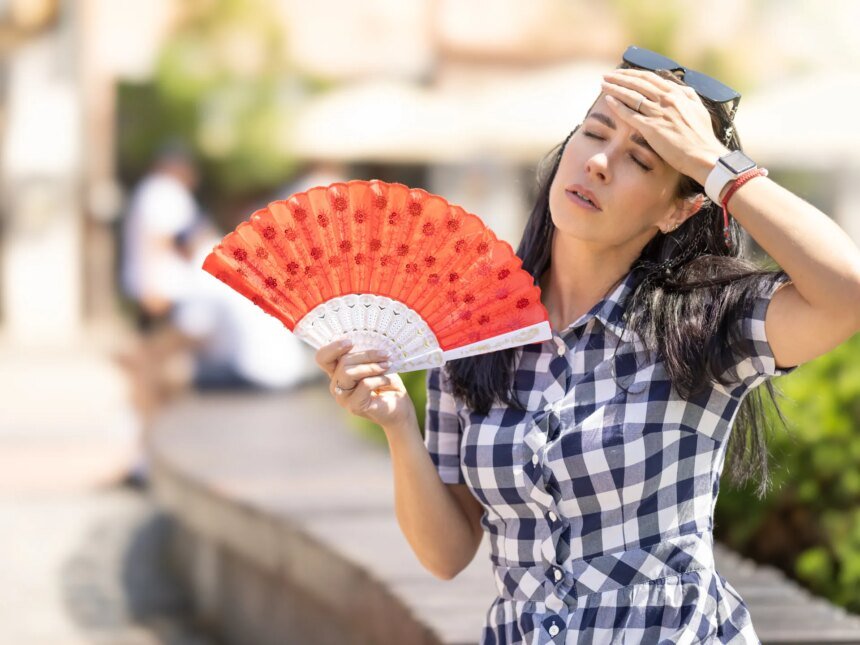
The body responds to high temperatures by trying to get rid of their effect, and symptoms begin to appear gradually in the form of what is medically known as heat exhaustion. It begins with dehydration and excessive sweating, followed by fatigue, headache, a decrease in the amount of urine excreted with a change in color, muscle spasms, and skin changes such as a rash, dryness, itching, and tingling, in addition to nosebleeds and a feeling of nausea.
Heat exhaustion at this stage is considered treatable at home if the person is able to reduce his temperature within 30 minutes by moving to a cool place and drinking fluids. But if heat exposure continues without intervention, heat exhaustion may develop into a completely more serious condition known as heat stroke, which is a medical emergency that requires immediate intervention.
The most important distinguishing sign between the two cases is the appearance of neurological symptoms. While a person in a state of heat exhaustion remains conscious and able to speak clearly, heatstroke causes mental confusion, incomprehensible speech, and loss of balance, and may lead to complete loss of consciousness. This change in mental state is the signal that should prompt those around the injured person to call an ambulance immediately without waiting.
With continued exposure to heat in conjunction with hard work and failure to replace lost fluids, health problems worsen and may turn into permanent damage. At the kidney level, the risk of developing chronic kidney disease, decline in kidney function, and the formation of stones increases.
With regard to the heart and breathing, the chances of developing heart disorders, such as heart muscle fatigue, high blood pressure, or rapid heartbeat, increase, in addition to respiratory problems such as asthma and difficulty breathing. Persistent high temperatures are also linked to an increased risk of liver disease, skin cancer and diabetes.
How does death occur due to heat?
Continuous heat waves that last for days and nights lead to a series of physical changes that weaken and exhaust the body, and their serious effects are concentrated on the heart and blood circulation.
With the loss of large amounts of fluids and salts through sweating, the blood becomes more viscous and concentrated, which increases the possibility of clots forming in the arteries that feed the heart and brain. This explains the high incidence of strokes and heart attacks during heat waves.
In parallel, the body responds to extreme heat by expanding blood vessels in the skin and increasing blood flow to it in order to cool down and get rid of the high internal temperature. This requires pumping a larger amount of blood that the heart may not be able to handle if it is already weak or sick, so its performance declines quickly due to the increased burden placed on it, leading to heart failure and possibly death.

How do we avoid health risks caused by extreme heat?
Health organizations and specialized authorities recommend following various preventive methods to avoid the consequences of extreme heat, which may be dire. These methods are not just theoretical advice, but have actually proven their effectiveness in real experiments around the world.
After the implementation of a preventive action plan in France in 2006, 4,388 fewer deaths were recorded than expected based on historical trends for that period.
In Italy, the percentage of deaths attributed to heat decreased from 6.3% before the implementation of the early warning plan (1999-2002) to 4.1% after its implementation (2013-2016).
In India, an estimated 2,380 deaths were averted after implementing an early warning system in the city of Ahmedabad, with a significant reduction in the relative risk of death at extreme temperatures after the intervention compared to before.
These results confirm that investing in early warning and awareness is not just a precautionary measure, but rather an actual proven tool to reduce human losses.
At the health policy level, activating and disseminating early warning systems to predict heat waves before they occur is a top priority, in addition to publishing recommended health instructions in various media outlets, and training health personnel to deal with cases of heat stress and diagnose them early, with careful coordination between health authorities and immediate ambulance personnel during periods of heat waves.
At the individual level, it is recommended to avoid leaving the house or performing any strenuous outdoor work during peak times of extreme heat days, and to try to stay in the shade, as temperatures there are 10 to 15 degrees Celsius lower than those exposed to the sun.
At home, it can be kept as cool as possible by opening the windows at night when temperatures drop, reducing the operating rate of electrical appliances and tools to reduce internal heat sources, and closing the windows and covering them with dark curtains that block the sun’s rays during the day.
It is also preferable to set the air conditioner at 27 degrees Celsius with the fan running in the room, as this contributes to reducing the room temperature by an additional 4 degrees.
On a personal level, it is recommended to shower with cold water, try to keep clothes moist while wearing them, and drink plenty of water regularly without waiting to feel thirsty.
Awareness programs that educate people about the dangers of heat waves and ways to prevent them remain the cornerstone of any effective long-term prevention strategy.