


Published On 4/7/2026
|
Last update: 7/5/2026 11:29 (Mecca time)
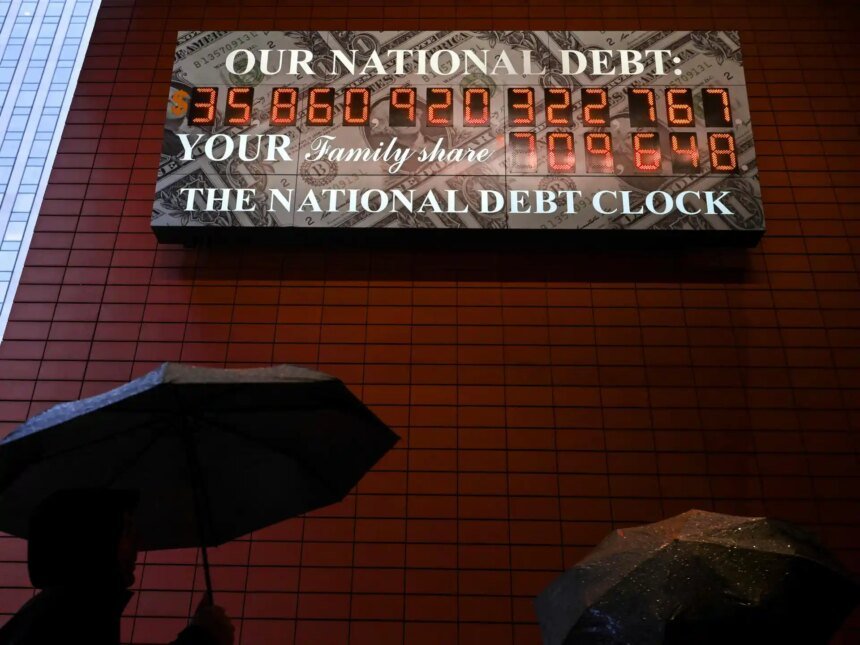
Days before the United States celebrates the 250th anniversary of its independence, public debt has returned to the forefront of economic debate, having exceeded $39 trillion, compared to only about $71 million when the modern state was founded in the late eighteenth century. A report published by Newsweek magazine believes that the path of American debt reflects in many aspects the history of the United States itself, as almost every major jump was associated with wars, economic crises, or exceptional spending programs, before it turned in recent years into a structural financial challenge that raises increasing questions about its sustainability.
Although the US economy is still the largest in the world, and the dollar maintains its position as the world’s main reserve currency, the increasing cost of debt service and the widening of the fiscal deficit raise growing concerns about Washington’s ability to continue borrowing at current rates without long-term economic repercussions.
From the War of Independence to $39 trillion
The beginning of the American public debt goes back to the year 1790, when the first Secretary of the Treasury, Alexander Hamilton, consolidated the debts incurred by the states and the federal government after the War of Independence, reaching about 71 million dollars at that time, which Hamilton described as “the price of freedom,” considering that debt could be useful as long as it remained within controllable limits.

The United States recorded the only case in its history in which it completely eliminated public debt in 1835 during the era of President Andrew Jackson, but borrowing resumed shortly thereafter, becoming a permanent feature of American financial policy.
The debt witnessed its first major jump during the Civil War, as it rose from about $65 million in 1860 to nearly $3 billion by the end of the war in 1865. The scene was repeated during the two world wars, especially World War II, when the debt jumped from $43 billion in 1940 to more than $250 billion in 1945, exceeding for the first time 100% of the gross domestic product, before reaching its peak at about 119% in 1946.
After decades of strong economic growth, American debt exceeded the trillion-dollar mark for the first time in 1981 during the era of President Ronald Reagan, and then doubled to two trillion dollars in just three years. Although debt growth slowed in the late 1990s with a budget surplus achieved, the attacks of September 11, 2001, the wars in Iraq and Afghanistan, and then the global financial crisis in 2008, brought borrowing back to the rise.
As for the Corona pandemic, it was the biggest turning point, as it alone added about $4.2 trillion to the debt during 2020 as a result of emergency spending programs to support the economy. According to Newsweek, the United States moved from one trillion dollars to 10 trillion dollars in about three decades, then to 30 trillion dollars in just 14 years, while the debt is expected to exceed 40 trillion dollars in the coming months if the current pace continues.
Why is the world still funding Washington?
Although the United States has the largest sovereign debt in the world, it does not face the financing pressures that other economies suffer, thanks to the global position of the dollar and the continued consideration of US Treasury bonds as among the safest and most liquid assets in the financial markets.

The US debt ratio currently stands at about 126% of GDP, according to International Monetary Fund estimates, which is a lower percentage than Japan, whose debt exceeds 200% of GDP, and also lower than Italy, while approaching the levels of the United Kingdom, Canada, and China.
The report believes that this position gives the United States an exceptional ability to borrow, but it does not eliminate the risks associated with the continued accumulation of debt at a faster pace than the growth of the economy, especially with the high cost of interest.
When does debt become a crisis?
Economists disagree about how risky American debt is. Professor at King’s College London, Jonathan Portes, believes that reaching a high level of debt does not necessarily mean an approaching financial crisis, citing Japan, which has maintained higher debt levels than the United States for decades without an economic collapse.
On the other hand, Professor of Applied Economics at Johns Hopkins University, Steve Hanke, warns that the main problem lies in the cost of servicing the debt, explaining that about one-fifth of federal tax revenues currently goes to paying debt interest, which increases the burden on taxpayers and limits the government’s ability to direct spending towards other priorities.
Doug Elmendorf, a professor of public policy at Harvard University, agrees with him, who believes that increased borrowing contributes to raising financing costs in the entire economy, from mortgages to car loans, warning that the continuation of this path may lead in the future to a crisis of financial confidence that raises interest rates sharply, although he stresses that the timing of such a crisis is still unpredictable.
The Newsweek report concludes that American debt is no longer merely the result of wars or temporary crises, but has gradually turned into a structural feature of public finances. While the strength of the economy and the dollar gives Washington a wide margin to continue borrowing, the widening interest bill and growing fiscal deficit put decision makers before an increasing challenge of achieving a balance between supporting economic growth and maintaining financial sustainability in the coming decades.