


Published On 4/7/2026
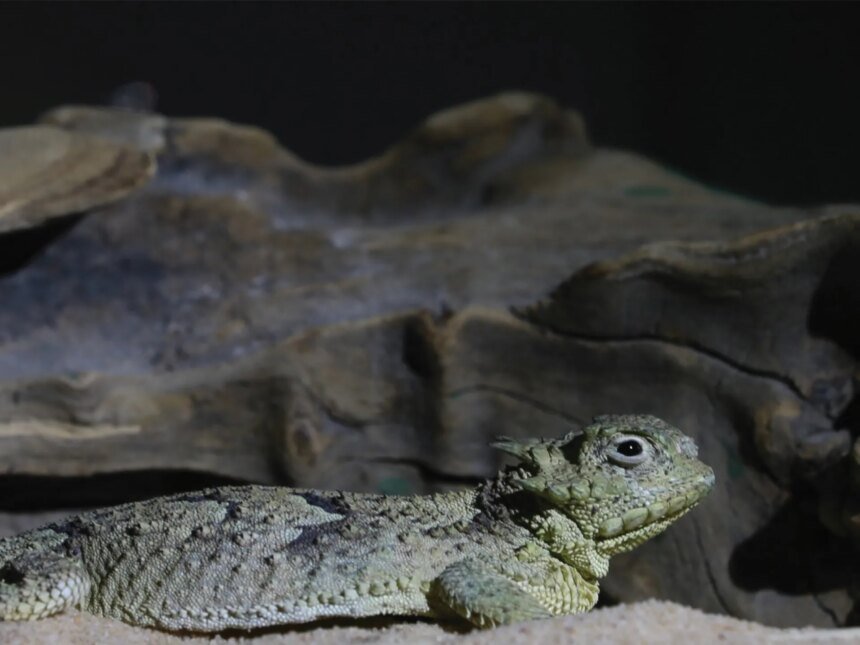
In the desert, water sometimes hides between soil particles, or appears as a passing layer of moisture that humans do not pay attention to. But some creatures that live in these harsh environments have developed amazing ways to capture this small amount of water and transfer it to their mouths. Among them is a small, spiny-looking horned lizard that lives in the deserts of North America, known as the “desert horned lizard.”
This lizard doesn’t just drink in the usual way; When water touches its skin, whether from rain or wet soil, the droplets move through tiny channels between the scales, as if its entire body were a small network transporting water towards the mouth. But the question that continues to baffle scientists is: After the water reaches the jaw area, how does the lizard actually get it into its mouth?
A new study published in the Proceedings of the National Academy of Sciences provides an answer to this question. Researchers monitored the drinking behavior of Phrynosoma platyrhinus, using high-speed imaging, and found that the secret lies not in the skin alone, but in the movement of the jaw itself. The lizard does not open its mouth and swallow water directly, but rather uses a precise and unbalanced movement between opening and closing the jaw to transfer water from the surface of the skin to the inside of the mouth.

Jaw turns into a mini pump
“When water began to collect near the mouth, the lizard did not open its jaws quickly,” explains the study’s lead author, Ho-Young Kim, a professor of mechanical engineering at Seoul National University. “Rather, it opened the jaw very slowly, then closed it quickly. In one cycle, the opening took a fraction of a second at a low speed, while the closing was much faster. According to measurements, the average jaw opening speed was about 3.2 millimeters per second, while the closing speed was about 26 millimeters per second.”
He added in a statement to Al Jazeera Net: “This unbalanced movement is not a coincidence. When the jaw is opened slowly, the water moves as a thin film towards the corners of the mouth instead of being lost as a layer stuck to the surface. When closing quickly, the tissues bend at the corners and push the water into the mouth. This means that the lizard uses its jaw as a small capillary pump, that is, a pump that depends on the movement of fluids within tiny spaces, not on a large suction force or direct swallowing of each drop.”
To understand this trick, the researchers made a simplified model that simulates a lizard’s jaw from two glass panels, one of which moves in a manner similar to the movement of the jaw. Experiments showed that slow opening reduces the amount of liquid lost on the plates. At a low opening speed, only about 15% of the liquid remained as a residual layer, while the percentage rose to about 68% at fast opening. This explains why the lizard does not rush to open its mouth; Slowness here is not a weakness, but rather part of a precise mechanism for conserving water, according to the study’s lead author.
From lizard skin to an artificial device
After understanding the movement, the team tried to transfer the idea from the lizard’s body to an artificial device; The researchers designed a small system that uses a sponge that absorbs water from a medium that simulates wet soil, then transfers the water to tiny channels, before it is collected by the movement of two plates similar to the movement of a jaw. In the experiment, the team used wet glass beads instead of natural soil, to prove the idea in controlled conditions.
The researchers not only collected water, but also covered the sponge with a substance known as “Nafion,” which is a substance capable of exchanging ions, to test the system’s ability to purify water from dangerous heavy metals such as lead, cadmium, arsenic, and chromium. The results showed that the system removed about 95% of these metals from solutions at a concentration of approximately 10 parts per million, whether the metals were singly or in a mixture.
This finding opens the door to the development of small, portable devices that can collect water from wet soil in dry areas, while purifying it at the same time. The idea may be useful in environments where clear liquid water is not available, but the soil retains some moisture. But the device, in its current form, is still closer to proving a scientific principle than a technology ready for use in the desert.
Despite the importance of the results, the researchers point out that the study has limitations, as the experiments were conducted on a limited number of lizards in the laboratory, not in their natural environment. The device was also tested using glass beads saturated with water instead of real, complex soil that contains salts, organic materials, and pollutants. The experiments were also conducted in a room with high humidity to reduce evaporation, a condition that may not be available in the desert, where heat and dry air may lead to rapid loss of water before it is collected.
The team declared that there were no conflicts of interest, and that the study was funded by the National Research Foundation of Korea through the Engineering Research Institute of Seoul National University; One of the researchers also received partial support from a research program at Seoul National University.