


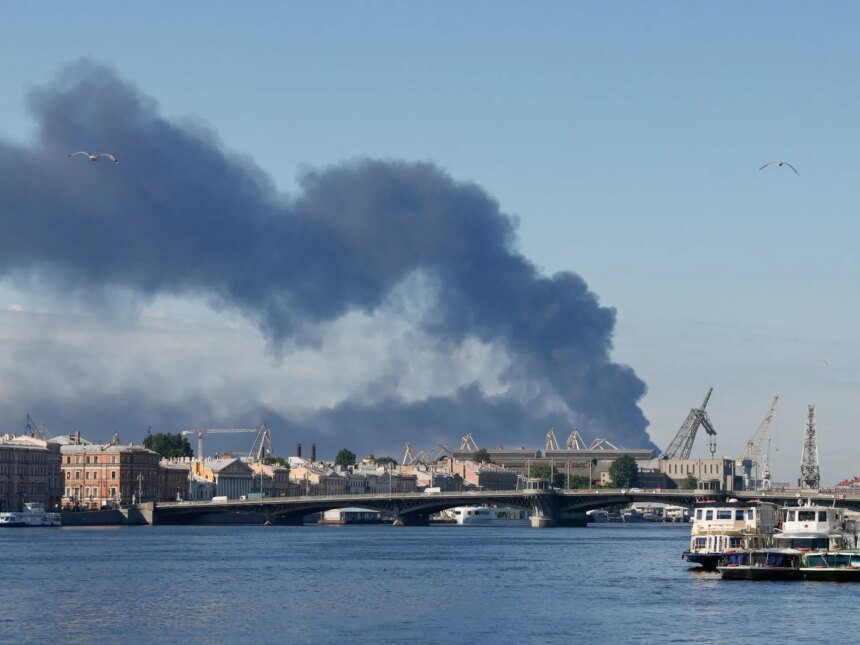
The governor of the Russian city of Saint Petersburg, Alexander Beglov, reported that the city was subjected to a “large-scale Ukrainian attack” with drones on Saturday morning, targeting an area that includes an oil station, without recording any casualties, while Ukraine announced that dozens of Russian drones had been shot down over several areas of the country last night.
In a post on his Telegram channel, Beglov said, “St. Petersburg is under a large-scale attack by enemy military drones,” adding that air defense means are working to confront the attack.
He explained that the strike targeted an oil station area in the Kirovsky neighborhood of the city, noting that “the effects resulting from the accident have been removed. There are no casualties.” He also said that the air defense forces shot down 72 drones, one of which fell in the Peterhof area, without causing casualties or damage.
For its part, the Russian Oil Company said that Ukrainian drones targeted a gas production facility in St. Petersburg. On the other hand, Ukrainian President Volodymyr Zelensky said that Ukrainian forces carried out long-range attacks today on cities and oil facilities inside Russia.
Ukrainian media published a video documenting columns of smoke rising from the port of St. Petersburg following a Ukrainian drone attack.
The Russian news agency TASS quoted the Ministry of Defense as saying that the air defense forces intercepted and destroyed 389 Ukrainian drones over Russian regions during the night.
In Ukraine, Al Jazeera’s correspondent reported hearing huge explosions in the center of the city of Dnipro in the south of the country, while the Ukrainian Air Force announced that 69 Russian drones had been shot down over several areas last night.

Control of Luhansk
In another field development, Russian presidential spokesman Dmitry Peskov said, in a statement to reporters, that Russian forces had completely taken control of the strategic city of Kostyantinivka in eastern Ukraine, stressing that the city was now entirely under Moscow’s control.
Peskov added that President Vladimir Putin went to a command center of the Russian army, where he listened to a report from his staff and thanked the Russian soldiers, noting that Russian forces also now control the entire Luhansk region in eastern Ukraine.
In addition, Russian military commander Anton Grunis reported that Russian forces are currently carrying out “combing and liquidation operations for isolated soldiers from the Ukrainian armed forces, who are trying to hide in buildings, basements and rubble” in Kostyantinivka.
Kostyantinivka is a fortified stronghold for Ukrainian forces, and is located on an axis that leads to the last major cities still under Kiev’s control in the Donbass region.
Moscow sought to seize the city as part of its advance through the Donetsk region, as Kostyantinivka is one of the last obstacles on the road leading to the large Ukrainian-controlled cities of Kramatorsk and Slovyansk in Donbass, which the Kremlin seeks to control.
The battle to control the city, which had a population of about 78 thousand people before the war, began at the end of 2025 with infiltration operations by Russian forces.
Lead
Putin appeared in television scenes wearing his military uniform with his staff, where he stressed that control of Kostyantinevka was of “major strategic importance.”
He said that the Russian Armed Forces still firmly hold the strategic initiative along the front, announcing control, since the beginning of this year, of 133 towns and more than 3,000 square kilometers of land in Donbass and Novorossiya.
He pointed out that what he called the security buffer zone, which Russia is working to establish, will expand if Kiev forces continue to target Russian infrastructure.
Last June, Putin indicated that his forces were on the verge of controlling Kostyantinivka.
Russian Chief of Staff Valery Gerasimov explained that Russian forces are now 9 kilometers from Zaporizhya, a major city in southern Ukraine that was inhabited by more than 700,000 people before the war.

High-tech weapons
In contrast, Ukrainian President Volodymyr Zelensky said that Kiev is capable of producing enough “high-tech” weapons to exceed Russia’s capacity in the long term.
Zelensky explained, in a post on the Telegram application yesterday, Friday, that the meeting with military officials, government ministers and representatives of the defense industry focused on increasing production within the framework of the drone and missile programs in Ukraine.
Zelensky noted that he instructed the Ministries of Foreign Affairs and Defense to focus on cooperation with partners who can provide additional financing for arms production in Ukraine.
He considered that investing in Ukrainian production is an investment in forcing Russia to peace, pointing out that the implementation of Ukraine’s plan for “long-term and medium-term sanctions” showed that Russia’s ability to wage war could be weakened, by bringing the consequences of the conflict closer to the daily life of Russian society.
He stressed that “Kiev will continue its policy of raising the price of the occupation on the occupier, and limiting Russia’s options for financing the war.”

Dead and wounded
On a related level, there were deaths and injuries in new attacks by Russian forces targeting a number of regions in northern and southeastern Ukraine.
Oleg Hrygorov, the governor of the Sumy region in northern Ukraine, said that a major Russian air strike on the center of the city of the same name yesterday, Friday, resulted in the killing of at least three people and the injury of others, including children.
“The center of the attack was a high-rise residential building, a shop and a street, with a very large number of people, including children,” Hrygorov wrote on the Telegram application.
He added that the injured were taken to hospitals, including a 13-year-old child in serious condition.
Other areas in Sumy and southeastern Ukraine – closer to the front lines – were also subjected to Russian attacks, killing six people, according to Reuters.
One person was killed when Russian forces dropped slide bombs near the city of Sumy, while more than 50 strikes, using drones, artillery shells and bombs, killed three people in the Dnepropetrovsk region, including two near Nikopol, a town located on the bank of the Dnipro River opposite the Russian-controlled Zaporizhya nuclear plant.
Oleksandr Hansa, governor of the Dnepropetrovsk region, said via the Telegram application that 12 people were injured.
Ivan Fedorov, the governor of the Zaporizhya region, said that two people were killed and 21 people were injured in an air strike on the city of Zaporizhya, which has been a frequent target of bloody attacks recently.
The Ukrainian capital, Kiev, witnessed a day of mourning, the day after a Russian attack with missiles and drones that killed at least 30 people, in the deadliest attack on the city this year.