

Published On 4/7/2026
French and British naval forces will not be able to clear the Strait of Hormuz of mines without Iran’s approval except by forming a large military force, which military expert Brigadier General Elias Hanna says may put the Gulf region in a bad scenario.
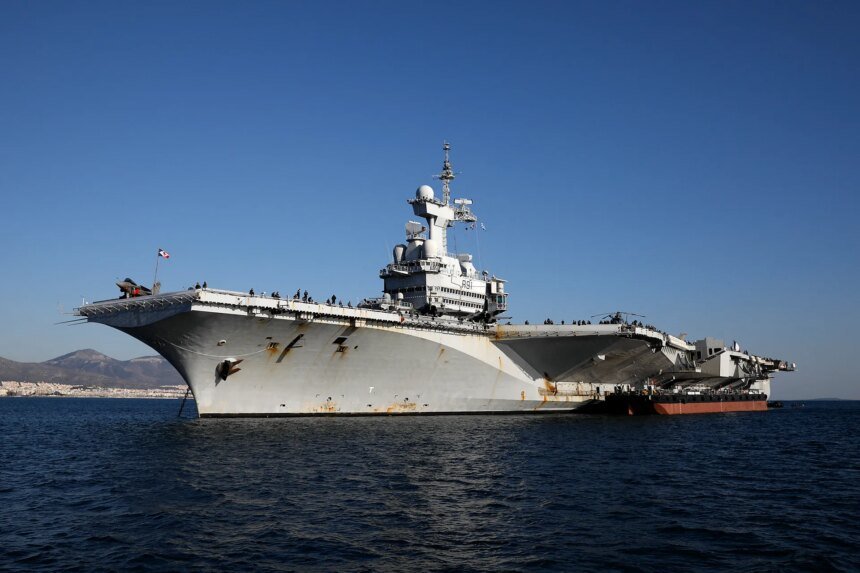
Britain and France have confirmed their readiness to deploy a multinational military mission to support freedom of navigation in the strait in cooperation with the Sultanate of Oman, in conjunction with Paris’ announcement of the return of its aircraft carrier from the Middle East after the US-Iranian understanding.
French President Emmanuel Macron also said that his country has deployed specialized mine-clearing means in the Middle East, including two minesweepers, along with two frigates and a maritime patrol plane.
But the Iranians rejected this talk, and Deputy Foreign Minister Kazem Gharibabadi said that the Strait is not an arena for military parade by external powers, warning of the repercussions of “any new adventure.”
Oman did not deny or confirm its agreement with Paris and London, nor even with Iran, on anything related to future action in the Strait.

The power of geography
Control of the strait represents the center of gravity of the Iranian strategy after the Revolutionary Guard moved the transit route from the Middle Corridor to the Iranian Corridor, as Hanna said in an analysis for Al Jazeera.
Therefore, Iran views this French and British intervention – which Hanna describes as very important – as an attempt to re-engineer the management of the Strait in a way that appears international, while Tehran has already established a local authority to manage the Strait to use it as a permanent pressure card.
The entry of a new additional force into the Strait delays the control that Iran wants to extend over the Strait, and adds parties to the table to which the Iranians do not want to add anyone because they deal from the logic of the victor, according to Hanna.
France and Britain can play an important role in the Strait given their military presence in the region, but they will not be able to do so without Iran’s approval, in the opinion of the military expert, who pointed out that clearing mines without Iranian approval requires mobilizing a large force to secure the clean-up process, which may put the Gulf region in a bad scenario.
What is strange – according to the spokesman – is that Iran says that it does not know the locations of many of the mines that it planted in the strait, and yet it considers the path that it has determined for crossing to be safe, as the Iranians cannot remove the mines in the first place from one area rather than another because this requires advanced equipment such as that possessed by France, the United Kingdom, and other countries that have announced their willingness to participate.
Hanna does not expect the French and British to come to remove the mines without the approval of Iran, which has the power of geography, and he believes that any step on this path will be in accordance with an international consensus on what the future of Hormuz will be.

Disagreement over paths
Iran wants to be a guarantor of the stability of navigation in the strait through an understanding with its neighbors, but Hanna says that in practice this means “Tehran’s control over who crosses and who does not, which is something that the countries of the region do not want.”
The Revolutionary Guard believes that the fifth clause of the memorandum of understanding signed with the United States stipulates determining transit routes in the strait in agreement with the Sultanate of Oman and the countries of the region, and says that Muscat’s opening of a new route south of Hormuz represents a violation of this clause.
Late last month, the Sultanate of Oman announced the provision of a temporary route away from the Iranian and international routes, in cooperation with the International Maritime Organization, which was rejected by the Iranian Revolutionary Guard, warning of the danger of using any route without coordination with Tehran.
The Omani route witnessed a great momentum in transit traffic during the first days, but it declined during the past days (from June 30 to July 3), to about 30 ships per day, equivalent to a third of what was passing before the war, but it is a stable crossing, according to an interactive screen presented by Mahmoud Al-Zubaq on Al-Jazeera.
At the same time, Bloomberg reported on Saturday that 8 ships that were preparing to cross the Strait changed their course, noting that 4 of them headed towards the Iranian route, while the other 4 turned back.