

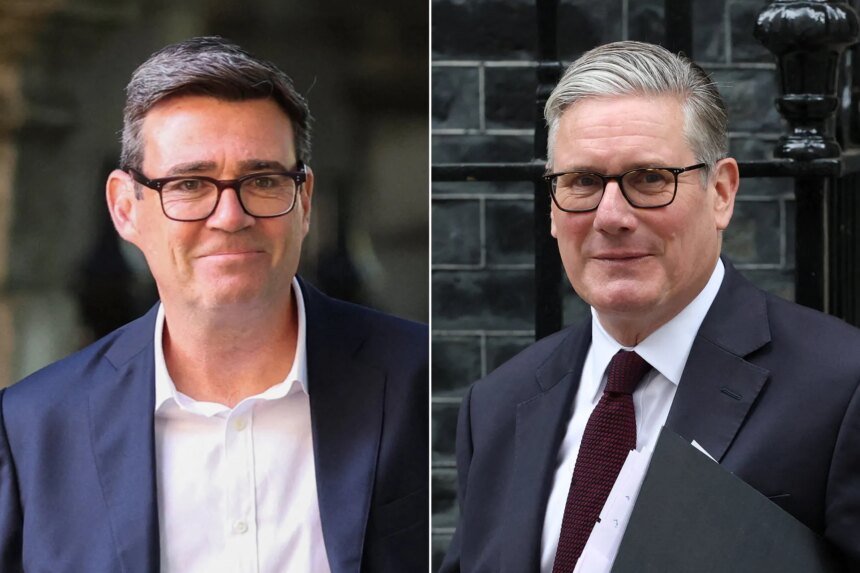
“If you are a prime minister and you care about the bills that families pay, then you should care about what happens in Ukraine and the Strait of Hormuz.” With these parting words, resigned British Prime Minister Keir Starmer outlined what could be described as the political will of his expected successor, Andy Burnham.
Starmer believes – as he leaves office – that global crises are no longer a separate external matter, but rather have a direct impact on the management of the economy, the standard of living of citizens, and internal policies.
In his first interview since announcing his resignation on June 22, Starmer called on his next successor at the head of the ruling Labor Party to allocate sufficient time to deal with international issues in light of an increasingly turbulent world.
Starmer’s statements reflect the conclusion of his experience after two years as prime minister, which is that today’s world, with its intertwining of wars, energy, trade and immigration, no longer allows any prime minister to limit himself to internal files or look at foreign policy as a separate matter.
Controversy of priorities
At a time when many within the Labor Party are calling for a focus on internal priorities, such as the livelihood crisis, housing and public services, Starmer insists that these same files are directly related to what is happening in Ukraine, the Strait of Hormuz, and global markets, and that separation between inside and outside is no longer possible.
Starmer warned his would-be successor, Burnham, against thinking that time devoted to diplomacy could be reduced and focused only on domestic issues, stressing that “international affairs and domestic affairs are in fact the same thing,” and that any new prime minister would face the same turbulent international environment that he faced during his term in office.
He said that the world has become “more dangerous and volatile” than ever before, considering that the impact of international conflicts is directly reflected in the lives of Britons, whether through energy prices, costs of living, or economic stability.
Starmer’s statements came in response to calls within the Labor Party demanding that the next leadership focus on internal priorities, which is what the party’s leadership candidate, Burnham, has adopted, who pledged to give priority to improving living standards, housing, infrastructure, and promoting decentralization of governance.
But Starmer believes that addressing these issues begins from the outside as well, pointing out that reducing energy bills, for example, requires stability in global areas of tension, and that the security of the British economy has become closely linked to geopolitical developments.
In defense of his government’s performance, the resigned British Prime Minister said that Britain has regained its international standing, and other countries are looking to it again to assume leadership roles, considering that supporting Ukraine and active participation in international alliances are among the most prominent achievements of his government, along with stabilizing the economy, improving the performance of health services, and reducing child poverty.

Internal criticism
However, this vision did not prevent him from being subjected to internal criticism for allocating significant time and effort to foreign policy issues, at a time when the economic and social crises were worsening within the country, which was reflected in the decline in the popularity of the Labor Party and the rise of the right-wing Reform Party led by Nigel Farage in the elections that took place last May.
Starmer’s departure comes at a time when his would-be successor faces a complex set of economic and political challenges, starting with a growing public finance deficit and government debt exceeding 3 trillion pounds, with the cost of borrowing rising to unprecedented levels as a result of increased government spending and high bond interest.
The next prime minister also faces increasing pressure to increase defense spending in light of global security tensions, a demand that clashes with a difficult financial reality and huge social expenditures that consume about a quarter of public spending, which puts the next government before very sensitive choices between funding the army or maintaining social welfare programs.
At the same time, economic growth rates remain weak, while official studies indicate that Britain’s exit from the European Union has caused long-term damage to investment and domestic output, making the relationship with the European Union one of the most complex issues facing the next leadership.
Although Starmer admitted that Brexit weakened the British economy, he avoided calling for a return to the European Union for fear of political division, while Burnham is seen as more open to developing the relationship with the European Union, without deciding the form or timing of this relationship.
In addition to this, the immigration file has become one of the most prominent political issues in Britain, after the far-right Reform the United Kingdom party invested in it to expand its popularity, which will force the new government to balance tightening measures to combat irregular immigration and preserving the needs of the labor market and humanitarian obligations.
As pressure mounted within the Labor Party, from MPs and ministers alike, Starmer had no choice but to announce his resignation and open the door to a race for party leadership, the features of which seem likely to favor Andy Burnham, the former mayor of Greater Manchester, who is preparing to take on a heavy legacy of economic challenges that shackled his predecessor and surrounded him from every direction.